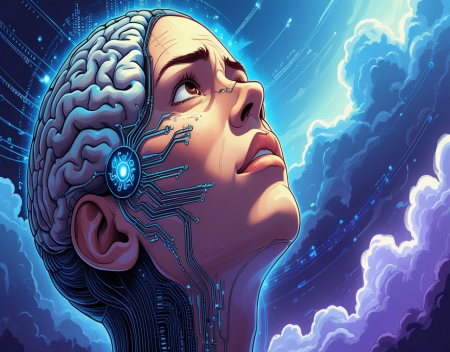
For most of human history, the mind has been the final private space. Thoughts could be shared through speech or writing, but the inner world itself remained inaccessible, protected by biology and silence. Neural interfaces, technologies designed to connect the human brain directly with machines, are beginning to challenge that boundary. As these systems advance from medical tools into consumer-facing enhancements, they raise a profound question. What happens to mental solitude when thoughts can be sensed, interpreted, or even influenced by external systems.
Neural interfaces are often introduced through therapeutic narratives. Devices that help paralyzed individuals communicate, restore limited movement, or manage neurological disorders represent undeniable progress. In these contexts, the technology serves as a bridge between damaged neural pathways and functional outcomes. Yet the same mechanisms that allow signals to be read and translated for healing also open the door to broader applications. Once brain signals can be decoded reliably, the distinction between assistance and access becomes increasingly fragile.
Mental solitude is more than privacy. It is the space where reflection, creativity, and emotional processing occur without external pressure. It allows individuals to think without performing, to doubt without consequence, and to imagine without record. Neural interfaces risk turning this space into a data source. Even if current systems focus on limited signal patterns, the long-term trajectory suggests increasing resolution and interpretive power. Over time, the boundary between voluntary expression and involuntary signal emission may blur.
One of the most significant psychological effects of neural interfaces is the potential normalization of cognitive monitoring. If brain activity can be tracked to optimize productivity, learning, or emotional regulation, individuals may begin to internalize the expectation of constant mental performance. The freedom to disengage, daydream, or experience unstructured thought could be subtly discouraged. Mental quiet, once a natural state, might be reframed as inefficiency or even risk.
There is also the issue of consent. While an individual may choose to use a neural interface, the social environments in which these technologies operate may exert pressure. Employers, educational institutions, or governments could incentivize or require their use for certain tasks. In such scenarios, opting out may carry social or economic penalties. The loss of mental solitude would not occur through force, but through normalization and expectation.
Data security further complicates the picture. Neural data is not just another biometric. It reflects patterns associated with emotion, intention, and cognition. If compromised, it cannot be changed like a password. Even anonymized datasets could reveal deeply personal traits when combined with other information. The prospect of mental data being stored, analyzed, or monetized raises ethical concerns that extend beyond traditional privacy frameworks.
The relationship between neural interfaces and identity is equally significant. Thoughts are not static objects. They emerge, shift, and dissolve. Capturing them in digital form risks freezing transient mental states into permanent records. A fleeting fear, an intrusive thought, or a half-formed idea could become part of an external archive, divorced from context and growth. This permanence challenges the human capacity for change and self-forgiveness.
There is also the question of influence. Neural interfaces do not merely read signals. Many are designed to stimulate or modulate neural activity. While this can be therapeutic, it also introduces the possibility of subtle behavioral shaping. If interfaces are used to enhance focus, regulate mood, or suppress undesirable impulses, individuals may gradually lose the ability to distinguish between self-directed thought and externally guided cognition. Mental solitude depends not only on privacy, but on agency.
Supporters of neural interfaces often argue that fears are overstated and that safeguards can be built in. These arguments are not without merit. Technology does not determine outcomes on its own. Social values, legal frameworks, and cultural norms play crucial roles. However, history suggests that once data can be collected, it eventually is. The challenge is not whether neural interfaces will affect mental solitude, but how consciously societies choose to protect it.
Preserving mental solitude in the age of neural interfaces may require redefining rights. The concept of cognitive liberty, the right to control one’s own mental processes and data, is gaining attention. Such a right would recognize that the mind is not merely another interface point, but the core of personhood. Without explicit protections, mental solitude risks becoming an artifact of the past.
As neural interfaces move from experimental labs into everyday life, the stakes extend beyond innovation. They touch the essence of what it means to think freely. The loss of mental solitude would not arrive with alarms or declarations. It would emerge gradually, as convenience and capability reshape expectations. Recognizing this trajectory early may be the only way to ensure that the mind remains a place of refuge rather than a node in a network.
Great experience with Computer Geek. They helped with my website needs and were professional, respon . . . [MORE].

Great, quick service when my laptop went into meltdown and also needed Windows 11 installed. Also ca . . . [MORE].
It was a great experience to working with you. thank you so much. . . . [MORE].
Thank you so much for great service and over all experience is good . highly recommended for all peo . . . [MORE].
We engaged The Computer Geeks in mid-2023 as they have a reputation for API integration within the T . . . [MORE].
The Rise of Automation in

Why Every Business Needs

ERP Systems for Small Bus