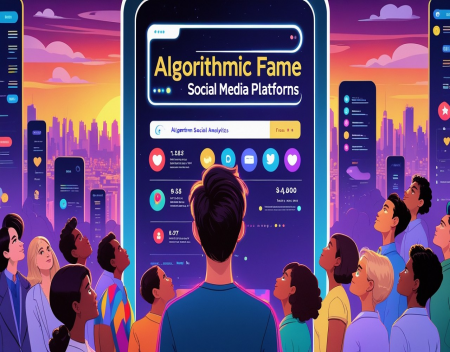
Fame was once shaped by talent scouts, editors, producers, and cultural gatekeepers who decided which voices were amplified and which were ignored. Today, that power has quietly shifted to algorithms. On platforms like TikTok, YouTube, Instagram, and X, visibility is no longer primarily earned through traditional credentials or institutional backing, but through mathematical systems designed to maximize engagement. As a result, fame has become increasingly algorithmic—manufactured, optimized, and often unpredictable. This transformation raises a critical question: who really decides who becomes famous in the digital age, and what does that mean for culture, creativity, and democracy?
At the core of algorithmic fame is attention economics. Social media platforms are not neutral stages; they are businesses whose survival depends on keeping users scrolling, watching, liking, and sharing. Algorithms are designed to predict what content will hold attention the longest and trigger the strongest emotional reactions. Whether that content is informative, truthful, or socially beneficial is often secondary. What matters most is engagement. As a result, creators who align—intentionally or not—with algorithmic incentives are far more likely to be promoted, regardless of their expertise or artistic merit.
This system fundamentally reshapes what fame looks like. Instead of being built slowly through sustained work, reputation, or mastery, digital fame can arrive overnight. A single viral video can transform an unknown individual into a global personality. But this visibility is fragile. The same algorithms that elevate creators can just as easily bury them. A slight change in platform priorities, posting frequency, or audience behavior can cause views to collapse without explanation. Fame becomes less a reward for consistency and more a temporary condition granted by opaque systems.
Algorithmic fame also changes what kind of content succeeds. Platforms tend to favor content that is emotionally charged, easily digestible, and optimized for short attention spans. Outrage, shock, humor, and spectacle often outperform nuance and depth. This pushes creators toward extremes—stronger opinions, louder personalities, more provocative imagery. Over time, this dynamic can distort public discourse, rewarding those who simplify complex issues or intentionally provoke controversy. The algorithm does not care whether a message is responsible or harmful, only whether it spreads.
Another consequence is the illusion of meritocracy. Platforms often promote the idea that “anyone can make it,” suggesting that success is purely a result of creativity and effort. While it is true that barriers to entry are lower than ever, algorithms are not neutral arbiters. They reflect hidden biases, data patterns, and commercial interests. Factors such as timing, geographic location, language, and even facial recognition biases can influence who gets promoted. This means that while fame appears democratic, it is still shaped by invisible structural forces.
Algorithmic fame also concentrates power in new ways. A small number of platforms effectively control global visibility. When an algorithm favors certain formats, trends, or narratives, entire cultures begin to conform to those preferences. Music becomes shorter to fit platform loops. Humor becomes faster. Political messaging becomes more emotionally manipulative. Instead of culture shaping technology, technology increasingly shapes culture. Creators are incentivized to adapt their identities and values to what the algorithm rewards, blurring the line between authenticity and performance.
The psychological impact on creators is significant. When success is governed by unpredictable systems, self-worth can become tied to metrics like views, likes, and shares. Many creators describe feeling trapped, constantly chasing relevance, afraid to experiment or slow down. Burnout is common, as the algorithm rewards constant output rather than long-term sustainability. Fame, once associated with stability and influence, becomes a stressful and fleeting condition.
For audiences, algorithmic fame also reshapes perception. Popularity is often mistaken for credibility. When an algorithm repeatedly places a creator in front of millions of viewers, it creates a sense of authority, regardless of the person’s qualifications. This can be dangerous in areas like health, finance, or politics, where misinformation can spread faster than corrections. The algorithm does not distinguish between expertise and confidence; it amplifies what performs.
Ultimately, algorithmic fame forces society to confront uncomfortable truths about power and visibility. Fame is no longer simply about talent or contribution, but about alignment with systems designed to extract attention. The question is not just who becomes famous, but who is never seen at all. As algorithms increasingly shape culture, identity, and influence, understanding their role is essential. If fame is now programmable, then so too is the culture it creates—and that makes algorithmic transparency not just a technical issue, but a cultural and ethical one.
Great experience with Computer Geek. They helped with my website needs and were professional, respon . . . [MORE].

Great, quick service when my laptop went into meltdown and also needed Windows 11 installed. Also ca . . . [MORE].
It was a great experience to working with you. thank you so much. . . . [MORE].
Thank you so much for great service and over all experience is good . highly recommended for all peo . . . [MORE].
We engaged The Computer Geeks in mid-2023 as they have a reputation for API integration within the T . . . [MORE].

How Technology Is Changin

What Comes After Silicon

The Future of Batteries