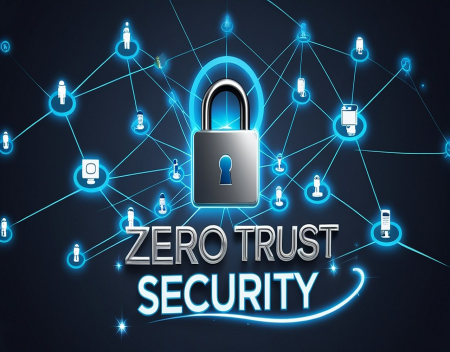
For many years, businesses approached cybersecurity by building a strong perimeter around their networks. Firewalls, antivirus software, and intrusion detection systems were designed to keep attackers out. The assumption was simple: if someone successfully logged into the company network, they were trusted. Unfortunately, today's cyber threats have exposed the weaknesses of that approach. Employees work remotely, cloud services store critical business data, mobile devices connect from anywhere, and cybercriminals have become experts at stealing login credentials. As a result, organizations are increasingly adopting a new security model known as Zero Trust.
Despite its name, Zero Trust does not mean businesses trust no one. Instead, it means that no user, device, or application is automatically trusted simply because it is inside the corporate network. Every request to access data or systems must be verified before permission is granted. In other words, the guiding principle of Zero Trust is "Never trust, always verify."
Traditional network security was built like a castle surrounded by a moat. Once someone crossed the drawbridge, they often had broad access to everything inside. If an attacker managed to steal an employee's password or compromise a single computer, they could sometimes move freely throughout the network searching for valuable data.
Zero Trust replaces this model by requiring continuous verification at every step. Even after a user successfully logs in, the system continues checking their identity, device security, location, permissions, and behavior before allowing access to sensitive resources.
Identity verification is one of the foundations of Zero Trust. Instead of relying only on usernames and passwords, organizations increasingly use Multi-Factor Authentication (MFA). This requires users to provide an additional form of verification, such as a code sent to a smartphone, a hardware security key, or biometric authentication like a fingerprint or facial recognition.
Even if a cybercriminal steals an employee's password, they are much less likely to gain access without the second authentication factor.
Another key concept is the principle of least privilege. Employees receive access only to the files, applications, and systems they need to perform their specific jobs. A salesperson, for example, may have access to customer relationship management software but not payroll records or engineering documents. Likewise, an accountant may not need access to product development systems.
Restricting permissions helps limit the damage if an account is compromised. Instead of gaining unrestricted access to the entire network, an attacker encounters multiple barriers that prevent movement between different systems.
Device security also plays an important role in Zero Trust. Before granting access, security systems evaluate whether a computer, tablet, or smartphone meets company security standards. Devices may be required to have current operating system updates, antivirus protection, encryption, and approved security software installed.
If a device appears compromised or fails security checks, access may be limited or denied entirely until the issue is resolved.
Continuous monitoring is another defining feature of Zero Trust. Traditional security often verified users only during login. Zero Trust continues monitoring activity throughout the user's session. If unusual behavior is detected, such as logging in from an unfamiliar country, accessing unusually large amounts of data, or attempting to reach unauthorized systems, additional verification may be required or access may be blocked automatically.
Artificial intelligence is increasingly helping detect these unusual patterns. AI-powered security systems can analyze login behavior, network traffic, user activity, and device health to identify suspicious activity much faster than traditional rule-based systems.
Microsegmentation is another important Zero Trust strategy. Instead of maintaining one large network where systems freely communicate, organizations divide networks into smaller, isolated segments. Sensitive databases, financial systems, development environments, and customer records may each operate within separate protected zones.
If an attacker successfully compromises one area of the network, microsegmentation makes it much more difficult to move laterally into other critical systems.
Cloud computing has accelerated the adoption of Zero Trust principles. Employees now regularly access applications hosted by multiple cloud providers rather than working exclusively inside a corporate office. Because there is often no clearly defined network perimeter anymore, verifying every access request becomes far more practical than relying solely on traditional firewalls.
Zero Trust also protects remote workers more effectively. Whether employees connect from home, hotels, airports, or client offices, the same identity verification and security checks apply regardless of their location. This provides consistent protection without assuming that office networks are inherently safer than external connections.
Application security is another essential component. Rather than allowing users unrestricted access to internal applications, Zero Trust verifies each request individually. Applications authenticate users before granting access and may request additional verification when particularly sensitive actions are performed.
Data protection is equally important. Sensitive information should be encrypted both while stored and while being transmitted across networks. Even if attackers intercept encrypted data, they cannot easily read its contents without the appropriate encryption keys.
Logging and auditing are also central to Zero Trust. Organizations maintain detailed records of authentication attempts, file access, administrative actions, and network activity. These logs help security teams investigate incidents, detect unusual behavior, and demonstrate compliance with industry regulations.
Despite its advantages, implementing Zero Trust is not a simple project. Many organizations have legacy systems that were never designed to support modern identity verification or fine-grained access controls. Transitioning to Zero Trust often requires upgrading infrastructure, improving identity management, reviewing user permissions, and adopting new security technologies.
Employee education is equally important. Staff members need to understand why additional authentication steps, device security requirements, and access restrictions exist. While these measures may initially seem inconvenient, they significantly reduce the likelihood of successful cyberattacks.
Small businesses can also benefit from Zero Trust principles, even if they lack enterprise-level security budgets. Enabling Multi-Factor Authentication, limiting user permissions, keeping software updated, encrypting sensitive data, using secure cloud services, and regularly reviewing account access are all practical steps that align with the Zero Trust philosophy.
One common misconception is that Zero Trust completely eliminates cyberattacks. No security strategy can guarantee absolute protection. Instead, Zero Trust focuses on minimizing risk and limiting the impact of successful attacks. If an attacker gains access to one account or device, additional layers of verification, restricted permissions, and network segmentation help prevent the breach from spreading.
Looking ahead, Zero Trust is expected to become the standard approach for cybersecurity. As businesses continue adopting cloud services, supporting hybrid workforces, integrating Internet of Things (IoT) devices, and using artificial intelligence, traditional perimeter-based security will become increasingly insufficient.
Governments, financial institutions, healthcare providers, and large enterprises have already embraced Zero Trust because it provides stronger protection against modern threats such as ransomware, phishing, credential theft, insider threats, and supply chain attacks.
Zero Trust represents a shift in how organizations think about security. Instead of assuming that anyone inside the network can be trusted, every user, device, and application must continually prove its identity and authorization. By verifying every access request, limiting permissions, monitoring activity, and protecting sensitive data, businesses can significantly strengthen their defenses against today's increasingly sophisticated cyber threats.
In a world where cyberattacks are becoming more frequent and more advanced, adopting a Zero Trust mindset is no longer just a best practice—it is quickly becoming a necessity for organizations that want to protect their systems, employees, and customers.
Great experience with Computer Geek. They helped with my website needs and were professional, respon . . . [MORE].

Great, quick service when my laptop went into meltdown and also needed Windows 11 installed. Also ca . . . [MORE].
It was a great experience to working with you. thank you so much. . . . [MORE].
Thank you so much for great service and over all experience is good . highly recommended for all peo . . . [MORE].
We engaged The Computer Geeks in mid-2023 as they have a reputation for API integration within the T . . . [MORE].

The Rise of Automation in
Why Every Business Needs
ERP Systems for Small Bus