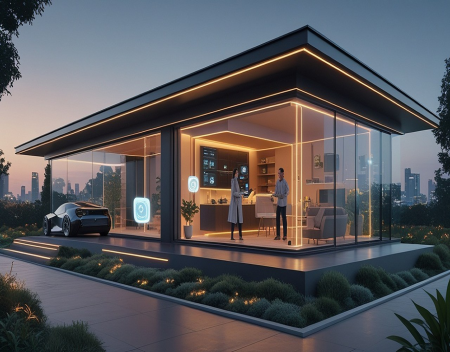
Imagine arriving home after work and finding the lights already adjusted to your preferred brightness, the temperature set to a comfortable level, and your favourite music playing in the background. Your security system has checked the doors, your thermostat has adjusted for changing weather conditions, and your appliances are operating according to your schedule.
This is the promise of smart home technology.
Smart homes use connected devices, sensors, software, and automation to make everyday household activities more convenient, efficient, and secure. Although many homes already contain smart thermostats, video doorbells, connected lights, and voice assistants, the technology is continuing to evolve.
In the coming years, smart homes are likely to become more intelligent, more energy-efficient, and better at anticipating the needs of the people living in them.
What Is a Smart Home?A smart home uses internet-connected devices and automated systems to monitor and control various household functions.
These devices may include lighting, heating and cooling systems, security cameras, door locks, appliances, entertainment equipment, and energy monitors.
Homeowners can often control these devices through smartphone applications, voice commands, wall-mounted panels, or automated schedules.
For example, a smart thermostat can adjust the temperature based on a schedule, while connected lighting can turn off automatically when a room is unoccupied.
Some devices can also communicate with one another. A smart home might turn on exterior lights when a security camera detects movement or adjust the thermostat when the occupants leave the house.
The goal is to make household systems easier to manage while improving comfort, safety, and efficiency.
Artificial Intelligence Will Make Homes SmarterOne of the biggest developments in smart home technology is the growing use of artificial intelligence.
Traditional smart home devices generally follow specific instructions. A light might turn on at a scheduled time, or a thermostat might maintain a selected temperature.
AI-powered systems could go further by learning household routines and using information from multiple devices to make decisions.
For example, a smart home system might recognize regular patterns in heating, lighting, and occupancy and suggest ways to improve comfort while reducing energy consumption.
AI assistants may also make it easier to control different devices through natural conversation rather than requiring users to navigate several applications.
However, homeowners should understand how these systems make decisions and what information they collect. Automation should remain predictable, and users should be able to override unwanted actions.
Smart Homes Will Become More Energy-EfficientEnergy management is likely to be one of the most valuable benefits of future smart homes.
Heating, cooling, lighting, appliances, and electric vehicle charging can account for a significant portion of household energy use. Smart technology can help homeowners understand where electricity is being consumed and identify opportunities to reduce waste.
Smart thermostats can adjust temperatures based on schedules and occupancy. Connected lighting can reduce unnecessary usage, while energy monitors can help identify unusually high consumption.
Homes with solar panels and battery storage may also use intelligent energy management to decide when to store electricity, use stored energy, or draw power from the electrical grid.
As more households adopt electric vehicles, smart charging systems may coordinate vehicle charging with household energy demand and electricity pricing.
In the future, these technologies could work together as a single energy management system rather than operating as separate products.
Integration Will Be More Important Than Individual DevicesOne of the current challenges with smart homes is that different products do not always work together smoothly.
A homeowner might have lighting from one manufacturer, security cameras from another, and a thermostat that requires a separate application.
Managing these systems can become frustrating, especially when devices use incompatible communication standards or depend on different cloud services.
Industry efforts such as Matter are intended to improve interoperability among supported smart home products.
As compatibility improves, homeowners should have more flexibility when choosing devices from different manufacturers.
This could make smart homes easier to expand and maintain, reducing the risk of becoming dependent on a single company's products.
However, compatibility will still vary by device and feature, so buyers should check requirements before purchasing equipment.
The Future of Home SecuritySmart home security systems are becoming more sophisticated.
Connected cameras, video doorbells, motion sensors, smart locks, and window sensors allow homeowners to monitor their properties remotely.
Future systems may use AI to distinguish between familiar activity, routine movement, and potentially suspicious events. This could reduce unnecessary notifications and help homeowners focus on important alerts.
Smart locks may also support more flexible access for family members, guests, and service providers.
For example, a homeowner might grant temporary access to a contractor and automatically revoke it after a scheduled period.
However, connected security devices must be protected against unauthorized access. Strong passwords, multifactor authentication where available, regular software updates, and secure home Wi-Fi are essential.
Homeowners should also consider what happens if the internet connection fails or a cloud service becomes unavailable.
Smart Appliances Will Become More ConnectedHousehold appliances are also becoming part of the smart home ecosystem.
Connected washing machines, refrigerators, ovens, and dishwashers can provide status updates, send maintenance notifications, and allow some functions to be controlled remotely.
Future appliances may use sensors and software to improve performance, identify potential problems, and help homeowners reduce waste.
A washing machine might notify the owner when a cycle is complete, while an oven could provide remote monitoring and alerts.
Some refrigerators can track certain stored items, although the usefulness and accuracy of these features vary between products.
The greatest long-term benefit may come from appliances that communicate with household energy systems and operate when electricity demand or costs are lower.
Smart Homes Can Help Older Adults Live IndependentlySmart home technology may also improve accessibility and support independent living.
Automated lighting can help illuminate hallways at night. Sensors can detect unusual activity patterns, and voice-controlled systems can allow people to operate lights, thermostats, and other devices without needing to reach physical switches.
Connected medication reminders and emergency alert systems may provide additional support for some individuals.
These technologies could help older adults and people with mobility limitations remain independent for longer.
However, smart home monitoring should respect privacy and personal choice. Technology can support people, but it should not be treated as a complete replacement for human care or emergency assistance.
Privacy and Cybersecurity ChallengesAs homes become more connected, they will generate increasing amounts of information about household routines, energy use, occupancy, and personal preferences.
This information can be useful for automation, but it can also create privacy risks if collected unnecessarily, stored insecurely, or shared without clear consent.
Smart home devices may also become targets for cybercriminals if they contain weak passwords, outdated software, or security vulnerabilities.
Homeowners should research manufacturers, review privacy settings, install updates, and disable features they do not need.
It is also wise to replace devices that no longer receive essential security updates, particularly when they control locks, cameras, or other sensitive systems.
Convenience should not come at the expense of basic security.
Will Smart Homes Become More Affordable?Smart home technology has become more accessible, but outfitting an entire house can still be expensive.
The cost depends on the number of devices, the complexity of installation, and whether the home needs new wiring, network equipment, or professional services.
Over time, broader adoption and improved compatibility may make smart home systems easier to install and expand.
Homeowners do not need to automate everything at once. Starting with a smart thermostat, a few connected lights, or a video doorbell can provide practical benefits without a major investment.
It is important to consider ongoing subscription fees, device replacement costs, and whether products will continue working if a manufacturer discontinues a service.
Final ThoughtsThe future of smart homes will involve more than controlling lights with a smartphone. Connected devices, artificial intelligence, energy management, and improved compatibility are moving homes toward systems that can coordinate many everyday functions.
These developments could make homes more comfortable, secure, accessible, and energy-efficient.
However, the best smart home will not necessarily be the one with the most gadgets. It will be the one that uses reliable technology to solve real problems while protecting the privacy and security of its occupants.
As smart home technology continues to improve, homeowners will have more opportunities to create living spaces that adapt to their needs and make everyday life easier.
Add a practical smart-home buying checklistMake the introduction more engaging
Great experience with Computer Geek. They helped with my website needs and were professional, respon . . . [MORE].

Great, quick service when my laptop went into meltdown and also needed Windows 11 installed. Also ca . . . [MORE].
It was a great experience to working with you. thank you so much. . . . [MORE].
Thank you so much for great service and over all experience is good . highly recommended for all peo . . . [MORE].
We engaged The Computer Geeks in mid-2023 as they have a reputation for API integration within the T . . . [MORE].
The Future of Smart Homes
Technology Trends Every S

The Hidden Costs of Legac