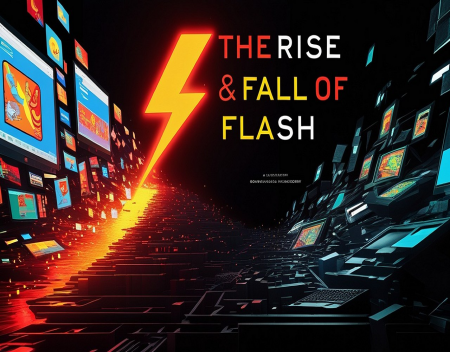
For many years, Adobe Flash was one of the most important technologies on the internet. It powered animated websites, browser games, interactive advertisements, educational applications, and early online video players. During the late 1990s and 2000s, Flash helped transform websites from mostly static pages into dynamic multimedia experiences.
For millions of internet users, Flash was an essential part of browsing the web. People used it to play games, watch animations, explore interactive websites, and enjoy entertainment that would have been difficult to create with the web technologies available at the time.
Yet by December 2020, Adobe officially ended support for Flash Player, and major browsers had already stopped running Flash content. A technology that once seemed indispensable had become obsolete.
What caused Flash to rise so quickly, and why did it ultimately disappear? Its story reveals how technological innovation, security problems, changing devices, and open standards can reshape the internet.
The Origins of FlashFlash began in the mid-1990s as a product developed by FutureWave Software. Originally known as FutureSplash Animator, it was designed to make it easier to create and display vector-based animations over the internet.
Vector graphics were particularly useful because they could scale to different screen sizes without becoming pixelated, and they could often be delivered in relatively small files. This mattered in an era when many people connected to the internet through slow dial-up modems.
Macromedia acquired FutureSplash in 1996 and renamed the technology Macromedia Flash. Over time, Flash evolved beyond animation into a platform for building interactive multimedia applications.
Designers and developers could use it to create animations, buttons, games, menus, and sophisticated website experiences. As broadband connections became more common and computers grew more powerful, Flash became an increasingly attractive tool for online content creators.
Adobe acquired Macromedia in 2005, bringing Flash under its expanding software portfolio. The technology continued to develop and became a familiar part of the internet experience.
The Golden Age of Flash WebsitesDuring the early 2000s, Flash was everywhere.
Website designers used it to create animated introductions, interactive menus, moving backgrounds, and entire websites that behaved more like multimedia presentations than traditional web pages.
At the time, standard HTML and JavaScript offered fewer convenient options for delivering complex animations and interactive experiences consistently across browsers. Flash provided a relatively unified development environment, allowing creators to produce content that looked and behaved similarly on many computers.
Some websites became famous for their elaborate Flash-based designs. Businesses used animated presentations to promote products, while artists and designers experimented with interactive storytelling and visual effects.
However, Flash websites could also be frustrating. Some required visitors to watch lengthy animated introductions before reaching the actual content. Others were slow to load, difficult to navigate, or poorly suited to search engines and accessibility tools.
Despite these drawbacks, Flash helped establish the idea that websites could be immersive multimedia experiences rather than simple collections of text and images.
Flash Games Changed Online EntertainmentOne of Flash's most memorable contributions was its role in browser-based gaming.
Websites such as Newgrounds and Miniclip became popular destinations for people looking for quick, accessible games that could run directly inside a web browser. Players did not necessarily need to purchase a game, install a large program, or own expensive hardware.
Independent developers could create and distribute games to large audiences with relatively modest resources. This helped create a thriving ecosystem of experimental games, humorous animations, puzzle challenges, platformers, and interactive stories.
Flash games were particularly popular in schools, offices, and homes because they were easy to access and often free to play.
Many successful developers gained experience through Flash before moving into larger commercial projects. The platform helped introduce a generation of players to independent gaming and demonstrated that small teams could create entertaining experiences for a global audience.
Although modern mobile games and browser technologies have replaced much of Flash's functionality, its influence remains visible in today's independent gaming industry.
Flash and the Rise of Online VideoFlash also played a major role in the early development of internet video.
Before Flash-based video players became widespread, watching online video could be difficult. Users sometimes needed special media players, browser plug-ins, or specific software configurations.
Flash offered a convenient way to embed video into websites and provide playback through a familiar browser interface.
YouTube, which launched in 2005, initially relied heavily on Flash Player to deliver videos to desktop browsers. Other websites adopted similar approaches, helping online video become a routine part of internet use.
Flash was not the only technology capable of delivering online video, but its widespread installation made it a practical choice for many services.
As internet speeds improved, video became one of the most important forms of online content. Flash helped bridge the gap between the early text-heavy web and the modern streaming experience.
The Problems That Led to Flash's DeclineDespite its popularity, Flash had several significant weaknesses.
Security was one of the biggest problems. Flash Player contained vulnerabilities that attackers could exploit to compromise computers or deliver malicious software. Adobe regularly released security updates, but the technology's complexity and widespread installation made it an attractive target.
Performance and battery consumption were also concerns. Flash content could place considerable demands on processors, particularly on less powerful computers. This became especially problematic as portable devices grew more important.
Dependence on a browser plug-in was another disadvantage. Flash required users to have compatible software installed and enabled. As web browsers became more sophisticated, maintaining a separate plug-in became increasingly unnecessary.
Finally, Flash was a proprietary technology controlled by Adobe. Although it provided developers with a powerful set of tools, the wider web community increasingly favoured open standards that could be implemented directly in browsers.
These weaknesses became more significant as the internet shifted toward mobile devices and more efficient web technologies.
Apple's Decision Changed the IndustryOne of the most important turning points came with the growth of smartphones and tablets.
In 2010, Apple published its position on Flash, explaining why it would not support Flash Player on the iPhone, iPad, and iPod touch. Apple raised concerns about reliability, security, performance, battery life, and the limitations of a plug-in-based approach to mobile computing.
Because Apple's mobile devices were becoming increasingly popular, the decision placed considerable pressure on websites and developers to find alternatives.
Flash content that worked on desktop computers did not automatically work on these devices. Publishers wanted their videos, games, and interactive experiences to reach mobile audiences without requiring a separate plug-in.
HTML5, CSS, and JavaScript offered a path forward. These technologies allowed developers to build interactive websites and deliver video and audio through browser-supported capabilities.
As mobile internet use expanded, the disadvantages of Flash became harder to ignore.
HTML5 and the Modern WebHTML5 and related web standards gradually replaced many of Flash's most important functions.
HTML5 video made it possible to play video directly within compatible browsers, while CSS animations and JavaScript enabled developers to create interactive interfaces without relying on Flash Player.
WebGL introduced a way to render advanced 2D and 3D graphics through web technologies, and improvements to JavaScript performance made browser-based applications increasingly capable.
These technologies were not simply replacements for individual Flash features. Together, they represented a broader shift toward a web where multimedia and interactive content could operate through built-in browser capabilities.
This approach reduced the need for third-party plug-ins and made it easier to develop experiences that worked across desktops, laptops, smartphones, and tablets.
The transition was gradual, but the direction became clear: the future of the web would depend less on proprietary plug-ins and more on native browser technologies.
The Official End of FlashAdobe announced in July 2017 that it would end support for Flash Player at the end of 2020. Browser developers subsequently removed or disabled Flash support, and Adobe stopped providing security updates after December 31, 2020.
In January 2021, Adobe began blocking Flash content from running in Flash Player.
This marked the end of an era. Websites that had not migrated their content faced broken animations, unavailable games, and missing interactive features. Some material disappeared permanently, while other projects were preserved by dedicated communities.
The Internet Archive's Flash-related preservation work and projects such as Ruffle, an open-source Flash Player emulator, have helped people access portions of this digital history. However, not every old Flash experience can be reproduced perfectly, especially when it depended on external services or features that no longer exist.
Flash may no longer be supported as a mainstream web platform, but its creative legacy has not completely disappeared.
Final ThoughtsThe rise and fall of Flash illustrates how quickly a successful technology can become outdated when the needs of users and developers change.
Flash helped make the internet more animated, interactive, and entertaining. It powered a generation of browser games, supported the early growth of online video, and gave designers tools to experiment with experiences that were difficult to build using the web standards of the time.
However, security vulnerabilities, performance concerns, mobile incompatibility, and the growth of open web standards gradually undermined its position.
Its disappearance was not simply the result of one company abandoning a product. It reflected a broader evolution in how the internet is built and experienced.
Today, HTML5, CSS, JavaScript, and other modern technologies provide many of the capabilities that once made Flash special, without requiring the same kind of browser plug-in.
For those who remember spending hours playing browser games or exploring elaborate animated websites, Flash remains an important part of internet history. It helped shape the online world we know today—and its story is a reminder that even the most popular technology must continue evolving to survive.
Great experience with Computer Geek. They helped with my website needs and were professional, respon . . . [MORE].

Great, quick service when my laptop went into meltdown and also needed Windows 11 installed. Also ca . . . [MORE].
It was a great experience to working with you. thank you so much. . . . [MORE].
Thank you so much for great service and over all experience is good . highly recommended for all peo . . . [MORE].
We engaged The Computer Geeks in mid-2023 as they have a reputation for API integration within the T . . . [MORE].
The Rise and Fall of Flas
The History of the Intern
The Evolution of Personal