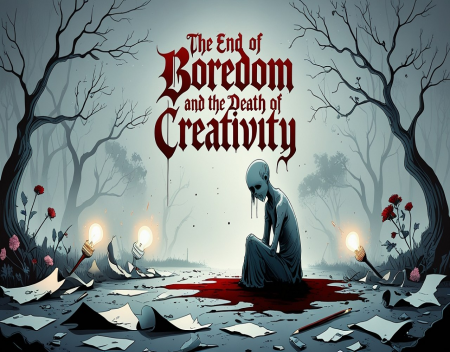
Boredom has long been treated as a problem to be solved rather than a condition to be understood. In the modern world, moments of silence or inactivity are increasingly rare, filled instantly by notifications, streaming content, social feeds, or algorithmically tailored distractions. Technology has succeeded in nearly eliminating boredom, but in doing so it may be eroding one of the most fertile conditions for human creativity. The end of boredom raises an unsettling question: if the mind is never left alone, what happens to imagination, originality, and deep thought?
Historically, boredom has served as a psychological threshold. When external stimulation fades, the mind turns inward, wandering across memories, ideas, and unresolved questions. This wandering state is not aimless; it is where connections form between seemingly unrelated concepts. Many creative breakthroughs, from artistic inspiration to scientific insight, have emerged not during moments of intense focus, but during idle reflection. Boredom creates cognitive space, allowing thoughts to recombine freely without the pressure of productivity or immediate reward.
In contrast, today’s digital environment is designed to capture and hold attention continuously. Platforms compete not just for minutes, but for mental presence, optimizing content to prevent disengagement. Algorithms learn what triggers emotional response and deliver it instantly, eliminating the discomfort that boredom once imposed. While this constant stimulation can feel enriching, it leaves little room for the kind of mental drift that fuels creativity. When every pause is filled, the mind loses opportunities to explore its own depths.
The death of boredom also alters how creativity is experienced and evaluated. Creative work increasingly competes with infinite content produced by others, much of it generated or curated by algorithms. This abundance can be inspiring, but it can also be paralyzing. When people are constantly consuming, they have less incentive to create. Original expression becomes harder to access when the mind is saturated with external ideas, trends, and expectations. Creativity shifts from exploration to reaction, driven by engagement metrics rather than internal curiosity.
There is also a psychological cost to the elimination of boredom. Constant stimulation trains the brain to expect novelty and reward on demand. Tasks that require sustained effort, patience, or delayed gratification become more difficult. Creative processes, which often involve frustration, repetition, and uncertainty, can feel intolerable in comparison to the instant satisfaction of digital entertainment. As tolerance for boredom declines, so does resilience in the face of creative struggle.
Children growing up in this environment face unique challenges. Unstructured time, once a staple of childhood, is increasingly replaced by screens and scheduled activities. While digital tools offer educational and creative possibilities, they can also limit the development of self-directed play and imagination. When boredom is immediately relieved by entertainment, children may struggle to learn how to generate their own ideas. The capacity to invent worlds, stories, or solutions from nothing depends on the experience of having nothing to do.
The relationship between boredom and creativity is not romantic nostalgia; it is grounded in cognitive science. Studies have shown that periods of low stimulation activate the brain’s default mode network, associated with introspection, memory consolidation, and creative insight. By constantly overriding this state, modern technology may be reshaping how the brain functions over time. Creativity becomes less about deep synthesis and more about rapid remixing, a shift that favors speed over substance.
Yet the end of boredom is not inevitable. Creativity does not vanish simply because distractions exist; it diminishes when people lose the ability or willingness to disengage. Reclaiming boredom requires intentional resistance to constant stimulation. This might mean allowing moments of silence, reducing reliance on passive entertainment, or embracing activities that do not provide immediate feedback. These choices can feel uncomfortable at first, but discomfort is precisely what signals the return of cognitive freedom.
In a world that fears boredom, choosing stillness becomes a radical act. Creativity thrives not in endless stimulation, but in the gaps between it. The death of boredom is not merely the loss of idle time; it is the loss of a mental landscape where ideas grow without direction or demand. If creativity is to survive, boredom must be recognized not as an enemy, but as a necessary companion to imagination.
Great experience with Computer Geek. They helped with my website needs and were professional, respon . . . [MORE].

Great, quick service when my laptop went into meltdown and also needed Windows 11 installed. Also ca . . . [MORE].
It was a great experience to working with you. thank you so much. . . . [MORE].
Thank you so much for great service and over all experience is good . highly recommended for all peo . . . [MORE].
We engaged The Computer Geeks in mid-2023 as they have a reputation for API integration within the T . . . [MORE].

How Technology Is Changin

What Comes After Silicon

The Future of Batteries