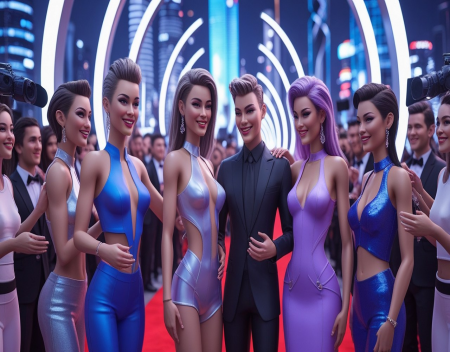
Fame has always been tied to visibility, talent, and the ability to capture public attention. From film stars and musicians to influencers and reality television personalities, the definition of celebrity has evolved alongside technology. Now, a new transformation is underway—one that challenges the very idea of what it means to be famous. Synthetic celebrities, entirely digital personalities created using artificial intelligence and computer graphics, are beginning to carve out their own place in global culture. Their rise signals a shift in how fame is manufactured, maintained, and consumed.
Unlike traditional celebrities, synthetic figures do not exist as physical people. They are carefully designed constructs, often blending hyper-realistic visuals with curated personalities. One of the most well-known examples is Lil Miquela, a digital influencer who has millions of followers, brand partnerships, and even a music career. To many fans, she feels as real as any human celebrity, despite being entirely fictional. This blurring of reality and simulation is at the core of the synthetic celebrity phenomenon.
The appeal of synthetic celebrities lies partly in control. Human celebrities are unpredictable. They make mistakes, express controversial opinions, and evolve in ways that may not align with brand expectations. Synthetic celebrities, on the other hand, can be perfectly managed. Their appearance never changes unless intended. Their behavior is scripted. Their image can be adjusted instantly to reflect trends or audience preferences. For companies and creators, this level of control is incredibly valuable. It reduces risk while maximizing consistency.
This shift raises important questions about authenticity. Traditionally, fame has been tied to a sense of realness—the idea that audiences are connecting with a genuine person. Even when celebrities carefully manage their public image, there is still an underlying belief that there is a real individual behind it. Synthetic celebrities disrupt this assumption. They are transparent illusions, yet audiences still form emotional connections with them. This suggests that authenticity in the digital age may be less about reality and more about consistency and relatability. If a character behaves in a way that feels coherent and engaging, it may not matter whether they are real or not.
Another key factor driving the rise of synthetic fame is the power of platforms like Instagram and TikTok. These platforms prioritize visual content, storytelling, and frequent engagement—all areas where synthetic personalities can excel. A digital influencer can post constantly, appear in any setting, and collaborate with anyone, real or virtual. There are no physical limitations, no scheduling conflicts, and no aging process. In a system that rewards constant visibility, synthetic celebrities have a distinct advantage.
However, this evolution also introduces new ethical concerns. One major issue is transparency. Not all audiences are fully aware when they are engaging with a synthetic personality, especially as technology becomes more advanced. This can lead to blurred lines between fiction and reality, particularly for younger audiences. There is also the question of accountability. When a synthetic celebrity promotes a product, spreads a message, or influences public opinion, who is responsible—the character or the creators behind it. The answer is not always clear, and existing regulations have yet to fully address this new landscape.
The economic implications are equally significant. Synthetic celebrities have the potential to reshape industries such as advertising, entertainment, and fashion. Brands may increasingly choose digital influencers over human ones due to lower costs and greater control. This could reduce opportunities for real people while concentrating creative power in the hands of those who design and manage these virtual figures. At the same time, it may open new roles in areas like digital character design, AI storytelling, and virtual production, creating a different kind of creative economy.
Culturally, synthetic celebrities challenge our understanding of identity and aspiration. Traditional celebrities often serve as role models or symbols of success. They represent achievements that others might hope to emulate. Synthetic figures, however, are unattainable by definition. They are designed to be ideal—flawless in appearance, perfectly styled, and endlessly adaptable. This can create unrealistic standards, particularly in areas like beauty and lifestyle, where the line between achievable and artificial becomes increasingly difficult to distinguish.
Despite these concerns, synthetic celebrities also offer creative possibilities. They can tell stories that transcend physical limitations, represent diverse identities without being tied to a single individual, and experiment with new forms of expression. In some cases, they may even provide a safer space for exploring complex or controversial topics, as their fictional nature creates a layer of separation from real-world consequences.
Ultimately, the rise of synthetic celebrities reflects a broader shift in how fame is constructed in the digital age. Fame is no longer just about being seen—it is about being engineered for attention. As technology continues to advance, the distinction between real and artificial will become less important than the experience itself. Audiences will engage with personalities that entertain, inspire, or resonate with them, regardless of their origin.
The future of fame will likely be a hybrid landscape, where human and synthetic celebrities coexist, collaborate, and compete. The challenge will be ensuring that this new form of fame remains transparent, ethical, and grounded in values that prioritize human well-being. Because while synthetic celebrities may be created by algorithms and artists, the culture they shape is still very real.
Great experience with Computer Geek. They helped with my website needs and were professional, respon . . . [MORE].

Great, quick service when my laptop went into meltdown and also needed Windows 11 installed. Also ca . . . [MORE].
It was a great experience to working with you. thank you so much. . . . [MORE].
Thank you so much for great service and over all experience is good . highly recommended for all peo . . . [MORE].
We engaged The Computer Geeks in mid-2023 as they have a reputation for API integration within the T . . . [MORE].
The Rise of Automation in

Why Every Business Needs

ERP Systems for Small Bus