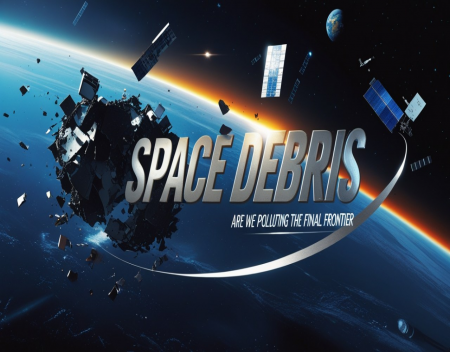
The promise of space exploration has always been tied to ideas of discovery, expansion, and the pursuit of knowledge beyond Earth. Yet as humanity launches more satellites, probes, and commercial missions into orbit, a growing problem threatens both our technological future and the safety of space itself: the expanding cloud of space debris surrounding the planet. Once seen as an abstract concern limited to engineers and scientists, the space debris crisis has become a serious issue that raises questions about responsibility, sustainability, and whether humanity is repeating the same environmental mistakes in orbit that it made on Earth.
Space debris refers to defunct satellites, fragments from collisions, spent rocket stages, and even small pieces of paint traveling at extremely high speeds. Because objects in low Earth orbit move at tens of thousands of kilometers per hour, even a tiny shard can cause catastrophic damage to a spacecraft. Over decades of launches, the number of objects orbiting Earth has increased dramatically. While many satellites provide essential services such as communication, weather monitoring, and navigation, the accumulation of debris has created congested orbital pathways that threaten future missions.
One of the most serious concerns is the potential for cascading collisions, sometimes referred to as a chain reaction effect. When two objects collide, they produce thousands of additional fragments, each capable of striking other satellites. As debris multiplies, safe orbits could become increasingly difficult to maintain. This scenario would not only endanger astronauts and space stations but could also disrupt critical infrastructure on Earth that relies on satellite technology. From banking systems to emergency communications, modern civilization is deeply interconnected with orbital networks, making the consequences of a debris crisis far reaching.
The rise of private space companies has accelerated the conversation around orbital pollution. Mega constellations consisting of thousands of small satellites promise global internet coverage and new economic opportunities, but they also contribute to the growing density of objects in orbit. While many companies design satellites to deorbit at the end of their lifespan, enforcement and oversight remain inconsistent across nations. Without strong international cooperation, the risk of overcrowding increases, turning Earth’s orbit into a contested and potentially hazardous environment.
Efforts to address the problem are already underway. Space agencies and research organizations are developing debris tracking systems capable of monitoring objects as small as a few centimeters. Improved tracking allows operators to perform avoidance maneuvers, reducing the likelihood of collisions. Engineers are also exploring active debris removal technologies, including robotic capture systems, nets, harpoons, and drag sails designed to pull defunct satellites back into Earth’s atmosphere where they burn up safely. While these solutions are promising, they remain expensive and technically complex, highlighting the need for preventative measures rather than relying solely on cleanup.
Beyond technical challenges, the space debris crisis raises ethical and legal questions. Who is responsible for debris created decades ago by missions that no longer exist. Should companies launching large satellite constellations be required to contribute to orbital cleanup funds. How do nations enforce regulations in a domain that exists beyond traditional territorial boundaries. These questions reflect a broader debate about whether space should be treated as a shared global environment requiring collective stewardship.
Public awareness of space debris has grown as near misses and satellite failures make headlines. Astronauts aboard the International Space Station have occasionally had to shelter in spacecraft during close approaches by debris fragments. Meanwhile, scientists warn that continued neglect could make certain orbital regions unusable for generations. The idea that humanity could render parts of space inaccessible through pollution challenges the romantic image of the final frontier as an endless, untouched expanse.
Despite these concerns, the situation is not without hope. Increased international dialogue, advances in satellite design, and improved tracking technologies demonstrate that solutions are within reach. Some companies are experimenting with reusable rockets and biodegradable satellite components, aiming to reduce long term environmental impact. Policy makers are beginning to discuss stricter launch regulations and standardized disposal practices to prevent future accumulation.
The space debris crisis ultimately serves as a reminder that exploration carries responsibility. As humanity extends its reach beyond Earth, the need to balance innovation with sustainability becomes more urgent. Orbit may seem vast, but it is a finite resource that requires careful management to ensure continued access for future generations. Whether we are polluting the final frontier is a question still being written, shaped by the decisions made today about how we launch, operate, and retire the technology that connects our world to the cosmos.
Great experience with Computer Geek. They helped with my website needs and were professional, respon . . . [MORE].

Great, quick service when my laptop went into meltdown and also needed Windows 11 installed. Also ca . . . [MORE].
It was a great experience to working with you. thank you so much. . . . [MORE].
Thank you so much for great service and over all experience is good . highly recommended for all peo . . . [MORE].
We engaged The Computer Geeks in mid-2023 as they have a reputation for API integration within the T . . . [MORE].

ERP Systems for Small Bus

CRM Software Explained

The Future of Digital Pay