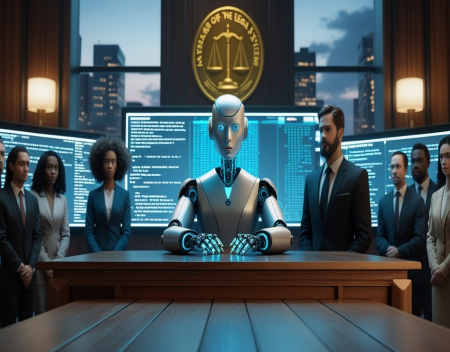
The idea of automated justice has moved from science fiction to serious policy debate. As artificial intelligence grows more sophisticated, many countries have begun experimenting with legal automation in areas ranging from bail assessments to minor civil disputes. Supporters argue that AI judges could deliver faster, cheaper, and more consistent rulings. Critics warn that the legal system is the last place society should hand over to machines. The question is no longer whether AI will be used in law but how far we should allow the technology to go. The implications reach into ethics, fairness, accountability, and the very nature of justice itself.
The most compelling argument for AI judges is the promise of impartiality. Human judges bring experience and insight, but they also bring implicit biases shaped by their backgrounds, beliefs, and personal histories. Studies from various judicial systems have shown disparities in sentencing based on race, gender, wealth, and appearance. AI systems, when properly trained and monitored, could theoretically eliminate such biases by treating every case according to the same principles. They never get tired. They never get frustrated. They never think differently on a bad day. This consistency is particularly appealing in high-volume courts where overworked judges handle hundreds of cases.
Efficiency is another strong advantage. Legal systems around the world suffer from backlog. Delayed justice can destroy lives, stall businesses, and clog the social system. AI could process procedural motions, help evaluate evidence, and handle routine cases quickly. For many individuals, especially those without the money to hire lawyers, a faster and more predictable system could make justice more accessible. If used correctly, automation could reduce legal costs and allow human judges to focus on complex cases that genuinely require human judgment.
Yet the risks are equally significant. AI is only as fair as the data used to train it. If historical legal data contains biased decisions, an AI judge could replicate or even amplify those biases at scale. Transparency becomes a major problem. Humans can explain their reasoning. AI systems often operate through opaque algorithms that cannot easily be interpreted. If someone receives an unfair ruling, how do they appeal a decision when they cannot understand how the decision was made in the first place?
Another concern lies in accountability. When a human judge makes a mistake, there is a clear chain of responsibility. When an AI judge errs, responsibility becomes diffuse. Is it the developers? The court administrators? The government that approved the system? Without a clear answer, automated justice risks creating a dangerous vacuum of accountability where no one can be held responsible for errors.
Beyond practicality, there are deeper philosophical questions. Justice is not only about applying laws. It involves empathy, moral reasoning, and understanding the nuances of human behavior. Machines can analyze patterns but cannot understand suffering. They cannot weigh mercy. They cannot intuit context in the way humans can. If society relies too heavily on automation, it risks reducing justice to a cold mathematical formula stripped of humanity. The courtroom may become efficient, but it may also lose its moral heart.
A balanced approach may lie between extremes. AI can assist but should not fully replace human judgment. Automated systems can handle clerical tasks, provide sentencing guidelines, check for inconsistencies, and help identify bias. But the final decision—especially in cases involving liberty, harm, or moral weight—should remain in human hands. Hybrid models combining AI efficiency with human empathy could offer the best of both worlds.
As technology evolves, society must decide what it wants justice to be. AI judges could make the system faster and more consistent, but they also risk reducing justice to an equation. The real challenge is ensuring that automation strengthens fairness rather than weakens it. The debate will continue, but one truth remains clear: justice should serve humanity, not replace it.
Great experience with Computer Geek. They helped with my website needs and were professional, respon . . . [MORE].

Great, quick service when my laptop went into meltdown and also needed Windows 11 installed. Also ca . . . [MORE].
It was a great experience to working with you. thank you so much. . . . [MORE].
Thank you so much for great service and over all experience is good . highly recommended for all peo . . . [MORE].
We engaged The Computer Geeks in mid-2023 as they have a reputation for API integration within the T . . . [MORE].

CRM Software Explained

The Future of Digital Pay

How Technology Is Changin