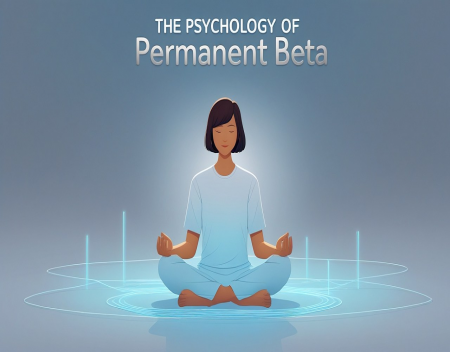
There was a time when products, systems, and even identities were expected to reach a state of completion. A book was published, a software program was released, a career path was chosen. Today, that sense of finality has largely disappeared. In its place is a culture of continuous updates, where nothing is ever truly finished. Apps like Instagram and TikTok are constantly evolving, introducing new features, interfaces, and algorithms. This constant state of change reflects a broader condition often described as “permanent beta”—a world where everything is provisional, adaptable, and never quite complete.
At first glance, permanent beta seems like progress. Continuous improvement allows for rapid innovation, quick fixes, and the ability to respond to user feedback in real time. Instead of waiting for major releases, updates happen seamlessly in the background. Bugs are addressed, features are refined, and systems become more efficient. From a technological standpoint, this model is highly effective. It aligns with the fast pace of digital life and the demand for constant optimization.
However, living within this framework has psychological consequences that are less obvious. When everything is always changing, it becomes difficult to develop a sense of stability. Users are constantly adapting to new interfaces, new rules, and new expectations. What worked yesterday may not work today. This creates a subtle but persistent cognitive load, as individuals must continuously relearn and adjust. Over time, this can lead to fatigue, even if each individual change seems minor.
The concept of permanent beta also extends beyond technology into personal identity. In a world shaped by digital platforms, individuals are encouraged to continuously refine and present themselves. Profiles are updated, content is curated, and personal brands are developed and adjusted over time. The self becomes a kind of ongoing project, subject to revision and optimization. While this can be empowering, it can also create pressure to constantly improve, perform, and stay relevant.
This pressure is reinforced by feedback systems embedded in platforms. Likes, comments, and views provide immediate data on how content is received. This feedback loop encourages experimentation but also fosters a mindset where value is tied to performance metrics. When identity is treated as something to be optimized, it can become difficult to separate self-worth from external validation. The result is a form of psychological instability, where individuals feel the need to constantly update themselves to maintain relevance.
Another aspect of permanent beta is the erosion of completion. In traditional models, finishing something—whether a project, a product, or a phase of life—provided a sense of closure and accomplishment. In a continuously updating environment, that sense of closure is harder to achieve. There is always another improvement to be made, another version to release, another adjustment to consider. This can lead to a feeling of never being “done,” which can be both motivating and exhausting.
The workplace reflects this shift as well. Many industries now operate on iterative cycles, where projects are constantly revised based on new data or changing conditions. While this allows for flexibility, it can also create uncertainty. Employees may feel that their work is never fully complete, leading to ongoing pressure to adapt and improve. The boundary between progress and perfectionism becomes blurred, as the expectation of continuous refinement can make it difficult to define success.
There is also a deeper philosophical implication. Permanent beta challenges the idea of a fixed reality. If systems, environments, and identities are always in flux, then stability becomes an illusion. This can create a sense of disorientation, as individuals struggle to anchor themselves in a world that is constantly shifting. At the same time, it reflects a more dynamic understanding of existence, where change is not an exception but the norm.
Despite these challenges, permanent beta is not inherently negative. It allows for adaptability, resilience, and ongoing growth. The key issue is balance. Without moments of stability, reflection, and completion, continuous change can become overwhelming. Individuals need spaces where they can pause, consolidate, and make sense of their experiences.
One possible response is to create intentional boundaries. This might involve limiting exposure to constant updates, taking breaks from platforms, or focusing on activities that provide a sense of completion. It may also involve redefining success—not as a final state, but as a process that includes both change and rest.
Ultimately, living under continuous update requires a shift in mindset. Instead of seeking permanence in a world designed for change, individuals may need to embrace fluidity while still maintaining a sense of self that is not entirely dependent on external systems. This is not an easy balance to achieve, but it is increasingly necessary.
In the end, the psychology of permanent beta reflects the broader condition of modern life. We are no longer living in a world of finished products and fixed identities, but in one of ongoing revision and adaptation. The challenge is not to resist this reality, but to navigate it in a way that preserves stability, meaning, and a sense of being grounded—even when everything else is still updating.
Great experience with Computer Geek. They helped with my website needs and were professional, respon . . . [MORE].

Great, quick service when my laptop went into meltdown and also needed Windows 11 installed. Also ca . . . [MORE].
It was a great experience to working with you. thank you so much. . . . [MORE].
Thank you so much for great service and over all experience is good . highly recommended for all peo . . . [MORE].
We engaged The Computer Geeks in mid-2023 as they have a reputation for API integration within the T . . . [MORE].
The Evolution of Personal
The Hidden Cost of Free A

The Psychology of Notific