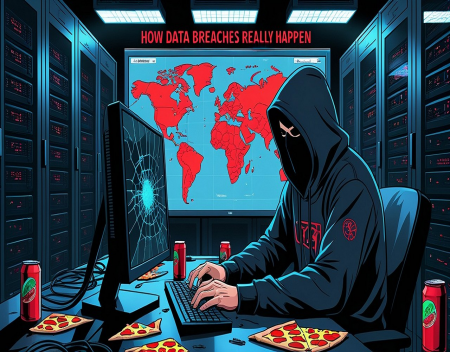
When people hear about a major data breach, they often imagine highly skilled hackers breaking through sophisticated security systems using advanced technology seen only in movies. While those types of attacks do occur, the reality is often far less dramatic. Many of the world's largest data breaches happen because of simple mistakes, weak passwords, outdated software, or employees who unknowingly fall victim to scams. Understanding how data breaches actually happen is one of the most effective ways for individuals and businesses to better protect themselves.
A data breach occurs whenever unauthorized individuals gain access to confidential information. This information may include customer records, financial details, passwords, medical records, employee information, trade secrets, or other sensitive business data. Once attackers obtain this information, they may sell it on criminal marketplaces, use it for identity theft, commit financial fraud, or demand ransom payments from the affected organization.
One of the most common causes of data breaches is phishing. Phishing attacks typically begin with an email, text message, or fake website designed to trick someone into revealing login credentials or downloading malicious software. These messages often appear to come from trusted sources such as banks, shipping companies, software vendors, government agencies, or even company executives.
Modern phishing emails have become extremely convincing. Attackers frequently copy company logos, email formatting, and writing styles to make fraudulent messages appear legitimate. A single employee clicking the wrong link or entering their password into a fake website can provide cybercriminals with access to an entire organization's systems.
Weak or reused passwords continue to be another major contributor to data breaches. Many people still use simple passwords or reuse the same password across multiple websites. If one website suffers a breach and login credentials are stolen, attackers often try those same usernames and passwords on banking websites, email providers, cloud services, and business applications.
This technique, known as credential stuffing, has become highly automated. Cybercriminals use software that can test millions of stolen credentials against thousands of websites in a relatively short period of time.
Multi-factor authentication significantly reduces this risk because even if attackers obtain a password, they still need an additional verification method to access the account.
Outdated software is another frequent cause of security incidents. Software developers regularly release updates that fix newly discovered security vulnerabilities. Unfortunately, some businesses delay installing these updates due to concerns about compatibility, downtime, or simple oversight.
Cybercriminals actively search the internet for systems running outdated software because they know these vulnerabilities can often be exploited automatically. In many cases, attacks begin within hours of a security flaw becoming publicly known.
Ransomware attacks frequently exploit these unpatched vulnerabilities. Once inside a network, attackers encrypt important files and demand payment to restore access. Many ransomware groups also steal sensitive information before encrypting systems, threatening to publish confidential data if the ransom is not paid.
Cloud computing has introduced new opportunities as well as new security challenges. Contrary to popular belief, storing data in the cloud is not inherently insecure. However, cloud services must be configured correctly.
Many breaches occur because organizations accidentally leave cloud storage publicly accessible, assign excessive user permissions, or fail to enable available security features. These configuration mistakes can expose sensitive information without any hacking taking place at all.
Human error remains one of the largest cybersecurity risks. Employees may accidentally email confidential documents to the wrong recipient, upload sensitive files to public websites, lose unsecured laptops, or improperly dispose of paper records containing personal information.
Even experienced IT professionals occasionally make mistakes. A simple configuration error on a firewall or database server can unintentionally expose thousands of customer records to the internet.
Insider threats also contribute to data breaches. While some employees intentionally steal confidential information before leaving a company or selling data to competitors, most insider incidents are accidental rather than malicious. Employees may unknowingly violate security policies, use unauthorized software, or store sensitive files on personal devices without realizing the associated risks.
Third-party vendors represent another increasingly common source of data breaches. Modern businesses often rely on software providers, cloud hosting companies, payment processors, managed IT services, and other external partners. If one of these vendors experiences a security incident, the attack may affect every organization connected to that service.
This type of attack, known as a supply chain attack, has become more common because compromising one trusted provider can potentially provide access to hundreds or thousands of organizations simultaneously.
Social engineering is another powerful technique used by cybercriminals. Rather than attacking computer systems directly, attackers manipulate people into voluntarily providing information or granting access. They may pretend to be technical support personnel, company executives, government officials, or trusted vendors to persuade employees to bypass security procedures.
Artificial intelligence has made these attacks even more convincing. Criminals can now use AI to generate highly personalized phishing emails, translate messages into multiple languages, clone voices, and even create realistic deepfake videos that impersonate trusted individuals.
Misconfigured access permissions also play a significant role in many breaches. Employees sometimes retain access to systems they no longer need, former staff members may continue having active accounts after leaving the company, or administrative privileges may be granted more broadly than necessary.
Following the principle of least privilege—giving users access only to the resources required for their jobs—can greatly reduce the impact of compromised accounts.
Poor monitoring allows many breaches to continue undetected for extended periods. In some cases, attackers remain inside business networks for weeks or even months before anyone realizes a breach has occurred. During that time, they quietly collect information, expand their access, and prepare for larger attacks.
Modern security monitoring systems use artificial intelligence and behavioral analysis to identify unusual login patterns, suspicious network activity, unauthorized data transfers, and other indicators of compromise much earlier than traditional security tools.
The consequences of data breaches extend far beyond stolen information. Organizations may face financial losses, legal liability, regulatory penalties, operational disruptions, reputational damage, and declining customer trust. Recovery often requires forensic investigations, system restoration, customer notification, legal consultation, and significant investments in improved cybersecurity.
Fortunately, most data breaches can be made far less likely by following well-established security practices. Businesses should keep software updated, require strong unique passwords, enable multi-factor authentication, regularly back up important data, encrypt sensitive information, conduct employee security awareness training, monitor networks for unusual activity, and review user access permissions on a regular basis.
Incident response planning is equally important. No organization can eliminate all cyber risk, but having a well-prepared response plan allows businesses to detect attacks quickly, contain damage, recover systems efficiently, and communicate effectively with customers and stakeholders.
The reality is that most data breaches do not happen because attackers possess extraordinary technical abilities. They happen because someone clicked a malicious link, reused a password, delayed installing a security update, or overlooked a simple configuration mistake. Cybercriminals often succeed by exploiting ordinary human behavior rather than extraordinary technical weaknesses.
Understanding how data breaches really happen helps organizations focus their security efforts where they matter most. By combining strong technology, well-trained employees, proactive monitoring, and sound security policies, businesses can dramatically reduce their risk and better protect the valuable information entrusted to them by customers, employees, and partners.
Great experience with Computer Geek. They helped with my website needs and were professional, respon . . . [MORE].

Great, quick service when my laptop went into meltdown and also needed Windows 11 installed. Also ca . . . [MORE].
It was a great experience to working with you. thank you so much. . . . [MORE].
Thank you so much for great service and over all experience is good . highly recommended for all peo . . . [MORE].
We engaged The Computer Geeks in mid-2023 as they have a reputation for API integration within the T . . . [MORE].

The Rise of Automation in

Why Every Business Needs

ERP Systems for Small Bus