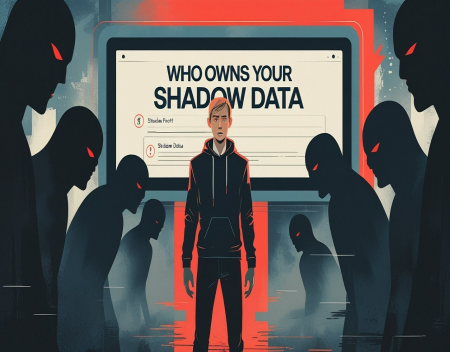
In the digital age, most conversations about privacy focus on the data people knowingly provide. Photos uploaded, posts shared, searches typed, and forms filled out. Yet a vast and growing category of information exists beyond direct consent or awareness. This is shadow data. It is the data created about individuals by others, by systems, and by inference. Shadow data raises a fundamental question that modern law and ethics have yet to answer clearly. Who owns information about you that you never knowingly gave away.
Shadow data includes information generated when someone else uploads a photo containing your face, syncs their contacts, tags your name, or shares location data that indirectly reveals your movements. It also includes inferred data, such as predictions about your interests, income level, health risks, or political leanings derived from algorithmic analysis. Even silence can create shadow data when systems infer behavior from absence rather than presence.
Unlike traditional personal data, shadow data is created without a direct relationship between the individual and the data collector. You may never use a platform, yet still appear in its datasets because friends, family, coworkers, or public cameras capture information that includes you. Opting out becomes nearly impossible. You cannot control what others share, and you often do not know what has been collected.
Ownership becomes ambiguous in this context. Platforms claim rights based on terms agreed to by the uploader, not the subject. The person who uploads a photo technically consents, even though the data contains other people. Companies treat inferred data as proprietary insights rather than personal information, arguing that predictions are created by the system rather than owned by the individual. This logic separates identity from control.
The consequences of shadow data ownership are significant. Facial recognition systems can identify people who never enrolled in them. Advertising profiles can be built on inferred traits without disclosure. Creditworthiness, employability, and risk assessments may incorporate shadow data that individuals cannot see or challenge. Decisions are made about people based on data they did not knowingly produce.
This lack of visibility undermines accountability. If you do not know what data exists about you, you cannot correct errors or contest misuse. If data is inferred, companies may claim there is nothing factual to dispute. The result is a system where individuals are affected by invisible information flows with little recourse.
Shadow data also raises ethical concerns about collective responsibility. One person’s consent can expose another. A single upload can compromise multiple people’s privacy. Traditional consent models assume individual control, but shadow data reveals privacy as relational. Protection cannot rely solely on personal choices when data is created socially.
From a legal perspective, existing frameworks struggle to keep pace. Many regulations focus on data provided directly by individuals. Inferred and third party generated data often falls into gray areas. Companies exploit these gaps, treating shadow data as less regulated and more valuable. The more invisible the data, the easier it is to extract and monetize.
Defenders argue that shadow data enables innovation and convenience. Social features work better when connections are mapped. Prediction improves when inference is allowed. While these benefits are real, they come at the cost of autonomy and fairness. Innovation built on unacknowledged data shifts power away from individuals and toward institutions that control analysis.
Resolving the question of ownership requires redefining personal data itself. Information that identifies, predicts, or influences a person should be treated as belonging, at least in part, to that person, regardless of how it was collected. Transparency about inferred data, rights to access and correction, and limits on secondary use are essential steps.
Shadow data thrives in the absence of visibility. Making it visible challenges entrenched business models and legal assumptions. The question of who owns your shadow data is ultimately about who controls your digital identity. Until that question is answered clearly, individuals will continue to live alongside data doubles they neither authorized nor govern.
Great experience with Computer Geek. They helped with my website needs and were professional, respon . . . [MORE].

Great, quick service when my laptop went into meltdown and also needed Windows 11 installed. Also ca . . . [MORE].
It was a great experience to working with you. thank you so much. . . . [MORE].
Thank you so much for great service and over all experience is good . highly recommended for all peo . . . [MORE].
We engaged The Computer Geeks in mid-2023 as they have a reputation for API integration within the T . . . [MORE].

The Rise of Automation in

Why Every Business Needs

ERP Systems for Small Bus