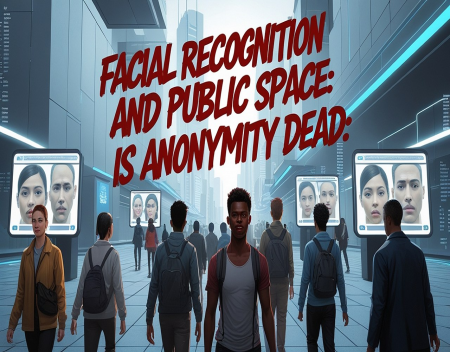
For much of modern history, public space offered a form of practical anonymity. People could walk down a street, enter a store, attend a protest, or sit in a park without being individually identified or recorded. While they might be seen by others, that observation was fleeting and largely untraceable. Facial recognition technology is changing this balance. As cameras become smarter and algorithms more accurate, the assumption of anonymity in public is rapidly eroding.
Facial recognition works by capturing an image of a face and comparing it against a database of known identities. Advances in machine learning have dramatically improved accuracy, even in crowded environments or poor lighting. What was once limited to controlled settings is now deployable at scale across cities, transportation hubs, and commercial spaces. Public space, once shared and transient, is becoming searchable and permanent.
The most immediate concern is consent. People generally choose whether to unlock a phone with their face or use biometric systems in private settings. In public, there is no such choice. A person can be identified, tracked, and analyzed without knowing it has happened. Opting out often requires avoiding entire areas of civic life, which is not a realistic option for most people.
Proponents argue that facial recognition enhances safety and efficiency. It can help locate missing persons, identify suspects, and streamline access to services. In theory, these uses are narrow and beneficial. In practice, the same infrastructure can be repurposed easily. A system designed to find one person can be used to monitor many. Function creep is not a hypothetical risk. It is a documented pattern.
Accuracy is another major issue. Facial recognition systems have shown uneven performance across different demographics. Errors disproportionately affect certain racial and ethnic groups, leading to false identification and unjust consequences. In public spaces, where stakes include detention, questioning, or surveillance, these errors are not minor technical flaws. They are civil liberties concerns.
Beyond accuracy lies a deeper social impact. Anonymity in public enables experimentation, dissent, and self expression. It allows people to explore ideas, identities, and affiliations without permanent records. When facial recognition removes that anonymity, behavior changes. People self censor. Protest participation declines. Social interactions become cautious. The chilling effect is subtle but powerful.
Facial recognition also shifts the power dynamic between citizens and institutions. Those who control the technology gain the ability to observe and analyze populations continuously. Individuals, meanwhile, have limited visibility into how they are being watched or how long data is retained. There is often no clear process to challenge misuse or correct errors. This asymmetry undermines democratic accountability.
Commercial use adds another layer of concern. Retailers use facial recognition to track customer behavior, identify repeat visitors, or flag perceived risks. Advertisers can tailor messages based on inferred demographics or emotions. Public space becomes a site of behavioral extraction rather than shared experience. People are no longer just present. They are being measured.
The question of whether anonymity is dead depends on policy choices being made now. Some cities and regions have restricted or banned facial recognition in public settings. Others have embraced it with minimal oversight. Technology alone does not eliminate anonymity. Unregulated deployment does.
Preserving anonymity does not require rejecting security or innovation. It requires setting clear boundaries. Strict limits on use, transparency about deployment, independent oversight, and meaningful avenues for redress are essential. Without these safeguards, facial recognition risks normalizing a society where identification is constant and unavoidable.
Public space has always been a foundation of civic life. It is where strangers coexist without obligation or scrutiny. If facial recognition becomes ubiquitous, that freedom may disappear quietly. Anonymity may not die in a single moment, but it can fade through normalization. The challenge is deciding whether society notices in time to protect it.
Great experience with Computer Geek. They helped with my website needs and were professional, respon . . . [MORE].

Great, quick service when my laptop went into meltdown and also needed Windows 11 installed. Also ca . . . [MORE].
It was a great experience to working with you. thank you so much. . . . [MORE].
Thank you so much for great service and over all experience is good . highly recommended for all peo . . . [MORE].
We engaged The Computer Geeks in mid-2023 as they have a reputation for API integration within the T . . . [MORE].
The History of the Intern
The Evolution of Personal
The Hidden Cost of Free A