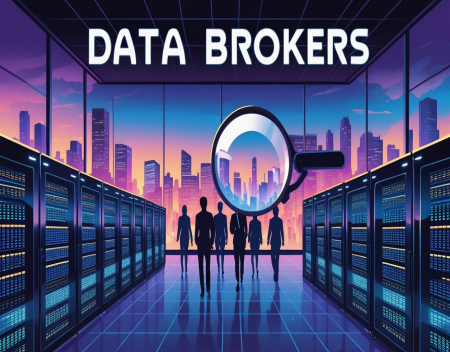
Most people think of their personal data as something they give away directly. They fill out a form, create an account, or click accept on a privacy policy. What often goes unnoticed is a massive parallel marketplace where personal information is bought, sold, and traded without direct interaction between individuals and buyers. This is the world of data brokers, an invisible economy built on profiling, aggregation, and resale of human lives reduced to data points.
Data brokers are companies that collect personal information from a wide range of sources, combine it into detailed profiles, and sell access to those profiles to other organizations. These sources include public records, loyalty programs, mobile apps, online purchases, location tracking, social media activity, and third party data sharing agreements. Individually, each data point may seem harmless. Together, they form a comprehensive picture of identity, behavior, and vulnerability.
Unlike social media platforms or apps, data brokers typically have no direct relationship with the people whose data they trade. Most individuals have never heard of the companies that hold thousands of attributes about them. This lack of visibility is central to the business model. If people do not know who is collecting their data, they cannot meaningfully object, opt out, or demand accountability.
The economy of personal information is vast and highly specialized. Some brokers focus on financial behavior. Others specialize in health related data, location histories, consumer preferences, or demographic inference. Profiles can include estimated income, family status, political interests, religious affiliation, health risks, and purchasing intent. These profiles are constantly updated, refined, and segmented into categories designed to predict future behavior.
Buyers range from advertisers and marketers to insurance companies, employers, political organizations, and government agencies. Advertisers use brokered data to target messages with precision. Insurers assess risk. Employers screen candidates. Political campaigns tailor persuasion strategies. Law enforcement and intelligence agencies may purchase data to bypass traditional oversight mechanisms. Each transaction adds value to the data while distancing it further from the individual it represents.
One of the most troubling aspects of the data broker industry is the absence of meaningful consent. People rarely know their data is being sold, let alone how often or to whom. Privacy policies may disclose sharing in vague language, but they do not convey the scale or permanence of data brokerage. Consent becomes theoretical rather than informed.
Errors and inaccuracies are another serious problem. Data broker profiles are often inferred rather than verified. A wrong assumption, outdated record, or mistaken identity can follow someone for years. These errors can affect credit, employment, insurance, and reputation. Yet correcting them is difficult. Many brokers offer no clear process for access or correction, and some are not legally required to do so.
The industry also amplifies inequality. Predictive profiling often disadvantages marginalized groups by labeling them as higher risk or lower value. Once categorized, individuals may face higher prices, fewer opportunities, or increased scrutiny. These outcomes are rarely visible or contestable, creating a feedback loop where disadvantage is reinforced by data.
Defenders of data brokerage argue that it supports economic efficiency and personalization. Targeted advertising funds free services. Risk modeling improves decision making. While these benefits exist, they rely on asymmetrical power. Companies profit from personal information while individuals bear the consequences without compensation or control.
Regulation has struggled to keep pace. Some regions have introduced data protection laws, but enforcement is uneven and loopholes remain. Data brokers often operate across jurisdictions, exploiting regulatory fragmentation. Transparency requirements are minimal, and penalties are often insufficient to deter abuse.
The invisible economy of personal information thrives on opacity. Its success depends on people not knowing how extensively they are tracked, categorized, and sold. Addressing this imbalance requires more than incremental reform. It requires recognizing personal data as an extension of the self, deserving of rights, visibility, and protection. Until then, data brokers will continue to profit quietly from lives they never meet, in a marketplace most people never see.
Great experience with Computer Geek. They helped with my website needs and were professional, respon . . . [MORE].

Great, quick service when my laptop went into meltdown and also needed Windows 11 installed. Also ca . . . [MORE].
It was a great experience to working with you. thank you so much. . . . [MORE].
Thank you so much for great service and over all experience is good . highly recommended for all peo . . . [MORE].
We engaged The Computer Geeks in mid-2023 as they have a reputation for API integration within the T . . . [MORE].
The Evolution of Personal
The Hidden Cost of Free A

The Psychology of Notific