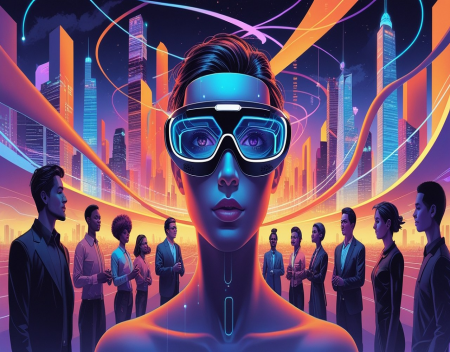
For most of human history, physical space has been understood as something stable, shared, and objective. A street, a room, or a city existed the same way for everyone who experienced it. While individuals might interpret spaces differently, the underlying reality remained constant. However, the rise of augmented reality is beginning to challenge this assumption in profound ways. With technologies like Apple Vision Pro and platforms such as Pokémon GO, digital layers are being placed directly onto the physical world, transforming how we perceive and interact with our surroundings.
Augmented reality, often referred to as AR, does not replace the physical world but enhances it by overlaying digital information, images, and experiences onto real environments. At first glance, this may seem like a simple extension of existing technologies, similar to how smartphones provide information about locations or objects. But AR goes much further. It integrates digital content into the fabric of physical space itself, creating environments that can be personalized, dynamic, and fundamentally different from one person to another.
This personalization is where the concept of “objective space” begins to break down. In an AR-enabled world, two people standing in the same location may see entirely different things. One person might see advertisements, navigation cues, or virtual art installations, while another sees something completely different—or nothing at all. The physical environment becomes a shared foundation, but the experienced reality diverges based on software, preferences, and permissions. Space is no longer a single, consistent experience, but a layered and individualized one.
The implications of this shift are far-reaching. One major impact is on how meaning is assigned to places. Traditionally, landmarks and public spaces derive significance from shared cultural recognition. A statue, a monument, or a storefront has a relatively fixed identity. With AR, these meanings can be altered or replaced entirely. A historical monument might be overlaid with additional context, alternative narratives, or even entirely fictional elements. While this can enrich understanding, it also raises questions about authority and authenticity. Who decides what version of reality is displayed, and whose perspective takes precedence.
Commercial interests are likely to play a significant role in shaping augmented spaces. Just as online platforms are driven by advertising, AR environments may become new frontiers for digital marketing. Imagine walking down a street where storefronts are enhanced with personalized promotions, or where empty walls are filled with targeted ads visible only to you. This could make physical space feel more interactive and useful, but it could also lead to a kind of sensory saturation where every surface becomes a potential channel for influence. The boundary between public space and commercial space becomes increasingly blurred.
Another consequence is the potential fragmentation of shared experiences. Part of what makes physical spaces meaningful is the fact that they are experienced collectively. People gather in the same places, see the same sights, and participate in the same environment. AR introduces the possibility that these shared experiences will become less common. Social interactions may be influenced by what each person is seeing through their device, creating subtle divides even when people are physically together. The idea of a common “reality” becomes harder to maintain when perception itself is customizable.
There are also deeper philosophical questions about perception and truth. If reality can be augmented, filtered, and altered in real time, how do we define what is real. Is the physical world still the primary reference point, or does the augmented layer become equally significant. Over time, people may begin to rely more on digital enhancements than on direct sensory experience, especially if those enhancements provide additional context or convenience. This could shift the balance between objective observation and mediated perception, making it more difficult to distinguish between what is inherently present and what has been added.
Despite these concerns, augmented reality also offers remarkable opportunities. It can enhance education by providing interactive, context-rich information in real-world settings. It can improve navigation, accessibility, and safety by delivering real-time guidance and alerts. It can also enable new forms of art and expression, turning entire cities into dynamic canvases. The technology itself is not inherently problematic; the challenge lies in how it is implemented and governed.
To navigate this new landscape, there will need to be discussions about standards, ethics, and user control. Individuals may need the ability to choose what layers of reality they engage with, and there may need to be protections against intrusive or manipulative content. Transparency will be key, ensuring that users understand when and how their perception is being altered.
Ultimately, augmented reality represents a shift from a world defined by shared physical space to one shaped by layered, subjective experiences. Objective space, as it has traditionally been understood, may not disappear entirely, but it will no longer be the sole framework through which reality is experienced. Instead, it will become the foundation for a new kind of environment—one where reality is not just observed, but continuously constructed.
In this emerging world, the question is not simply what space is, but who controls how it is seen. And as augmented reality continues to evolve, that question will become increasingly central to how we understand both technology and ourselves.
Great experience with Computer Geek. They helped with my website needs and were professional, respon . . . [MORE].

Great, quick service when my laptop went into meltdown and also needed Windows 11 installed. Also ca . . . [MORE].
It was a great experience to working with you. thank you so much. . . . [MORE].
Thank you so much for great service and over all experience is good . highly recommended for all peo . . . [MORE].
We engaged The Computer Geeks in mid-2023 as they have a reputation for API integration within the T . . . [MORE].

CRM Software Explained
The Future of Digital Pay

How Technology Is Changin