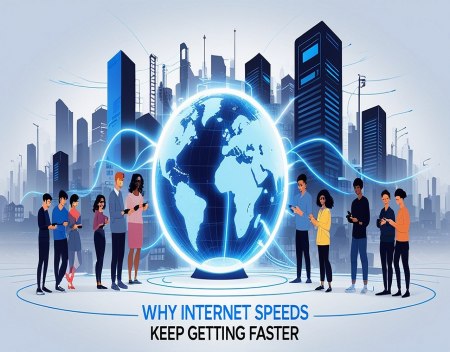
Not long ago, connecting to the internet meant listening to the familiar sounds of a dial-up modem while hoping nobody picked up the telephone. Downloading a single song could take several minutes, and streaming high-quality video was practically impossible. Today, many households enjoy internet connections capable of downloading entire movies in just a few minutes, while businesses routinely operate on multi-gigabit fiber connections. As internet providers continue advertising faster and faster speeds, many people wonder why these improvements keep happening and whether we truly need them.
The simple answer is that our online habits have changed dramatically. Every year, the amount of data we consume increases, and internet infrastructure must evolve to keep up with growing demand.
One of the biggest reasons internet speeds continue increasing is video streaming. Streaming services have become one of the primary ways people consume entertainment, replacing DVDs, cable television, and even movie rentals. Years ago, standard-definition video required relatively little bandwidth. Today, Full HD (1080p) is considered the minimum by many viewers, while 4K Ultra HD has become increasingly common. Some streaming platforms are already experimenting with 8K content, which requires significantly more data.
A household with multiple family members streaming different shows simultaneously can quickly consume hundreds of megabits per second. Faster internet ensures everyone can enjoy smooth, buffer-free viewing without competing for bandwidth.
Remote work has also transformed internet usage. Millions of employees now work from home either full-time or part-time, relying on video conferencing, cloud storage, remote desktop software, and online collaboration tools throughout the day. Unlike traditional web browsing, these applications require stable connections with strong upload speeds as well as fast downloads.
This shift has encouraged internet providers to expand fiber networks that offer symmetrical upload and download speeds, making remote work more efficient and reliable.
Cloud computing is another major driver of increasing internet speeds. Instead of storing all files and software locally, many individuals and businesses now rely on cloud-based services for document storage, backups, email, accounting, customer management, and countless other tasks.
Every time a document synchronizes, a photo uploads automatically, or software accesses cloud resources, data travels across the internet. As more applications move online, demand for faster and more reliable connections continues growing.
Online gaming has also evolved considerably. While older games required relatively little bandwidth, modern titles frequently download updates that are tens or even hundreds of gigabytes in size. New game installations often exceed 100 GB, making faster download speeds highly desirable.
Competitive multiplayer gaming also depends on low latency and stable connections. Although higher download speeds don't necessarily reduce lag, improvements in network infrastructure often accompany higher-speed internet services, creating a better overall gaming experience.
Smart homes are placing additional demands on residential internet connections. Many households now contain dozens of connected devices, including smart televisions, security cameras, voice assistants, thermostats, doorbells, lighting systems, appliances, gaming consoles, tablets, smartphones, and laptops.
Each device may use only a small amount of bandwidth individually, but together they create constant internet activity. Faster connections ensure these devices operate smoothly without interfering with one another.
Artificial intelligence is becoming another important factor. AI-powered applications frequently communicate with cloud servers to generate text, create images, analyze documents, translate languages, or answer complex questions. While some AI processing now occurs directly on personal devices, many advanced models still rely heavily on cloud computing.
As AI becomes integrated into productivity software, search engines, education, healthcare, and business applications, internet traffic generated by AI services is expected to grow substantially.
Businesses also require faster internet than ever before. Large organizations routinely transfer enormous datasets, conduct high-definition video meetings, perform cloud backups, manage remote employees, and operate cloud-based software platforms. Downtime or slow connections can reduce productivity and increase operational costs.
To support these needs, internet providers continue investing in faster backbone infrastructure capable of carrying massive amounts of data across cities, countries, and continents.
Technology itself has also improved significantly. Modern fiber optic networks transmit information using pulses of light instead of electrical signals carried through traditional copper cables. Fiber can transport vastly greater amounts of data over longer distances while maintaining exceptional reliability and low latency.
Even cable internet has advanced considerably through newer technologies that allow providers to deliver much higher speeds over existing infrastructure than was previously possible.
Wireless internet continues improving as well. Each new generation of Wi-Fi technology increases network capacity, supports more connected devices, and delivers faster data transfer within homes and businesses. Likewise, cellular technologies such as 5G—and eventually 6G—provide mobile users with performance that rivals some wired broadband connections.
Interestingly, these wireless technologies often depend on fiber infrastructure behind the scenes. Cellular towers require high-capacity fiber connections to carry the tremendous amount of data generated by smartphones and other mobile devices.
Software updates have become another reason for increasing internet speeds. Operating systems, security patches, applications, and games receive frequent updates that are often much larger than in previous years. Downloading these updates quickly minimizes interruptions while helping users stay protected against cybersecurity threats.
Content creation has also expanded dramatically. Millions of people now upload videos to streaming platforms, participate in live broadcasts, share high-resolution photographs, host podcasts, and collaborate on creative projects online. These activities place greater emphasis on upload speeds, encouraging providers to offer faster symmetrical fiber services.
Education has similarly evolved. Online classrooms, virtual laboratories, cloud-based learning platforms, and interactive educational tools all require dependable broadband connections. Students frequently participate in live video lessons while downloading assignments and accessing cloud resources simultaneously.
Healthcare is becoming increasingly connected as well. Telemedicine appointments, remote patient monitoring, digital medical imaging, and AI-assisted diagnostics depend on reliable, high-speed internet connections that can securely transmit sensitive information without delays.
One question people often ask is whether extremely fast internet is truly necessary. For someone living alone who only checks email and browses websites, a modest broadband connection may still be perfectly adequate. However, modern households rarely use the internet that way.
Today's average family may have several people streaming different videos, participating in video calls, downloading software updates, backing up photos to the cloud, playing online games, and operating dozens of smart home devices—all at the same time. As digital lifestyles continue expanding, faster internet becomes increasingly valuable.
Another reason internet speeds keep improving is competition. Internet Service Providers constantly compete by offering faster plans, better reliability, and more attractive pricing. This competition encourages ongoing investment in infrastructure, benefiting consumers through improved performance and broader availability of high-speed services.
Looking ahead, internet demand is unlikely to slow. Emerging technologies such as virtual reality, augmented reality, autonomous vehicles, smart cities, industrial automation, holographic communication, and increasingly sophisticated AI systems will require even greater bandwidth and lower latency.
Many experts believe that today's gigabit internet connections may eventually seem as ordinary as broadband does today.
The continued growth of internet speeds reflects more than advances in technology—it reflects the changing way we live, work, learn, and communicate. Every new digital service places additional demands on our networks, encouraging providers to build faster, more capable infrastructure.
As fiber networks expand, wireless technologies mature, and cloud services continue growing, internet speeds will almost certainly keep increasing. What once seemed unimaginably fast quickly becomes the new normal, ensuring the internet remains ready to support the innovations of tomorrow.
Great experience with Computer Geek. They helped with my website needs and were professional, respon . . . [MORE].

Great, quick service when my laptop went into meltdown and also needed Windows 11 installed. Also ca . . . [MORE].
It was a great experience to working with you. thank you so much. . . . [MORE].
Thank you so much for great service and over all experience is good . highly recommended for all peo . . . [MORE].
We engaged The Computer Geeks in mid-2023 as they have a reputation for API integration within the T . . . [MORE].

The Browser Wars Revisite

The Rise and Fall of Flas
The History of the Intern