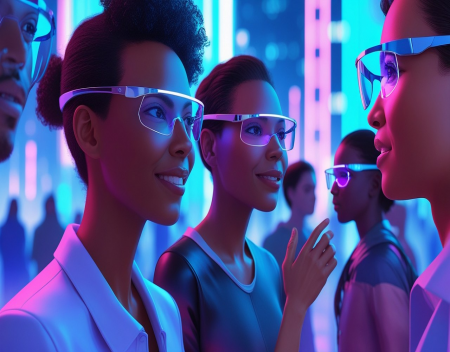
For more than a decade, the smartphone has been the defining technology of modern life. It is our map, our camera, our wallet, our social hub, and our primary connection to the digital world. But as augmented reality technology rapidly advances, many technologists predict that smartphones may eventually be replaced—or at least overshadowed—by AR glasses. Instead of looking down at screens, we may soon see digital information layered directly onto the physical world. This shift raises a profound question: what happens to society, behavior, and identity when screens disappear and reality itself becomes the interface?
The promise of AR glasses lies in seamless integration. Rather than pulling a device from your pocket, information would appear naturally in your field of vision. Directions could hover over the road ahead. Names and context could appear during conversations. Notifications might fade into view without demanding full attention. In theory, this would make technology less intrusive, allowing users to stay engaged with the real world while still accessing digital tools. The post-screen era is often marketed as a more human-centered evolution of computing.
However, replacing smartphones with AR glasses would not simply be a hardware upgrade. It would fundamentally reshape how people experience reality. When digital content becomes omnipresent and persistent, the boundary between the physical and virtual worlds begins to blur. Every environment could be customized, filtered, or enhanced. Advertisements might follow you down the street. Public spaces could look radically different depending on who is viewing them. Reality itself could become subjective, shaped by software preferences and corporate platforms.
One of the most immediate social impacts would be on attention and presence. Smartphones already fragment focus, pulling users away from their surroundings. AR glasses could either solve this problem or worsen it dramatically. On one hand, hands-free, glance-based interaction might reduce compulsive checking and scrolling. On the other, constant visual overlays could create a state of perpetual distraction. When information is always in your line of sight, the mind may never fully rest. Silence and mental downtime could become even rarer than they are today.
Privacy concerns would also intensify. AR glasses rely on cameras, sensors, and continuous environmental scanning to function effectively. This means that users—and potentially the companies behind the devices—would be constantly collecting data about the world and the people in it. Facial recognition, object tracking, and location mapping could become default features. Even those who choose not to wear AR glasses might still be captured by others’ devices, raising serious questions about consent in public spaces.
The workplace would undergo major changes as well. AR glasses could dramatically increase productivity by providing real-time instructions, remote assistance, and contextual data. Surgeons could see patient information while operating. Technicians could receive step-by-step overlays during repairs. Office workers could attend virtual meetings without screens, interacting with floating documents and avatars. At the same time, this could lead to heightened surveillance and performance monitoring. Employers might track gaze, attention, and efficiency in ways that feel invasive, blurring the line between support and control.
Social interaction would also be transformed. AR has the potential to enhance communication through shared virtual experiences, translations, and accessibility features. People could see captions during conversations or visual cues that aid understanding. Yet there is also the risk of social fragmentation. If individuals are viewing different layers of reality, shared experiences may erode. Eye contact could lose meaning if it is unclear what someone is truly focusing on. Authentic connection might be challenged by invisible interfaces mediating every interaction.
There is also a deeper psychological question at the heart of the post-screen era. When reality becomes editable, what happens to our sense of truth? Filters and digital enhancements could make the world more beautiful, more informative, or more comforting—but also less honest. Just as social media filters reshape self-image, AR overlays could reshape how people perceive cities, nature, and even other human beings. The temptation to escape into curated realities may grow stronger, especially if the physical world feels overwhelming or disappointing.
Despite these concerns, it is unlikely that AR glasses will fully replace smartphones overnight. More realistically, there will be a long transition period in which both coexist. Smartphones may become secondary devices, used for tasks requiring precision or privacy, while AR glasses handle ambient computing. The outcome will depend not only on technological capability, but on cultural norms, regulation, and public resistance or acceptance.
The post-screen era offers enormous potential, but it also carries significant risks. If AR glasses become the next dominant platform, society will need to confront questions about attention, privacy, inequality, and the nature of shared reality itself. The disappearance of screens does not mean the disappearance of influence. In many ways, it could make technology more powerful than ever—because when it is everywhere, it is easier to forget it is there at all.
The challenge ahead is not simply to build better AR glasses, but to decide what kind of world we want to see when we put them on.
Great experience with Computer Geek. They helped with my website needs and were professional, respon . . . [MORE].

Great, quick service when my laptop went into meltdown and also needed Windows 11 installed. Also ca . . . [MORE].
It was a great experience to working with you. thank you so much. . . . [MORE].
Thank you so much for great service and over all experience is good . highly recommended for all peo . . . [MORE].
We engaged The Computer Geeks in mid-2023 as they have a reputation for API integration within the T . . . [MORE].

CRM Software Explained

The Future of Digital Pay

How Technology Is Changin