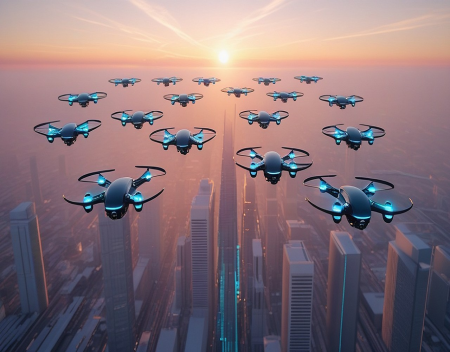
Drones have gone from being relatively expensive pieces of specialized equipment to becoming common technology. They are now used for photography, surveying, agriculture, construction, inspections, emergency response, delivery, and many other applications.
But the next major step in drone technology is not simply making drones smaller, faster, or capable of carrying heavier cameras.
It is making them autonomous.
An autonomous drone can use sensors, cameras, GPS, artificial intelligence, and onboard computers to navigate and perform tasks with limited or no direct control from a human operator.
Instead of someone constantly controlling every movement, the drone can determine where it needs to go, avoid obstacles, collect information, and return to its starting point on its own.
This could dramatically expand what drones are capable of doing.
What Is an Autonomous Drone?A traditional drone is usually controlled by a person using a remote controller or smartphone.
An autonomous drone operates differently.
It can be programmed with a destination, route, or specific task and then use onboard technology to complete that task.
For example, a drone might be instructed to inspect a particular section of a bridge. It could fly to the bridge, follow a predetermined route, use cameras to examine the structure, record the results, and return to its launch location.
The operator may still monitor the flight, but doesn't necessarily need to control every movement.
The more advanced the system becomes, the more decisions the drone can potentially make by itself.
Artificial Intelligence Is Changing DronesArtificial intelligence is one of the technologies driving the growth of autonomous drones.
A drone can use AI to analyze information from cameras and other sensors while it is flying.
It might recognize buildings, vehicles, people, trees, power lines, or other obstacles.
This allows the drone to react to its environment instead of simply following a predetermined route.
For example, if a tree has fallen across the planned flight path, an autonomous drone could potentially recognize the obstruction and calculate another route.
That is much more sophisticated than simply telling a drone to fly from point A to point B.
Autonomous Drones in AgricultureAgriculture is an area where autonomous drones could become particularly valuable.
Farmers can use drones to monitor crops, inspect fields, identify areas suffering from disease or lack of water, and collect aerial imagery.
An autonomous drone could potentially fly over a field on a regular schedule and collect consistent information without requiring a pilot to manually control the aircraft.
AI could then analyze the images and identify areas that require attention.
Instead of treating an entire field in exactly the same way, farmers could potentially use this information to apply water, fertilizer, or other treatments more precisely.
This could save resources and improve crop management.
Inspections Become EasierMany industries need to inspect large or difficult-to-reach structures.
Bridges, towers, roofs, pipelines, wind turbines, solar farms, and electrical infrastructure all require regular inspection.
Traditionally, inspections may require workers to climb structures, use lifts, or employ helicopters.
Drones can already make many of these jobs safer.
Autonomous drones could take the technology further by performing routine inspections with minimal human involvement.
A drone could follow the same inspection route repeatedly, allowing companies to compare images and measurements over time.
This could make it easier to identify gradual deterioration before it becomes a serious problem.
Search and RescueAutonomous drones could also be extremely useful during emergencies.
After a natural disaster, finding people quickly can be difficult. Roads may be blocked, buildings may be damaged, and large areas may need to be searched.
A drone can cover much more ground than a person on foot.
An autonomous system could search designated areas using cameras, thermal sensors, or other equipment.
AI could potentially help identify people or signs of activity and alert emergency responders.
Multiple drones could also work together to cover a large area.
This could provide emergency teams with valuable information without immediately putting additional people into dangerous environments.
Delivery DronesAutonomous delivery is another area attracting significant attention.
Instead of a person driving a vehicle to deliver a small package, an autonomous drone could potentially transport the package directly to the customer's location.
This could be particularly useful for urgent deliveries such as medical supplies.
There are still major challenges involving regulations, weather, airspace, battery life, safety, and operating over populated areas.
However, as autonomous technology improves, drones could eventually become an important part of certain delivery networks.
Drones Working TogetherThe future may involve groups of autonomous drones rather than individual machines.
Multiple drones could potentially communicate with each other and divide a task among themselves.
For example, a large area could be divided into sections, with each drone responsible for searching a particular area.
This concept is sometimes referred to as drone swarming.
The drones could potentially coordinate their movements without requiring a human operator to control each one individually.
Such systems could have applications in agriculture, mapping, environmental monitoring, disaster response, and infrastructure inspection.
The Challenge of Battery LifeOne of the biggest limitations facing autonomous drones is still the battery.
Flying requires a considerable amount of energy, particularly when a drone is carrying cameras, sensors, and other equipment.
An autonomous drone is only useful if it can stay in the air long enough to complete its mission.
Improvements in batteries, motors, lightweight materials, and energy management will therefore be important.
Future systems may also use automated charging stations.
A drone could complete part of a mission, return to a charging station, recharge itself, and then continue working.
This could allow fleets of drones to operate for much longer periods without human intervention.
Weather and Unexpected ConditionsAutonomous drones also have to deal with the real world.
Wind, rain, snow, fog, extreme temperatures, birds, buildings, power lines, and other aircraft can all create problems.
A human pilot can sometimes make a quick judgment when conditions change.
An autonomous drone needs software capable of making those decisions.
This is one of the reasons autonomous flight is much more complicated than simply programming a drone to follow GPS coordinates.
The system needs to understand what is happening around it and determine whether continuing the mission is safe.
Safety and RegulationAs autonomous drones become more common, safety will become increasingly important.
A drone operating without constant human control must be able to avoid people, buildings, aircraft, and other hazards.
There are also questions about privacy and surveillance.
A drone equipped with high-resolution cameras can collect enormous amounts of information from the air. Regulations and responsible operating practices will therefore be important as the technology becomes more widespread.
Different countries and jurisdictions also have rules governing where drones can fly, how high they can operate, and when a human operator must be involved.
The Future of Autonomous DronesThe combination of AI, improved sensors, better batteries, and more powerful onboard computers could make autonomous drones considerably more capable.
Instead of simply following instructions, future drones may be able to understand objectives.
An operator might say that a particular building needs to be inspected, and the drone could determine how to accomplish the task.
It could plan its route, identify areas requiring closer inspection, record the results, and return when the job is finished.
This would represent a significant shift from remotely controlled aircraft to intelligent robotic systems.
Final ThoughtsAutonomous drones are becoming much more than flying cameras.
They are evolving into robotic platforms capable of navigating environments, collecting information, analyzing what they see, and performing increasingly complicated tasks.
Agriculture, construction, infrastructure inspection, emergency response, environmental monitoring, and delivery could all benefit from the technology.
There are still significant challenges to overcome, particularly around battery life, safety, weather, privacy, regulation, and reliable AI decision-making.
But the basic direction is clear.
Today's drone often requires a person to control it.
Tomorrow's drone may simply need to be told what needs to be done.
As autonomous technology continues to improve, fleets of intelligent drones could become an important part of how we monitor, inspect, protect, and manage the world around us.
Great experience with Computer Geek. They helped with my website needs and were professional, respon . . . [MORE].

Great, quick service when my laptop went into meltdown and also needed Windows 11 installed. Also ca . . . [MORE].
It was a great experience to working with you. thank you so much. . . . [MORE].
Thank you so much for great service and over all experience is good . highly recommended for all peo . . . [MORE].
We engaged The Computer Geeks in mid-2023 as they have a reputation for API integration within the T . . . [MORE].

The Rise and Fall of Flas

The History of the Intern

The Evolution of Personal