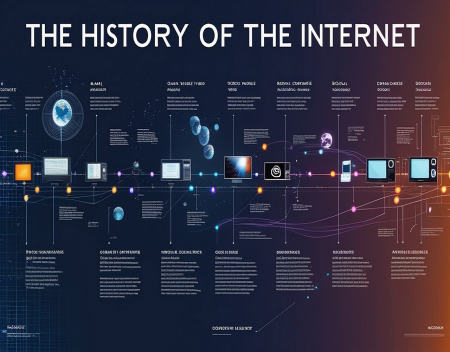
The internet is one of the most influential inventions in modern history. It connects billions of people, allows businesses to operate globally, provides instant access to information, and supports everything from online banking to entertainment and artificial intelligence. Today, it is difficult to imagine daily life without email, websites, video calls, and online services.
However, the internet did not appear overnight. It developed over several decades through advances in computer networking, communications technology, and international collaboration. What began as a research project connecting a small number of computers eventually grew into a worldwide network that transformed nearly every aspect of modern society.
Understanding the history of the internet helps explain how this technology developed and why it continues to shape the future.
The Early Foundations of Computer NetworkingDuring the 1950s and 1960s, computers were large, expensive machines primarily used by universities, government agencies, and major organizations. These computers generally operated independently, and sharing information between different systems was difficult.
Researchers began exploring ways to connect computers so they could exchange information and share resources. One important concept was packet switching, a method of breaking data into smaller units called packets and sending them across a network.
Instead of requiring a dedicated communication channel for an entire transmission, packet switching allowed network resources to be shared efficiently. Packets could travel through available routes and be reassembled at their destination.
This approach became a fundamental building block of modern networking.
During the 1960s, researchers and government organizations in the United States supported projects aimed at developing reliable computer communications. The Advanced Research Projects Agency, known as ARPA, played a major role in funding the development of an experimental network that would eventually become known as ARPANET.
ARPANET: The Beginning of the InternetIn 1969, ARPANET connected its first computers at research institutions in the United States. The initial network was small, but it demonstrated that computers at different locations could communicate over a shared network.
One early milestone occurred when researchers attempted to send a message from a computer at the University of California, Los Angeles, to a computer at the Stanford Research Institute. The intended word was "LOGIN," but the system crashed after transmitting the first two letters. Even so, the experiment demonstrated that remote computer communication was possible.
ARPANET expanded during the following years, connecting more universities and research facilities. Email emerged as one of its most useful applications during the early 1970s, making it easier for researchers to communicate and collaborate.
The network was not yet the modern internet. It was one network among several developing systems, and different networks did not automatically communicate with one another.
The next major challenge was creating a common method for connecting these separate networks.
The Development of TCP/IPAs computer networking expanded, researchers needed a way for different networks and computer systems to exchange data reliably.
Vinton Cerf and Robert Kahn were central figures in the development of the Transmission Control Protocol and Internet Protocol, commonly known together as TCP/IP. These protocols established rules for breaking information into packets, addressing destinations, routing data, and managing communication between systems.
TCP/IP allowed independently operated networks to communicate through a common set of standards. This was a crucial step toward creating a network of networks.
On January 1, 1983, ARPANET adopted TCP/IP as its standard networking protocol. This transition is widely recognized as a major milestone in the development of the modern internet.
During the 1980s, other networks expanded as well. The National Science Foundation established NSFNET to connect research institutions and support academic computing. Its development helped broaden networking beyond the original ARPANET community.
As more networks adopted common standards, the internet grew into a larger and more interconnected system.
The World Wide Web Changes EverythingAlthough the internet existed before the 1990s, it was not yet easy for ordinary people to navigate. Many services required specialized software or technical knowledge.
That changed with the development of the World Wide Web.
In 1989, British computer scientist Tim Berners-Lee proposed a system for linking information through hypertext. Working at CERN, the European particle physics laboratory, he developed the core technologies that made the web possible, including HTML, HTTP, and the first web browser and web server.
The first website appeared in 1991. It explained the World Wide Web project and how people could use it.
The web provided a way to connect documents through clickable links, making it much easier to move between information sources. Rather than learning the details of separate networking services, users could navigate pages through a browser.
The release of graphical browsers, particularly Mosaic in 1993, helped make the web more accessible. Images, links, and a more approachable interface attracted growing numbers of users.
It is important to distinguish between the internet and the World Wide Web. The internet is the underlying global network infrastructure, while the web is a service that operates on it. Email, online gaming, and other applications can use the internet without being part of the web itself.
The Internet Goes Mainstream in the 1990sDuring the 1990s, internet access expanded rapidly beyond universities and research organizations.
Internet service providers began offering connections to households and businesses. Dial-up modems allowed users to connect through telephone lines, although speeds were slow compared with modern broadband.
Early internet users explored websites, joined discussion forums, exchanged email, and participated in online chat rooms. Search engines emerged to help people find information across a growing number of websites.
Commercial activity also expanded. Companies established websites to promote products, communicate with customers, and conduct business online. Online shopping services began changing how consumers discovered and purchased goods.
The growth of the internet created new industries and business opportunities. Technology companies developed browsers, search engines, online marketplaces, and communication services.
However, the early internet also faced limitations. Connections could be unreliable, websites were often basic, and users had to be careful about scams and security threats. Even so, the potential of a globally connected information system was becoming increasingly clear.
Broadband, Social Media, and the Mobile InternetDuring the 2000s, broadband connections gradually replaced dial-up for many households. Cable and DSL services offered faster speeds, making it more practical to download large files, watch online videos, and use interactive websites.
Websites also became more dynamic. Rather than simply reading information, users could create accounts, publish content, upload photographs, and interact with other people.
Social networking platforms helped transform the internet into a major part of everyday social life. Video-sharing services allowed anyone with a camera and an internet connection to publish content to a worldwide audience.
Smartphones then brought internet access into people's pockets. Mobile applications, wireless networks, and faster cellular connections made it possible to communicate, shop, navigate, and consume entertainment from almost anywhere.
The internet was no longer something people used only when sitting at a computer. It became an increasingly continuous part of daily life.
The Modern Internet: Cloud Computing and Artificial IntelligenceToday, the internet supports an enormous range of services. Cloud computing allows individuals and organizations to store information and run applications on remote infrastructure. Video streaming delivers entertainment on demand, while online collaboration tools allow people to work together across continents.
Connected devices have expanded the internet beyond computers and phones. Smart televisions, home security systems, vehicles, wearable devices, and industrial equipment can communicate over networks and exchange information.
Artificial intelligence is also changing how people use the internet. AI-powered systems can summarize information, translate languages, answer questions, generate content, and help automate complex tasks.
At the same time, the modern internet faces significant challenges. Cybercrime, misinformation, privacy concerns, online fraud, and unequal access remain important issues. Governments and technology companies continue debating how online services should be regulated and how personal information should be protected.
As internet infrastructure expands, energy consumption and the environmental impact of data centres are also receiving increased attention.
What Comes Next?The internet will continue evolving as new technologies become available. Faster fibre connections, satellite networks, improved wireless systems, and new networking technologies may expand access and improve performance.
Artificial intelligence could make online services more personalized and easier to use, while developments in cybersecurity may help protect users from increasingly sophisticated threats.
The Internet of Things may connect even more everyday objects, from household appliances to transportation systems. This could improve convenience and efficiency, but it will also increase the importance of security and responsible data management.
The future internet will likely be more capable and deeply integrated into everyday life. Its success, however, will depend not only on technological progress but also on trust, accessibility, privacy, and reliability.
Final ThoughtsThe history of the internet is a story of collaboration, experimentation, and continuous innovation. From early computer networking projects and ARPANET to TCP/IP, the World Wide Web, broadband, smartphones, cloud computing, and artificial intelligence, each stage has expanded what connected technology can accomplish.
What began as a specialized tool for researchers has become a global platform for communication, education, commerce, entertainment, and innovation.
The internet has changed how people live and work, creating opportunities that previous generations could scarcely imagine. Yet its development also reminds us that powerful technology brings responsibilities, including protecting privacy, improving security, and ensuring that more people can benefit from access.
The internet is no longer simply a tool we use occasionally. For much of the world, it has become essential infrastructure—and its next chapter is already being written.
Great experience with Computer Geek. They helped with my website needs and were professional, respon . . . [MORE].

Great, quick service when my laptop went into meltdown and also needed Windows 11 installed. Also ca . . . [MORE].
It was a great experience to working with you. thank you so much. . . . [MORE].
Thank you so much for great service and over all experience is good . highly recommended for all peo . . . [MORE].
We engaged The Computer Geeks in mid-2023 as they have a reputation for API integration within the T . . . [MORE].
The History of the Intern
The Evolution of Personal
The Hidden Cost of Free A