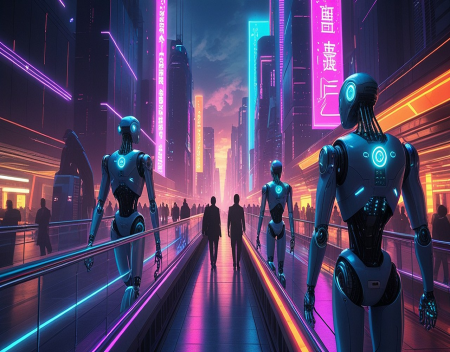
Robots have been a part of science fiction for generations, but today they are becoming an increasingly important part of the real world. Robots already build cars, move products through warehouses, explore dangerous environments, assist surgeons, and perform tasks that would be difficult or dangerous for humans.
However, the robots of today are only an early step toward what may be possible in the future.
Advances in artificial intelligence, sensors, batteries, computer processing, and robotics are allowing machines to become more capable and adaptable. Instead of simply repeating a programmed movement, future robots may be able to understand their surroundings, make decisions, learn from experience, and work alongside people.
The future of robotics could change everything from manufacturing and healthcare to transportation and everyday life.
Robots Are Becoming More IntelligentTraditional industrial robots are extremely good at performing specific tasks. A robot on a factory assembly line can repeat the same movement thousands of times with incredible accuracy.
The limitation is that these robots generally operate within controlled environments.
Artificial intelligence is beginning to change that.
Future robots could use cameras, microphones, sensors, and AI systems to understand what is happening around them. Instead of being programmed for every possible situation, they could interpret instructions and adapt to changing circumstances.
For example, rather than programming a robot to pick up one specific object from one specific location, an AI-powered robot could potentially be instructed to "clean up the table" and determine for itself what objects need to be moved and where they should go.
That represents a major change in what robots can do.
Humanoid RobotsOne of the most interesting areas of robotics is the development of humanoid robots.
Humanoid robots are designed with a body shape that resembles a human, including arms, hands, legs, and sometimes a human-like head.
There is a practical reason for this design. Much of the world has been built for humans. Doors, stairs, tools, vehicles, shelves, and workplaces are designed around the human body.
A robot with a similar physical structure could potentially operate in environments that were never specifically designed for robots.
Future humanoid robots could eventually perform tasks such as moving boxes, working in warehouses, assisting with household chores, performing basic maintenance, or helping in environments that are dangerous for humans.
Robots in HealthcareHealthcare is another area where robotics could have a major impact.
Robotic systems are already used to assist surgeons with certain procedures, allowing extremely precise movements.
Future medical robots could become even more capable.
Robots may eventually assist elderly people, help patients with physical rehabilitation, deliver supplies throughout hospitals, or provide assistance to people with disabilities.
Some robots could also operate in situations where human workers face significant risks, such as handling infectious materials or entering contaminated environments.
Robotics will not necessarily replace doctors and nurses. Instead, the technology may give healthcare professionals additional tools that allow them to spend more time on tasks requiring human judgment and interaction.
Robots in the HomeThe average home already contains simple robotic technology.
Robot vacuum cleaners and lawn-mowing robots are becoming increasingly common. These machines can navigate around obstacles and perform repetitive tasks without constant human supervision.
Future household robots could be considerably more capable.
Imagine a robot that can unload a dishwasher, pick up objects from the floor, prepare basic meals, do laundry, or help organize a home.
The challenge isn't simply teaching a robot how to perform one task. It is teaching a robot to understand a constantly changing environment.
A home is far less predictable than a factory. Furniture moves, pets run around, children leave objects on the floor, and people constantly change what they are doing.
AI-powered robotics could eventually make it possible for machines to handle this unpredictability.
Robots and Dangerous JobsRobots are particularly valuable when a job is dangerous.
Machines can enter burning buildings, inspect damaged structures, work around hazardous chemicals, explore mines, investigate disaster zones, and operate underwater.
Space exploration is another obvious example.
Sending robots into dangerous environments is often much safer and less expensive than sending humans.
As robots become more autonomous, they may be able to perform increasingly complicated missions without requiring constant instructions from people.
The Impact on JobsOne of the biggest questions surrounding robotics is what will happen to employment.
Robots can perform many repetitive physical tasks more efficiently than humans. As technology improves, some jobs may become automated.
Manufacturing, warehouse operations, transportation, agriculture, cleaning, and other industries could experience significant changes.
However, automation doesn't necessarily mean that humans will stop working.
New technologies have historically eliminated some jobs while creating others. The growth of robotics could increase demand for robot technicians, engineers, programmers, trainers, maintenance specialists, and other professionals.
The bigger challenge may be helping workers transition from jobs that are becoming automated into new roles.
Robots Working With HumansThe future of robotics isn't necessarily about replacing humans.
In many situations, the best solution may be humans and robots working together.
A robot could handle physically demanding or repetitive tasks while a human makes important decisions.
For example, a warehouse worker could use robots to transport heavy items while concentrating on tasks that require judgment and communication.
This concept is sometimes called collaborative robotics.
Instead of separating robots from people, future workplaces may be designed specifically around human-robot cooperation.
Robots Will Need Better BatteriesOne of the biggest limitations facing mobile robots is energy.
A robot can have excellent artificial intelligence and advanced sensors, but if its battery only lasts a short time, its usefulness is limited.
Future improvements in batteries and energy efficiency will therefore be extremely important.
Robots will need to operate for longer periods while remaining lightweight and relatively inexpensive.
Advances in battery technology could make a significant difference in everything from household robots to delivery machines and humanoid systems.
Robots Will Need to Understand the Real WorldThe physical world is incredibly complicated.
Humans effortlessly recognize objects, understand distances, predict movement, and adapt to unexpected situations.
Robots still struggle with many of these tasks.
Future progress in robotics will depend heavily on improving what is sometimes called machine perception.
Robots will need to understand not just what a camera sees, but what those objects mean and how they relate to one another.
A robot working in a kitchen, for example, needs to understand the difference between a glass, a dish, a sharp knife, a hot stove, and a fragile object.
This kind of understanding is essential if robots are going to operate safely around people.
The Importance of SafetyAs robots become more powerful, safety will become increasingly important.
A robot operating in a factory is already capable of causing serious injuries if something goes wrong. A future humanoid robot operating inside a home could potentially interact with people, pets, vehicles, tools, and other dangerous objects.
Developers will therefore need to ensure that robots can recognize potentially dangerous situations and behave appropriately.
Security will also matter. Connected robots could potentially be hacked if they are not properly protected.
The more capable robots become, the more important cybersecurity and safety controls will be.
The Future Could Be Very DifferentRobotics may eventually become as common as computers and smartphones are today.
Instead of thinking of robots as unusual machines found only in factories, people may encounter them everywhere.
There could be robots delivering packages, maintaining infrastructure, assisting healthcare workers, working on farms, cleaning buildings, helping elderly people, and performing household chores.
Some may look completely mechanical, while others may have humanoid designs.
The most important development may not be the physical robot itself, but the intelligence that allows it to understand and interact with the world.
Final ThoughtsThe future of robotics is difficult to predict, but it is clear that robots are becoming increasingly capable.
Artificial intelligence is giving machines better ways to understand their surroundings and make decisions, while improvements in sensors, batteries, motors, and computing are expanding what robots can physically accomplish.
Robots are unlikely to replace humans in every job or become the science-fiction machines often portrayed in movies. The more realistic future is probably one where robots become specialized tools that work alongside people and take over tasks that are repetitive, dangerous, physically demanding, or simply inconvenient.
The technology still has significant challenges to overcome, but the direction is clear.
Today's robots perform specific tasks. Tomorrow's robots may understand what we want them to accomplish and figure out how to do it themselves.
That could make robotics one of the most transformative technologies of the coming decades.
Great experience with Computer Geek. They helped with my website needs and were professional, respon . . . [MORE].

Great, quick service when my laptop went into meltdown and also needed Windows 11 installed. Also ca . . . [MORE].
It was a great experience to working with you. thank you so much. . . . [MORE].
Thank you so much for great service and over all experience is good . highly recommended for all peo . . . [MORE].
We engaged The Computer Geeks in mid-2023 as they have a reputation for API integration within the T . . . [MORE].

The Browser Wars Revisite

The Rise and Fall of Flas
The History of the Intern