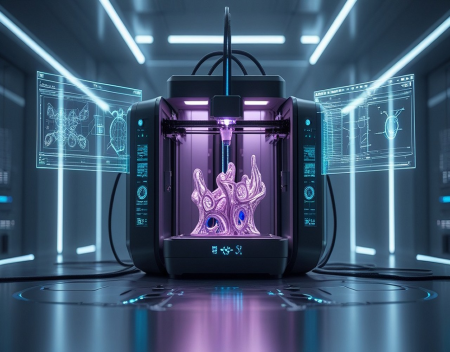
3D printing has gone from an interesting technology used mainly by engineers and hobbyists to a practical tool used in manufacturing, healthcare, construction, aerospace, and even space exploration. What was once an expensive and complicated process is becoming increasingly affordable and accessible.
Unlike traditional manufacturing, which often involves cutting, drilling, or machining material into a desired shape, 3D printing creates objects layer by layer from a digital design. This allows manufacturers to produce complicated shapes that would be difficult or impossible to create using conventional methods.
As 3D printers become faster, more accurate, and capable of working with a wider range of materials, the technology could have a major impact on how products are designed, manufactured, and delivered.
How 3D Printing WorksAt its simplest, 3D printing begins with a digital model created using computer-aided design software. The model is divided into hundreds or thousands of thin layers.
The printer then creates the object one layer at a time.
Different types of 3D printers use different techniques. Some melt plastic filament and build the object layer by layer. Others use lasers or light to harden liquid resin or fuse powdered materials.
The result is a physical object created directly from a digital file.
This basic concept has remained the same, but the technology surrounding it continues to improve.
Faster 3D PrintersOne of the biggest limitations of 3D printing has traditionally been speed.
Printing a relatively simple object could take hours, while larger or more complicated objects could take considerably longer.
New printing technologies are making the process much faster.
Higher printing speeds, improved motion systems, more powerful lasers, and better software are allowing manufacturers to produce parts more quickly.
As speed improves, 3D printing becomes more practical for large-scale manufacturing.
The future could see 3D printers producing products almost continuously rather than being used primarily for prototypes and small production runs.
More Advanced MaterialsAnother major development is the growing variety of materials that can be used in 3D printing.
Plastic remains one of the most common materials, but printers can also work with metals, ceramics, composites, resins, and other specialized materials.
Metal 3D printing is particularly important for industries such as aerospace and automotive manufacturing.
Future printers could work with increasingly advanced materials that offer greater strength, flexibility, heat resistance, and durability.
This could allow 3D-printed components to replace traditionally manufactured parts in many applications.
3D Printing in HealthcareHealthcare could become one of the most exciting areas for 3D printing.
Doctors and researchers are already using 3D printing to create customized medical devices, prosthetics, implants, and anatomical models.
Because every person's body is different, customized medical products can provide significant advantages.
A 3D printer can create a prosthetic or implant based on a patient's individual measurements.
Researchers are also exploring bioprinting, which involves using specialized materials and living cells to create biological structures.
The ultimate goal is to develop printed tissues and potentially functioning organs.
Although fully functional 3D-printed replacement organs remain a major scientific challenge, continued research could eventually make this technology possible.
3D-Printed HousesConstruction is another area where 3D printing could have a significant impact.
Large construction printers can deposit layers of concrete or other building materials to create walls and other structural components.
Instead of dozens of workers performing every stage of construction manually, automated systems could produce significant portions of a building.
This could potentially reduce construction time, material waste, and labour requirements.
3D printing could also make it easier to create unusual architectural designs that would be expensive to build using traditional methods.
The technology could eventually become particularly useful for producing affordable housing and rapidly constructing buildings after natural disasters.
3D Printing in Space3D printing could also change how astronauts operate in space.
Space missions are extremely expensive, and transporting every tool and replacement component from Earth is difficult.
Instead, astronauts could potentially carry a 3D printer and manufacture certain tools and replacement parts when needed.
This becomes even more interesting for future missions to the Moon and Mars.
A spacecraft or lunar base could potentially use locally available materials to manufacture certain components instead of transporting everything from Earth.
Researchers are already investigating ways to use materials such as lunar or Martian soil as part of future construction processes.
Personalized ProductsTraditional manufacturing works best when companies produce large numbers of identical products.
3D printing changes that equation.
Because each object can be produced directly from a digital file, manufacturers can create customized products without necessarily needing expensive molds or specialized machinery.
Customers could eventually order products designed specifically for them.
This could include customized footwear, medical devices, furniture, tools, automotive components, and other products.
Instead of choosing from a limited selection of standard products, consumers could increasingly receive products designed around their individual requirements.
Manufacturing Closer to the Customer3D printing could also change global supply chains.
Today, many products are manufactured in large factories and shipped around the world.
In the future, some products could be manufactured much closer to where they are needed.
A company could distribute digital design files rather than physical products. A local manufacturing facility could then print the item on demand.
This could reduce shipping requirements and the amount of inventory businesses need to keep in warehouses.
It could also make it easier to produce replacement parts for older products.
Less Waste3D printing has the potential to reduce manufacturing waste because many printing techniques use only the material required to create the object.
Traditional manufacturing can involve removing large amounts of material from a block of metal or plastic.
However, 3D printing is not automatically environmentally friendly.
Printers still consume electricity, and some printing materials can be difficult to recycle. Certain processes can also require support structures that become waste.
The environmental benefits will therefore depend heavily on the materials and printing methods being used.
Artificial Intelligence and 3D PrintingArtificial intelligence could make 3D printing even more powerful.
AI systems can help designers create optimized components based on specific requirements.
For example, an engineer could tell an AI system that a component needs to be lightweight but extremely strong. The software could generate unusual shapes designed to meet those requirements.
These designs can then be sent directly to a 3D printer.
This process could produce structures that human designers might never have considered.
AI could also monitor the printing process and identify problems while an object is being produced.
The Challenges AheadDespite its potential, 3D printing still faces several challenges.
Printing large objects can be slow, and industrial printers can be expensive. Material costs can also be significant.
Quality control is another concern. A printed component needs to be reliable, particularly when it is being used in an aircraft, automobile, medical device, or other safety-critical application.
There are also intellectual property concerns.
If someone owns a digital design file, it may be possible for that file to be copied and distributed without permission. This could create new challenges for manufacturers and designers.
The Future of 3D PrintingThe long-term future of 3D printing could be much bigger than simply producing plastic models.
We could see automated factories containing fleets of intelligent 3D printers producing products around the clock. Consumers could download customized designs and have them manufactured locally.
Medical professionals could produce increasingly sophisticated implants and prosthetics. Construction companies could print buildings more quickly. Space missions could manufacture tools and components far from Earth.
Eventually, 3D printing may become less of a specialized technology and more of a normal part of manufacturing.
Final Thoughts3D printing has already changed the way many businesses design and manufacture products, but its biggest impact may still be ahead.
Faster printers, stronger materials, artificial intelligence, robotics, and improved software are gradually removing many of the limitations that have held the technology back.
The most important change may be the shift from mass production to mass customization. Instead of manufacturing millions of identical products, businesses could increasingly produce products tailored to individual customers.
We may eventually reach a point where manufacturing becomes something that can happen almost anywhere—from a factory on Earth to a workshop in someone's home or even a future base on another planet.
3D printing is not going to replace every traditional manufacturing method, but it could become one of the most important manufacturing technologies of the future.
Great experience with Computer Geek. They helped with my website needs and were professional, respon . . . [MORE].

Great, quick service when my laptop went into meltdown and also needed Windows 11 installed. Also ca . . . [MORE].
It was a great experience to working with you. thank you so much. . . . [MORE].
Thank you so much for great service and over all experience is good . highly recommended for all peo . . . [MORE].
We engaged The Computer Geeks in mid-2023 as they have a reputation for API integration within the T . . . [MORE].

The Browser Wars Revisite

The Rise and Fall of Flas
The History of the Intern