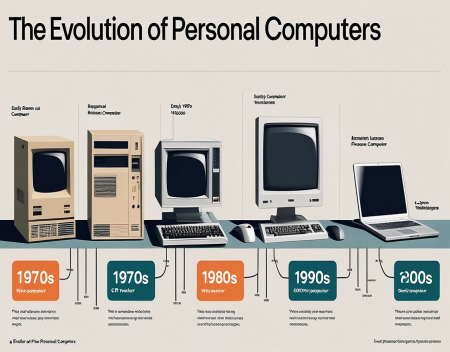
Personal computers have transformed the way people work, communicate, learn, and entertain themselves. What began as a collection of expensive, technically demanding machines used primarily by hobbyists and specialists has evolved into an essential part of everyday life. Modern computers can fit inside backpacks, operate powerful software, connect people across the globe, and perform tasks that once required entire rooms of equipment.
The evolution of personal computers is a story of technological breakthroughs, fierce competition, and changing consumer expectations. From the earliest home computers of the 1970s to today's powerful laptops and AI-capable desktops, each generation has made computing more accessible and more capable.
Understanding this history helps explain how computers became such an important part of modern society and offers clues about where the technology may be heading next.
The Early Days of Personal ComputingBefore personal computers became widely available, computers were generally large, expensive machines operated by businesses, universities, and government organizations. They often required specialized facilities and trained personnel, putting them beyond the reach of ordinary consumers.
That began to change during the 1970s, when advances in microprocessor technology made it possible to build smaller and more affordable computers.
Early machines such as the Altair 8800, introduced in 1975, attracted electronics enthusiasts and hobbyists. These systems were often sold as kits and required users to assemble components or write their own programs. They were far from user-friendly by modern standards, but they demonstrated that computing could become a personal activity rather than something reserved for large institutions.
The arrival of machines such as the Apple II in 1977 helped bring personal computing to a broader audience. With colour graphics, an accessible design, and software for practical tasks, the Apple II became an important part of the emerging home computer market.
During this period, personal computers were used for programming, simple games, education, and basic business applications. Although their capabilities were limited, they established the foundation for the industry that followed.
The Rise of IBM and MicrosoftThe introduction of the IBM Personal Computer in 1981 marked another major milestone. IBM was already a respected name in business computing, and its entry into the personal computer market helped establish PCs as serious tools for professional environments.
IBM's computer used an Intel processor and an operating system supplied by Microsoft. The architecture and software ecosystem surrounding IBM-compatible computers encouraged other manufacturers to develop competing systems.
Microsoft's MS-DOS became a major operating system for these machines, while Microsoft Windows later introduced a graphical environment that made computers easier for many people to use.
During the 1980s, personal computers became increasingly common in offices. Businesses used them for spreadsheets, word processing, accounting, databases, and document preparation.
Software such as Lotus 1-2-3 and early versions of Microsoft Excel helped demonstrate how computers could improve productivity. Instead of relying entirely on typewriters, calculators, and paper records, employees could create, edit, calculate, and organize information digitally.
The growing popularity of IBM-compatible PCs also encouraged competition, helping expand the range of available hardware and price points.
Windows and the Graphical User InterfaceEarly personal computers often relied on text commands. Users needed to know specific instructions to launch programs, manage files, and perform other tasks.
Graphical user interfaces changed that experience by allowing people to interact with visual elements such as windows, icons, menus, and buttons.
Apple helped popularize graphical computing with the Macintosh in 1984. Microsoft's Windows operating environment subsequently became a dominant part of the PC landscape, especially as Windows 95 brought a more integrated desktop experience to a large audience.
These developments made personal computers more approachable for people without technical backgrounds.
Instead of memorizing commands, users could navigate through menus, click icons, and move files using a mouse. Word processors, desktop publishing tools, educational software, and games became easier to access.
The graphical interface also helped establish many familiar elements of computing that remain in use today, including desktop layouts, taskbars, file folders, and application windows.
The Internet Changes EverythingDuring the 1990s, the growing availability of the internet transformed personal computers from largely standalone machines into communication and information platforms.
Dial-up modems allowed home users to connect to online services and websites through telephone lines. Although early connections were slow by modern standards, they opened access to email, online forums, digital libraries, and eventually electronic commerce.
Web browsers made it easier to explore the internet without needing specialized technical knowledge. As internet service became more widespread, computers became essential tools for communication, research, shopping, and entertainment.
The arrival of broadband connections improved speeds and allowed users to remain connected without tying up a telephone line.
This development also changed the software industry. Email programs, online games, digital downloads, and web-based services became increasingly important. Computers were no longer just tools for creating documents or running local applications; they had become gateways to a rapidly expanding digital world.
From Desktops to Laptops and Mobile ComputingFor many years, desktop computers were the standard choice for personal computing. They generally offered more performance for the money, larger displays, and easier hardware upgrades.
However, improvements in processor efficiency, batteries, and compact components gradually made portable computers more practical.
Laptops allowed people to work, study, and access information away from a fixed desk. As prices declined and performance improved, they became common among students, professionals, and households.
Later, smartphones and tablets introduced new forms of personal computing. These devices did not replace traditional PCs entirely, but they changed expectations about convenience and portability.
Today, many people use a combination of desktop computers, laptops, tablets, and smartphones. Files and services can be synchronized through cloud platforms, allowing users to move between devices with relatively little disruption.
The distinction between personal computers and other digital devices has consequently become less clear, even though traditional PCs remain important for demanding work, software development, gaming, and content creation.
Modern Computers: Faster, Smaller, and More PowerfulModern personal computers are dramatically more capable than their predecessors.
Multi-core processors, solid-state drives, large amounts of memory, and advanced graphics processors allow today's systems to handle complex workloads that would have overwhelmed early home computers.
A modern PC can edit high-resolution video, run sophisticated simulations, process enormous datasets, and deliver realistic three-dimensional graphics. Some computers also include specialized hardware designed to accelerate artificial intelligence tasks.
Solid-state drives have improved startup times and application responsiveness, while high-resolution displays offer sharper images and more accurate colours. Wireless networking, Bluetooth, and high-speed ports have also made connecting devices easier.
At the same time, computers have become more energy-efficient and compact. Small desktop systems can provide impressive performance without requiring the large cases and extensive cooling systems associated with some older machines.
However, greater complexity has introduced new challenges. Security threats, software compatibility, electronic waste, repairability, and rising hardware requirements all influence the modern computing experience.
Artificial Intelligence and the Next Generation of PCsArtificial intelligence is beginning to influence how personal computers operate.
AI-powered features can help users summarize documents, generate text, edit images, search for information, and automate repetitive tasks. Some applications rely primarily on cloud-based AI services, while others can perform selected tasks directly on a computer using local processing hardware.
Manufacturers are increasingly incorporating dedicated AI accelerators into processors and system designs. These components can handle certain AI workloads more efficiently than relying exclusively on a central processor.
Local AI processing may offer benefits such as lower latency and improved privacy for some tasks, although results depend on the software, hardware, and how information is handled.
Future personal computers may become more adaptive, offering assistance based on a user's workflow and making complex operations easier to perform. Voice interaction, natural-language search, and automated organization could become more common.
Nevertheless, traditional computing skills will remain valuable. Users will still need to understand their tools, evaluate AI-generated information, protect sensitive data, and make decisions about how technology should be used.
What Does the Future Hold?Personal computers are unlikely to disappear, but their design and role will continue to evolve.
Some systems may become more modular and repairable, while others will prioritize thin designs, long battery life, and highly integrated components. Cloud computing will continue to complement local hardware, allowing some demanding applications to run on remote servers rather than entirely on a user's machine.
Gaming, professional graphics, scientific computing, and AI development may drive demand for increasingly powerful systems. Meanwhile, many everyday users may find that affordable laptops and compact desktops already provide more performance than they need.
Future computers may also offer improved energy efficiency, stronger security protections, and better integration with smart-home devices and other connected technologies.
The most successful systems will likely balance performance, usability, security, affordability, and sustainability rather than focusing on raw processing power alone.
Final ThoughtsThe evolution of personal computers has taken us from expensive, complicated machines used by enthusiasts to powerful devices that support nearly every aspect of modern life.
Each major development—from the microprocessor and graphical user interface to the internet, portable computing, and artificial intelligence—has expanded what people can accomplish with a computer.
Despite the rise of smartphones and cloud services, personal computers remain essential because they provide flexibility, control, and the performance needed for many demanding tasks.
As technology continues to advance, computers will become more capable and increasingly integrated into everyday activities. Yet their fundamental purpose will remain the same: helping people create, communicate, solve problems, and turn ideas into reality.
The next chapter in personal computing may be powered by artificial intelligence, but it will build on decades of innovation that transformed the computer from a specialized machine into one of the most influential tools ever created.
Great experience with Computer Geek. They helped with my website needs and were professional, respon . . . [MORE].

Great, quick service when my laptop went into meltdown and also needed Windows 11 installed. Also ca . . . [MORE].
It was a great experience to working with you. thank you so much. . . . [MORE].
Thank you so much for great service and over all experience is good . highly recommended for all peo . . . [MORE].
We engaged The Computer Geeks in mid-2023 as they have a reputation for API integration within the T . . . [MORE].
The Evolution of Personal
The Hidden Cost of Free A
The Psychology of Notific