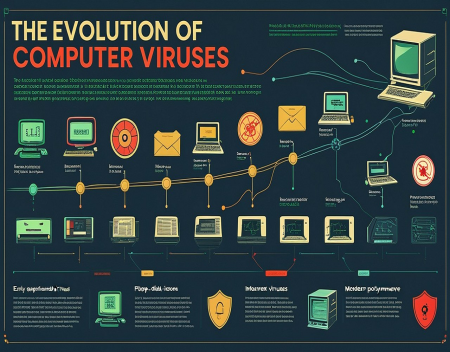
Computer viruses have been a threat to computers for decades, evolving from relatively simple experiments into sophisticated tools used by cybercriminals, organized crime groups, and state-sponsored attackers. As computers and networks have become more powerful and interconnected, malicious software has evolved alongside them.
Understanding the history of computer viruses helps explain how cybersecurity has changed and why protecting modern devices requires more than simply installing antivirus software.
The Early Days of Computer VirusesThe earliest computer viruses emerged when computers were becoming more widely used in universities, research institutions, and businesses. In the early days, many programs were created as experiments to explore how software could spread between machines.
One early example was the Creeper program, developed in the early 1970s for the ARPANET, a precursor to the modern internet. Creeper could move between compatible computers and display a message. It was not a conventional destructive virus, but it demonstrated that programs could spread across connected systems.
The term "computer virus" became more widely recognized in the 1980s as researchers studied self-replicating software. Unlike ordinary programs, a virus attaches itself to another program or file and spreads when that infected host is executed.
One of the most famous early examples was the Brain virus, which appeared in 1986. It infected floppy disks used by IBM-compatible personal computers. Although it was relatively limited compared with modern malware, Brain demonstrated that personal computers could be infected simply by exchanging physical media.
During this period, viruses often spread through floppy disks shared among friends, colleagues, and computer users. Since internet access was not yet widespread, physical distribution played a major role in their spread.
The Rise of Mass-Market MalwareAs personal computers became common in homes and offices during the late 1980s and 1990s, viruses became more widespread. Users frequently exchanged files and software, creating opportunities for infected programs to travel between computers.
Some viruses were designed to display messages, alter files, or interfere with normal computer operations. Others could corrupt data or make systems unusable.
The Michelangelo virus, discovered in the early 1990s, attracted significant public attention because it was programmed to damage data on a particular date. Widespread media coverage raised awareness of computer security, although predictions about the scale of its impact proved exaggerated.
The period also saw the development of antivirus software. Security companies began maintaining collections of known virus signatures, which could be used to identify and remove familiar threats.
However, this approach had a limitation: antivirus programs were most effective against threats they already knew about. New or modified viruses could sometimes avoid detection until security researchers developed appropriate updates.
The Internet Changes EverythingThe expansion of the internet during the 1990s and early 2000s fundamentally changed how malware spread.
Previously, attackers often depended on infected disks or files being physically exchanged. With email, websites, and network connections, malicious programs could reach thousands of potential victims much more quickly.
Email became a particularly effective distribution method. Some malware arrived as attachments disguised as documents, pictures, or other seemingly harmless files. Other attacks persuaded recipients to open an attachment by using an intriguing subject line or a message that appeared to come from someone they trusted.
The Melissa virus, which appeared in 1999, spread through Microsoft Word documents and used infected computers' email systems to send copies of itself to other people. It disrupted email services at numerous organizations and demonstrated how quickly malware could spread through trusted communication channels.
In 2000, the ILOVEYOU worm spread through email messages that encouraged recipients to open an attachment. Once activated, it could overwrite files and send copies of itself to other contacts.
Strictly speaking, a computer virus and a worm are different. A virus typically attaches to a host file or program, while a worm can spread independently across systems or networks. However, both are forms of malware, and their capabilities can overlap.
These incidents demonstrated that human behavior had become a critical part of computer security. Even sophisticated technology could not fully protect a system if users were persuaded to execute malicious files.
From Viruses to Ransomware and CybercrimeBy the 2000s, malware development increasingly became a business. Rather than creating malicious software simply to experiment or cause disruption, attackers began using it to steal information, obtain financial rewards, and gain unauthorized access to organizations.
Trojan horses became particularly common. A Trojan disguises itself as legitimate or useful software but performs malicious actions after installation. Unlike a traditional virus, it does not necessarily replicate itself.
Spyware and keyloggers were designed to monitor activity, capture keystrokes, collect credentials, or steal personal information. This allowed attackers to access online banking accounts, email accounts, and business systems.
Ransomware became one of the most damaging forms of modern malware. It can encrypt files or otherwise prevent access to systems, then demand payment for recovery. Some criminal groups also steal sensitive data before encrypting systems and threaten to publish it if the victim refuses to pay.
Major incidents have demonstrated how malware can affect hospitals, government agencies, manufacturers, and other critical organizations. The consequences can extend far beyond individual computers, disrupting essential services and causing significant financial losses.
Modern cybercrime groups may operate like businesses, dividing responsibilities among developers, access brokers, negotiators, and other participants. Some use ransomware-as-a-service arrangements, allowing less technically skilled criminals to use malware developed by others.
Polymorphic Malware and Evasion TechniquesAs antivirus software improved, malware authors developed ways to make their creations harder to detect.
Polymorphic malware changes aspects of its code or appearance as it spreads, making it more difficult for traditional signature-based detection to recognize every copy. Metamorphic malware can go further by rewriting substantial portions of its own code while preserving its functionality.
Other threats attempt to avoid detection by hiding inside legitimate processes, delaying malicious activity, or checking whether they are running inside a security research environment.
Some attackers rely on fileless techniques, which use legitimate system tools and memory-based execution rather than relying entirely on conventional malicious files stored on a disk. These methods can make investigations more challenging, although they do not necessarily leave a system without evidence of an attack.
Security software has responded by adding behavioral analysis, reputation systems, cloud-based threat intelligence, and endpoint detection and response tools. Instead of looking only for known virus signatures, these technologies also examine suspicious actions and relationships between events.
The Role of Artificial IntelligenceArtificial intelligence is beginning to influence both sides of the cybersecurity battle.
Security teams can use machine learning to analyze large volumes of activity, identify unusual behavior, prioritize alerts, and detect patterns that may indicate an attack. These systems can help organizations respond more quickly to emerging threats.
Attackers can also use AI tools to improve phishing messages, automate parts of their operations, and adapt their techniques. More convincing messages may be easier to produce at scale, making it harder for recipients to identify scams based on poor spelling or awkward wording alone.
However, AI does not make every attack sophisticated or successful. Many security incidents still result from familiar problems, including stolen passwords, unpatched software, excessive permissions, and users being tricked into trusting malicious messages.
The underlying lesson remains the same: technology changes, but attackers continue looking for weaknesses in people, software, and security procedures.
How to Protect Yourself TodayAlthough modern malware is more sophisticated than the viruses of the 1980s, many effective protective measures remain straightforward.
Keep software updated. Operating systems, browsers, applications, and internet-connected devices should receive security updates promptly. Updates often fix vulnerabilities that attackers could otherwise exploit.
Use reputable security software. Built-in security tools and established antivirus products can detect many threats, but no security product can guarantee complete protection.
Be cautious with unexpected messages. Avoid opening suspicious attachments or clicking unfamiliar links, even when a message appears to come from someone you know. Verify unusual requests through a separate communication method.
Use strong, unique passwords. A password manager can help you create and maintain different passwords for different accounts. Enable multifactor authentication wherever possible.
Maintain reliable backups. Keep important files backed up, ideally using a combination of backup methods, including one that is offline or otherwise protected from modification. Test your backups so you know you can restore your data.
Limit administrator access. Use ordinary user accounts for routine activities when practical, and grant elevated permissions only when necessary.
Secure your network. Use modern Wi-Fi security, change default device passwords, and replace routers or other equipment that no longer receives security updates.
Final ThoughtsComputer viruses have evolved from relatively simple experiments and floppy-disk infections into a much broader landscape of malware designed for espionage, theft, extortion, and disruption.
The internet accelerated the spread of malicious software, while modern cybercrime transformed malware into a profitable criminal industry. Today's threats may use encryption, stealth techniques, automation, and artificial intelligence, but they still exploit weaknesses in software, systems, and human decision-making.
The future will almost certainly bring new forms of malware as technology continues to advance. The most effective defense is therefore not relying on a single security product, but combining updated software, sensible online habits, strong authentication, restricted access, and dependable backups.
Understanding how malware has evolved is an important first step toward recognizing that computer security is not a one-time task. It is an ongoing responsibility.
Great experience with Computer Geek. They helped with my website needs and were professional, respon . . . [MORE].

Great, quick service when my laptop went into meltdown and also needed Windows 11 installed. Also ca . . . [MORE].
It was a great experience to working with you. thank you so much. . . . [MORE].
Thank you so much for great service and over all experience is good . highly recommended for all peo . . . [MORE].
We engaged The Computer Geeks in mid-2023 as they have a reputation for API integration within the T . . . [MORE].
The Evolution of Computer
The Browser Wars Revisite
The Rise and Fall of Flas