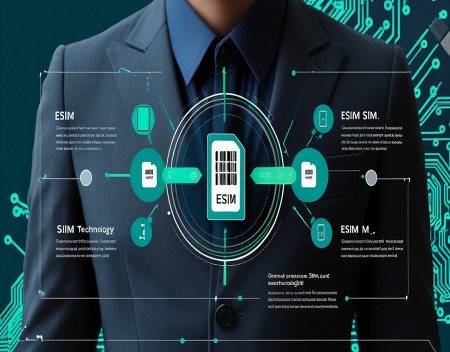
For decades, changing the mobile phone network on a smartphone usually meant dealing with a tiny piece of plastic. The physical SIM card stored information that allowed a phone to connect to a particular cellular network. If you changed carriers or bought a new phone, you might need to remove the old SIM card and install another one.
That is changing with the growing adoption of eSIM technology.
An eSIM eliminates the need for a removable physical SIM card. Instead, the SIM functionality is built directly into the phone's hardware, allowing cellular service information to be downloaded and activated electronically.
Although eSIM technology may seem like a small change, it could eventually transform the way people activate, change, and manage mobile phone services.
What Is an eSIM?The term eSIM stands for embedded Subscriber Identity Module.
Unlike a traditional SIM card, an eSIM isn't a small piece of plastic that you insert into a slot. The necessary hardware is built into the device.
Instead of physically replacing the SIM, a carrier can provide an electronic profile that is downloaded onto the device.
Once activated, the phone can connect to the carrier's network just as it would with a traditional SIM.
From the user's perspective, the biggest difference is that there is no physical card to install.
How Does an eSIM Work?When you sign up for a mobile plan that supports eSIM, the carrier provides the information needed to activate the service.
Depending on the carrier and device, activation might involve scanning a QR code, using a carrier application, or following instructions directly through the phone's settings.
The phone downloads the carrier profile and securely stores it in the eSIM hardware.
Once the profile is activated, the device can connect to the cellular network.
If you switch carriers later, you can potentially download another profile without replacing any physical hardware.
No More Tiny SIM CardsOne of the simplest advantages of eSIM technology is convenience.
Traditional SIM cards are extremely small and easy to lose.
Changing them can also be frustrating, particularly if you don't have the correct SIM tool available.
With an eSIM, there is nothing physical to remove or insert.
Changing service can often be completed through software.
This can be particularly useful when traveling or switching between mobile providers.
Multiple Cellular PlansMany eSIM-compatible phones can store multiple cellular profiles.
This doesn't necessarily mean every profile can be active simultaneously, but it can make switching between services much easier.
For example, someone could maintain a primary personal number and a separate business line on the same phone.
A traveler could also maintain a regular home-country plan while adding a temporary local data plan for another country.
This eliminates the need to physically swap SIM cards.
eSIMs and International TravelTravel is one area where eSIM technology can be particularly useful.
International travelers have traditionally had several options.
They could use their existing carrier's roaming service, purchase a local SIM card, or buy a travel SIM before leaving home.
An eSIM can simplify the process.
A traveler can purchase a compatible international data plan and download it to the phone before or after arriving at the destination.
This can provide access to local mobile data without removing the primary SIM.
The exact pricing and network availability depend on the eSIM provider and destination.
Dual-SIM FunctionalityeSIM technology has also made dual-SIM functionality more practical.
A phone can potentially use two different mobile services, allowing users to separate personal and business communications or maintain different numbers.
The exact capabilities vary by smartphone.
Some devices allow two lines to remain active, while others may place restrictions on which services can be used simultaneously.
Before purchasing a phone for dual-SIM use, it's important to check the specific model's capabilities.
eSIMs Can Save SpaceFor smartphone manufacturers, eliminating the physical SIM card slot creates additional design flexibility.
A SIM tray takes up physical space inside a device and requires an opening through the phone's exterior.
Removing it can potentially free up internal space for other components.
It can also make it easier for manufacturers to improve water and dust resistance because there is one fewer physical opening in the device.
The space savings aren't enormous, but when manufacturers are trying to fit increasingly sophisticated technology into extremely thin devices, every bit of space can matter.
Security AdvantageseSIM technology can provide some security advantages compared with physical SIM cards.
A physical SIM can be removed from a phone and placed into another compatible device.
An eSIM is integrated into the device and managed electronically.
This can make certain types of unauthorized SIM transfers more difficult.
However, eSIMs are not immune to security threats.
Cybercriminals can still attempt to take control of mobile accounts through phishing, social engineering, stolen credentials, or fraudulent carrier account changes.
Users should therefore protect their carrier accounts with strong passwords and available security features.
What Happens If You Lose Your Phone?With a traditional SIM card, someone who finds your phone could potentially remove the SIM and put it into another device.
An eSIM doesn't work that way.
The embedded profile isn't simply removable like a plastic SIM.
However, losing a phone is still a serious security issue.
The device should be protected with a strong passcode and biometric authentication.
Users should also know how to remotely lock or erase their phone if it is lost or stolen.
The Downsides of eSIMDespite its advantages, eSIM technology isn't perfect.
One disadvantage is that moving an eSIM between devices can sometimes be less straightforward than moving a physical SIM card.
With a traditional SIM, you can remove the card from one phone and put it into another compatible phone.
With eSIM, the process depends on the carrier and device.
Some carriers make transfers extremely easy, while others require additional verification or customer support.
This can become frustrating if you're frequently switching phones.
Carrier SupportAnother limitation is that not every carrier or mobile plan supports every eSIM feature.
Support has improved significantly, but availability still varies by country and provider.
Before purchasing an eSIM-only phone, consumers should make sure their carrier supports eSIM activation and the specific device they plan to use.
This is particularly important when buying an imported smartphone.
What About Older Phones?Not every smartphone supports eSIM.
The technology is primarily found on newer devices, although the exact capabilities vary considerably between models.
Some phones support both a physical SIM and eSIM.
Others may rely entirely on eSIM.
Before changing plans or purchasing a device, it's important to check whether the phone supports the required type of cellular service.
Are Physical SIM Cards Going Away?Eventually, physical SIM cards may become much less common.
As more manufacturers adopt eSIM-only designs, consumers will increasingly become accustomed to activating mobile service digitally.
However, physical SIM cards are unlikely to disappear immediately.
They remain useful in markets where eSIM adoption is limited and for consumers who frequently move SIM cards between devices.
The transition will probably happen gradually.
eSIM and the Future of Mobile ServiceThe biggest change eSIM introduces is that a mobile subscription becomes less tied to a physical piece of hardware.
Instead of thinking about your SIM card as something you own and move between phones, you can think of your cellular service as a digital profile that can be activated on compatible devices.
This could make switching carriers much easier.
It could also encourage greater competition because consumers may be able to activate a new service without waiting for a physical SIM card to arrive.
In the future, purchasing a mobile plan could become almost entirely digital.
You could buy a plan online, download the carrier profile, activate it, and start using the service within minutes.
Final ThoughtseSIM technology may not look like a revolutionary change, but it represents an important shift in how mobile phones connect to cellular networks.
By replacing the physical SIM card with an embedded digital system, eSIMs make it easier to switch carriers, use multiple plans, travel internationally, and activate mobile service without handling tiny pieces of plastic.
There are still limitations, particularly around carrier support and transferring service between devices. However, those limitations are becoming less significant as eSIM adoption grows.
The future of mobile connectivity is increasingly digital.
The physical SIM card served the smartphone industry well for many years, but it may eventually become another piece of technology that people remember using.
The next time you activate a new phone, you may not need to insert anything at all.
Great experience with Computer Geek. They helped with my website needs and were professional, respon . . . [MORE].

Great, quick service when my laptop went into meltdown and also needed Windows 11 installed. Also ca . . . [MORE].
It was a great experience to working with you. thank you so much. . . . [MORE].
Thank you so much for great service and over all experience is good . highly recommended for all peo . . . [MORE].
We engaged The Computer Geeks in mid-2023 as they have a reputation for API integration within the T . . . [MORE].
Digital Transformation Ex

The Rise of Automation in

Why Every Business Needs