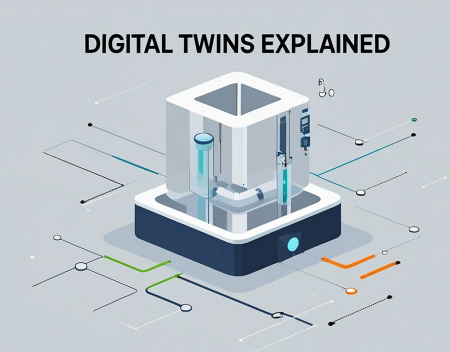
Imagine being able to create a virtual copy of a real-world machine, building, vehicle, factory, or even an entire city and then use that digital copy to understand what is happening in the real world.
That is essentially the idea behind a digital twin.
Digital twins are becoming an important technology in manufacturing, engineering, healthcare, transportation, energy, construction, and many other industries. By combining sensors, software, data, artificial intelligence, and computer models, a digital twin can provide a detailed digital representation of something that exists in the physical world.
The technology can help organizations understand how things are working today, predict what might happen in the future, and identify potential problems before they become expensive failures.
What Is a Digital Twin?A digital twin is a virtual representation of a physical object or system that is connected to real-world data.
The physical object could be almost anything.
It might be an aircraft engine, a wind turbine, a factory machine, a vehicle, a building, or an entire manufacturing facility.
Sensors attached to the physical object can collect information such as temperature, pressure, vibration, speed, energy consumption, and operating conditions.
That information can then be sent to the digital twin.
The digital model can use this information to reflect the current condition of the real-world object.
This makes a digital twin much more useful than a simple computer drawing or 3D model. It is intended to represent what is actually happening in the physical world.
How Digital Twins WorkA digital twin typically combines several technologies.
Sensors collect information from the physical object. Networks transmit that information to computer systems, where it can be stored and analyzed.
Software then uses the data to update the digital representation.
Artificial intelligence and machine learning can add another layer of capability. Instead of simply showing what is happening, the system can analyze historical and current data to identify patterns and potentially predict future problems.
For example, sensors on an industrial machine might detect that vibration levels are gradually increasing.
The digital twin could recognize that this pattern has previously been associated with a component failure.
The company could then schedule maintenance before the machine actually breaks down.
Digital Twins in ManufacturingManufacturing is one of the most important applications for digital twin technology.
A factory can create digital representations of machines, production lines, or entire manufacturing processes.
Engineers can use these models to understand how equipment is performing and identify potential bottlenecks.
They can also experiment with changes digitally before making those changes to the real factory.
For example, a manufacturer could simulate what would happen if a production line operated at a higher speed.
If the simulation suggests that a particular machine would become a bottleneck, engineers can address the problem before making changes in the real facility.
This can save time and reduce the cost of experimentation.
Predictive MaintenanceOne of the most valuable uses of digital twins is predictive maintenance.
Traditional maintenance often follows a schedule. A machine might receive maintenance every six months regardless of its actual condition.
Predictive maintenance takes a different approach.
Sensors continuously monitor equipment, while software analyzes the information for signs of deterioration.
If the digital twin suggests that a component is likely to fail soon, maintenance can be scheduled before the failure occurs.
This can prevent unexpected downtime and potentially extend the life of expensive equipment.
Digital Twins and BuildingsDigital twins are also being used for buildings.
A digital twin of a building can include information about heating, ventilation, air conditioning, electricity consumption, security systems, elevators, and other equipment.
Building managers can use this information to understand how the building operates.
For example, the system might identify areas that consume unusually large amounts of energy.
It could also help determine how changes to heating or cooling systems would affect energy consumption.
This could make buildings more efficient while reducing operating costs.
Digital Twins in TransportationVehicles are another promising application.
Manufacturers can create digital twins of cars, trucks, aircraft, ships, and other vehicles.
The model can be used during development to test designs and simulate different operating conditions.
Once the vehicle is in service, real-world data can potentially be used to monitor its condition.
Aircraft are particularly interesting because maintenance is extremely important and aircraft components can be expensive.
Monitoring the condition of engines and other systems can help maintenance teams identify potential problems before they become serious.
Digital Twins of CitiesThe concept can also be expanded far beyond individual machines.
Some organizations are developing digital representations of entire cities.
A city digital twin could combine information about roads, buildings, traffic, public transportation, energy use, weather, and other infrastructure.
City planners could potentially use the model to simulate proposed changes.
For example, they could study what might happen to traffic if a new road were built or how a new building could affect surrounding infrastructure.
This could help planners make better decisions before spending large amounts of money on construction.
Digital Twins in HealthcareHealthcare could also benefit from digital twin technology.
Researchers are exploring ways of creating highly personalized digital models that represent aspects of an individual patient's health.
In the future, digital models could potentially help doctors understand how a patient might respond to different treatments.
There are significant challenges involved, particularly because human biology is extremely complicated and medical information is highly sensitive.
However, the concept could eventually contribute to more personalized healthcare.
Digital Twins and Artificial IntelligenceArtificial intelligence is likely to make digital twins significantly more powerful.
A basic digital twin might show the current condition of a machine.
An AI-powered digital twin could go further by analyzing years of historical data, recognizing patterns, predicting failures, and recommending actions.
AI could also allow digital twins to handle enormous amounts of information that would be difficult for humans to analyze manually.
This combination of real-time data, simulation, and AI could make digital twins valuable decision-making tools rather than simply digital monitoring systems.
Digital Twins Are Not PerfectDespite their potential, digital twins have limitations.
A digital twin is only as accurate as the information it receives.
If sensors provide incorrect data or important information is missing, the digital representation may not accurately reflect reality.
Creating and maintaining a digital twin can also be expensive.
Organizations may need sensors, networking equipment, cloud computing resources, specialized software, and people with the skills to manage the system.
There are also cybersecurity concerns. If a digital twin is connected to important physical infrastructure, protecting the associated data and systems becomes extremely important.
The Future of Digital TwinsAs sensors become cheaper, networks become faster, and artificial intelligence becomes more capable, digital twins are likely to become more common.
The technology may eventually be used throughout the entire life cycle of a product.
A manufacturer could create a digital twin during the design stage, use it to optimize production, monitor the product while it is being used, predict maintenance requirements, and analyze its performance throughout its lifetime.
This creates a continuous connection between the physical and digital worlds.
Final ThoughtsDigital twins represent an important step toward a world where physical objects and systems have constantly updated digital counterparts.
Instead of simply collecting data about a machine, building, vehicle, or factory, organizations can use that data to create a living digital representation that helps them understand what is happening and predict what might happen next.
The technology has applications ranging from manufacturing and transportation to buildings, energy, healthcare, and city planning.
Digital twins won't eliminate every problem, and creating accurate models can be expensive and complicated. However, as artificial intelligence, sensors, cloud computing, and connected devices continue to improve, digital twins could become an increasingly important part of how we design, operate, and maintain the physical world.
The idea is relatively simple: build a digital version of the real world, connect it to real-world data, and use it to make better decisions.
That simple idea could have a very large impact on the future of technology.
Great experience with Computer Geek. They helped with my website needs and were professional, respon . . . [MORE].

Great, quick service when my laptop went into meltdown and also needed Windows 11 installed. Also ca . . . [MORE].
It was a great experience to working with you. thank you so much. . . . [MORE].
Thank you so much for great service and over all experience is good . highly recommended for all peo . . . [MORE].
We engaged The Computer Geeks in mid-2023 as they have a reputation for API integration within the T . . . [MORE].
The Browser Wars Revisite
The Rise and Fall of Flas
The History of the Intern