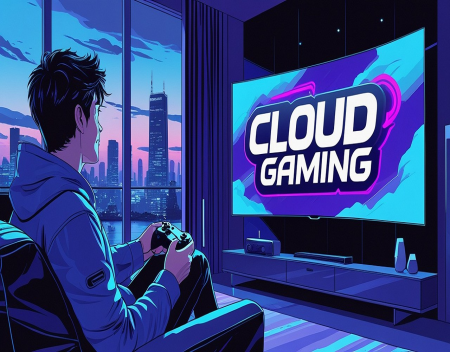
For decades, playing a video game meant having powerful hardware sitting in front of you. Whether it was a gaming PC, PlayStation, Xbox, or another console, the device in your home was responsible for rendering graphics, processing game logic, handling physics, and running the game itself.
Cloud gaming is changing that model.
Instead of requiring the player's device to perform all of the heavy computing, cloud gaming allows games to run on powerful remote servers. The video and audio are streamed to the player's device, while their controller or keyboard inputs are sent back to the server.
In theory, this could make high-end gaming available on almost any modern device with a sufficiently fast internet connection.
But is cloud gaming really the future of video games?
What Is Cloud Gaming?Cloud gaming is sometimes described as gaming on demand.
With a traditional game, the software is installed on your computer or console. The hardware in that device does most of the processing required to run the game.
With cloud gaming, the game runs on a remote server in a data center.
When you press a button on your controller, that input is transmitted over the internet to the cloud server. The server processes the input, renders the next frame of the game, and sends the resulting video back to your screen.
This happens continuously, potentially dozens or even hundreds of times per second.
To the player, the experience is supposed to feel similar to playing a game installed locally.
No Expensive Gaming PC RequiredOne of the biggest advantages of cloud gaming is that it can reduce the need for expensive hardware.
Modern high-end games can require powerful processors, graphics cards, large amounts of memory, and fast storage.
A gaming PC capable of running the newest games at high resolutions can cost thousands of dollars.
Cloud gaming changes the equation.
The expensive hardware exists in the data center rather than in your home.
Your device might only need enough processing power to receive and display the video stream.
This means a relatively inexpensive laptop, tablet, smart TV, or other compatible device could potentially play games that would normally require a high-end gaming computer.
Play on More DevicesCloud gaming can also make games more portable.
Instead of being tied to one gaming PC or console, a player could potentially access their games from multiple devices.
You might play on a television at home, continue on a laptop, and later use a tablet or another compatible device.
The actual game is running in the cloud, so the device is essentially acting as a screen and input system.
This could make gaming more flexible than ever.
No Large DownloadsModern video games can be enormous.
It isn't unusual for major games to require tens or even hundreds of gigabytes of storage.
Downloading and installing a large game can take hours, particularly on slower internet connections.
Cloud gaming largely eliminates this requirement.
Because the game runs remotely, there may be little or no need to download the entire game to your device.
Updates can also be handled on the server side.
When developers release a new version, players don't necessarily have to wait for a massive download before they can play.
Internet Speed Is CriticalCloud gaming has one major requirement that traditional gaming doesn't: a strong internet connection.
When a game is running locally, your controller input goes directly to the computer or console.
With cloud gaming, the input has to travel across the internet to a remote data center.
The resulting video then has to travel back.
This creates the possibility of latency.
Even a small delay can be noticeable in fast-paced games.
A slight delay might not matter much in a turn-based strategy game, but it could make a significant difference in a competitive first-person shooter.
This is one of the biggest obstacles cloud gaming still has to overcome.
Latency Is More Than Internet SpeedA common misconception is that cloud gaming only requires a fast internet connection.
Speed is important, but latency can be even more important.
Latency measures how long it takes information to travel between your device and the server.
You could have an extremely fast internet connection but still experience noticeable delays if the gaming server is physically far away or your network has routing problems.
This is why cloud gaming providers place data centers in different geographic regions.
The closer the server is to the player, the shorter the potential communication distance.
Data Centers Are Becoming Gaming MachinesCloud gaming is another example of how important data centers have become.
Instead of thousands of gamers purchasing individual high-performance graphics cards, cloud gaming companies can operate powerful graphics hardware in centralized facilities.
These servers can run games for many customers.
The infrastructure can be managed centrally, making it easier to maintain hardware, install updates, and optimize performance.
However, running games for large numbers of users requires enormous computing resources.
Gaming servers need powerful processors, GPUs, high-speed networking, storage, electricity, and advanced cooling systems.
Cloud Gaming Could Change Game DevelopmentCloud gaming may eventually influence how games themselves are designed.
Developers have traditionally needed to consider the limitations of consumer hardware.
A game has to run on a player's particular computer or console.
Cloud-based games could potentially use much more powerful computing resources.
Developers could create larger and more complex virtual worlds without worrying as much about the hardware sitting in the player's home.
Some games could potentially use server-side AI, advanced physics simulations, and enormous multiplayer environments that would be difficult to run locally.
The Subscription ModelCloud gaming also fits naturally with subscription services.
Instead of purchasing individual games, players could potentially pay a monthly fee for access to a large library.
This is similar to how streaming services changed television and movies.
Rather than buying every game individually, players could subscribe and play whatever titles are included in the service.
This could make gaming more affordable for some players, although subscription costs can add up over time.
It also raises questions about ownership.
When you purchase a physical game or digital copy, you generally expect to retain access to it.
With a cloud gaming subscription, access can depend on whether the game remains available on the service.
Game Ownership Could Become Less ImportantCloud gaming represents a broader shift from owning software to accessing services.
Music moved from CDs to streaming services.
Movies moved from DVDs to streaming platforms.
Software increasingly moved from permanent installations to subscriptions.
Video games could follow a similar path.
Instead of maintaining a personal collection of installed games, players could eventually maintain a library of cloud-based titles accessible through a subscription or digital account.
Whether consumers will fully embrace this model remains uncertain.
Cloud Gaming and Mobile DevicesMobile devices could benefit significantly from cloud gaming.
Smartphones and tablets are convenient but have physical limitations.
They cannot match the cooling systems and power consumption of a high-end gaming PC.
Cloud gaming allows these devices to access much more powerful hardware remotely.
A future smartphone could potentially play visually demanding games that would be impossible to run locally.
As mobile networks continue improving, particularly with newer generations of wireless technology, cloud gaming could become increasingly practical outside the home.
Security and ReliabilityCloud gaming also introduces new concerns.
Because games are running on remote systems, users depend heavily on the provider's infrastructure.
If the service experiences an outage, players may be unable to access their games.
Cybersecurity is another concern.
Gaming accounts contain valuable information and may be connected to payment methods. Cloud gaming companies therefore need strong authentication, encryption, monitoring, and security systems.
Will Cloud Gaming Replace Consoles and Gaming PCs?Probably not—at least not completely.
Local gaming has several advantages.
A powerful gaming PC or console can provide extremely low latency because the game runs directly on the device.
Players also don't need an internet connection for many single-player games.
Local hardware provides predictable performance and gives users greater control over their games and equipment.
For serious competitive gamers, these advantages may remain extremely important.
Cloud gaming is therefore more likely to become another option rather than completely replacing traditional gaming.
The Future May Be HybridThe most likely future could be a combination of local and cloud gaming.
A game might perform some processing locally while using cloud servers for particularly demanding tasks.
For example, a gaming PC could render most of the game locally while cloud servers handle AI calculations, multiplayer environments, or large-scale simulations.
This hybrid approach could provide the advantages of both technologies.
Final ThoughtsCloud gaming has enormous potential.
It could make high-end games accessible on cheaper devices, eliminate massive downloads, simplify updates, enable gaming across multiple devices, and introduce new subscription-based business models.
However, it also has limitations.
Reliable high-speed internet, low latency, server availability, data usage, subscription costs, and concerns about game ownership all remain important considerations.
The technology is improving rapidly, and better networks and increasingly powerful data centers will continue to make cloud gaming more practical.
But traditional gaming isn't going away anytime soon.
For players who demand maximum performance and minimum latency, local hardware will remain attractive. For casual players, travelers, and people who don't want to spend thousands of dollars on gaming hardware, cloud gaming could be an increasingly compelling alternative.
The future of video games may therefore not be entirely in the cloud.
Instead, the future could be a world where games can run anywhere—on your console, your PC, your phone, your television, or a powerful computer hundreds of kilometers away in a data center.
The real revolution isn't simply moving games to the cloud. It's removing the assumption that the computer running the game has to be sitting in front of you.
Great experience with Computer Geek. They helped with my website needs and were professional, respon . . . [MORE].

Great, quick service when my laptop went into meltdown and also needed Windows 11 installed. Also ca . . . [MORE].
It was a great experience to working with you. thank you so much. . . . [MORE].
Thank you so much for great service and over all experience is good . highly recommended for all peo . . . [MORE].
We engaged The Computer Geeks in mid-2023 as they have a reputation for API integration within the T . . . [MORE].
The Browser Wars Revisite
The Rise and Fall of Flas
The History of the Intern