Software development used to be very different from what it is today. Traditionally, companies would spend months or even years planning a software project, writing detailed specifications, developing the entire product, and finally releasing it to customers.
The problem with this approach is that technology and customer expectations can change quickly. By the time a project is finished, the original requirements may no longer make sense.
Agile development was created to address this problem. Instead of trying to plan everything in advance, Agile focuses on developing software in smaller pieces, getting feedback regularly, and making changes throughout the project.
What Is Agile Development?Agile development is a software development approach that emphasizes flexibility, collaboration, continuous improvement, and frequent delivery of working software.
Rather than building an entire application before anyone sees it, Agile teams break a project into smaller pieces. These pieces are developed and tested over relatively short periods of time.
The team can then review what has been created, collect feedback, and decide what should happen next.
This makes Agile particularly useful for projects where requirements are likely to change.
How Agile WorksAgile projects are typically divided into smaller development cycles. These cycles are often called sprints, although the exact terminology and process can vary depending on the Agile methodology being used.
A sprint might last one or two weeks, for example.
At the beginning of the sprint, the team decides which tasks should be completed. Developers then work on those tasks, while testers and other team members help ensure the software works correctly.
At the end of the sprint, the team reviews the completed work and considers what should be improved or developed next.
The process then repeats.
Instead of having one enormous deadline at the end of the project, Agile creates a series of smaller milestones.
Why Agile Became PopularOne of the biggest advantages of Agile is that it accepts the reality that things change.
A customer might initially request a particular feature and then realize several weeks later that something different would be more useful.
With a traditional development process, changing requirements can be expensive and disruptive.
With Agile, change is expected.
The team can adjust its priorities during the project and focus on the features that provide the most value.
This doesn't mean developers simply change everything whenever someone asks. Agile still requires planning and organization. The difference is that planning happens continuously rather than assuming everything can be predicted at the beginning.
The Importance of Customer FeedbackCustomer feedback is a major part of Agile development.
Instead of waiting until a project is completely finished to show it to customers, Agile encourages frequent demonstrations and reviews.
This can reveal problems early.
For example, a development team might spend several months building an online ordering system. If customers don't actually understand how the ordering process works, discovering that problem after the entire system is finished could be expensive.
With Agile, users can see early versions of the system and provide feedback while there is still plenty of time to make improvements.
Agile Teams Work TogetherAgile also places a strong emphasis on communication.
A traditional project might involve different departments working separately, with information passing from one group to another.
Agile teams tend to work more closely together.
Developers, testers, designers, project managers, product owners, and other stakeholders may communicate regularly throughout the project.
This can help identify problems much earlier.
If a developer discovers that a feature is technically difficult to implement, for example, the team can discuss alternatives immediately rather than discovering the problem near the end of the project.
Agile Does Not Mean No PlanningOne common misunderstanding is that Agile means developers simply start writing code without a plan.
That is not how Agile works.
Agile teams still plan their projects, establish priorities, estimate work, define goals, and track progress.
The difference is that Agile planning is flexible.
Instead of creating one enormous plan that is expected to remain unchanged for a year, the team continuously evaluates the project and adjusts its plans based on what it has learned.
In other words, Agile replaces some long-term certainty with continuous adjustment.
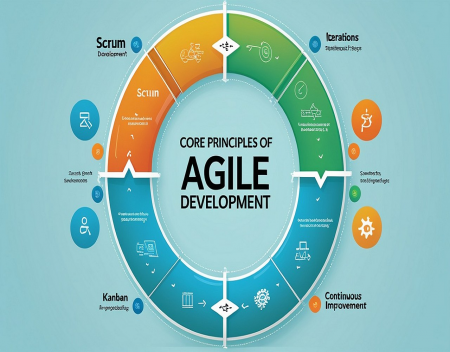
Common Agile MethodologiesAgile is not actually one specific development method. It is more of an overall philosophy and collection of principles.
Several methodologies use Agile principles.
Scrum is one of the most widely known. Scrum uses short development cycles, regular meetings, defined roles, and prioritized lists of work.
Kanban focuses on visualizing work and managing the flow of tasks. Teams often use a board showing tasks that need to be done, tasks currently being worked on, and completed tasks.
Extreme Programming, often called XP, places a strong emphasis on software quality and engineering practices such as frequent testing and continuous feedback.
Different organizations may also create their own processes that incorporate Agile ideas.
The Benefits of Agile DevelopmentAgile can provide several advantages.
One of the biggest is faster delivery. Customers can begin using useful parts of a product before the entire project is complete.
Agile can also improve software quality because testing and feedback happen throughout development rather than being left until the end.
Another advantage is greater flexibility. Teams can change priorities when business requirements, customer expectations, or technology changes.
Agile can also reduce the risk of spending enormous amounts of money developing something customers ultimately don't want.
The Problems With AgileAgile is not perfect.
Poorly implemented Agile can result in constant meetings, changing priorities, unclear responsibilities, and developers who feel like they are constantly being asked to change direction.
Some organizations also adopt Agile terminology without actually adopting the underlying principles.
Simply having daily meetings and calling development periods "sprints" does not automatically make a company Agile.
Agile requires good communication, realistic priorities, strong leadership, and a willingness to learn from mistakes.
There is also a risk of focusing too heavily on short-term goals while losing sight of the overall product.
Agile and Modern Software DevelopmentAgile has become particularly valuable as software has become increasingly connected to cloud services, mobile devices, artificial intelligence, and constantly changing online platforms.
Modern applications can rarely remain unchanged for years. Companies need to release improvements, respond to security threats, support new devices, and react to customer feedback.
Agile development fits naturally into this environment because it is designed around continuous improvement.
It also works well with practices such as continuous integration and continuous deployment, where software changes can be tested and released frequently.
Final ThoughtsAgile development is ultimately about accepting that software projects rarely go exactly according to plan.
Instead of pretending that every requirement can be predicted months or years in advance, Agile encourages teams to develop software in smaller pieces, gather feedback, learn from experience, and adjust as they go.
When implemented properly, Agile can help companies deliver useful software faster while reducing the risk of building something that doesn't meet customer needs.
Agile isn't about eliminating planning or deadlines. It is about making software development more flexible and responsive to reality.
In a technology industry where customer expectations and technology can change almost overnight, that flexibility can be one of the biggest advantages a development team can have.
Great experience with Computer Geek. They helped with my website needs and were professional, respon . . . [MORE].

Great, quick service when my laptop went into meltdown and also needed Windows 11 installed. Also ca . . . [MORE].
It was a great experience to working with you. thank you so much. . . . [MORE].
Thank you so much for great service and over all experience is good . highly recommended for all peo . . . [MORE].
We engaged The Computer Geeks in mid-2023 as they have a reputation for API integration within the T . . . [MORE].
The Hidden Cost of Free A

The Psychology of Notific
Why Subscription Services