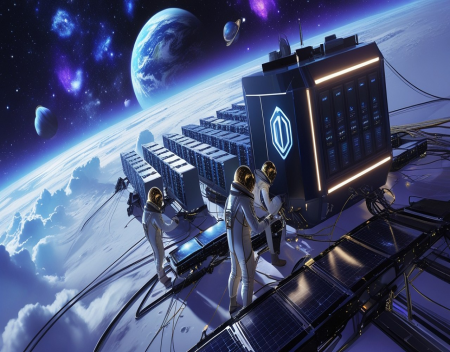
As humanity produces more digital information than ever before, the concept of storing data beyond Earth has shifted from science fiction into serious technological discussion. Off world data centers, meaning massive digital storage facilities located in orbit or on the Moon, represent a bold response to the growing demand for computing power and secure long term archives. The idea is simple in theory. Move storage and processing infrastructure into space, where cooling is easier, solar energy is abundant, and physical distance offers new layers of protection. Yet beneath this futuristic vision lies a complex web of technological challenges, economic realities, and philosophical questions about what it means to preserve humanity beyond the planet that created it.
One of the primary motivations behind off world data centers is the rapid expansion of global data production. Artificial intelligence systems, streaming services, scientific research, and billions of connected devices generate immense volumes of information every day. Traditional data centers on Earth consume large amounts of energy and require significant cooling infrastructure. In orbit, extreme cold and the vacuum of space could theoretically reduce the need for traditional cooling systems. Solar power arrays could supply continuous energy without reliance on fossil fuels or terrestrial electrical grids. Supporters argue that moving data infrastructure into space could ease environmental strain on Earth while providing a scalable solution for the digital future.
Security is another major factor driving interest in space based storage. Natural disasters, cyberattacks, and geopolitical conflicts threaten critical information systems on Earth. A data center placed in orbit could be physically isolated from many terrestrial risks, acting as a backup archive for essential records such as scientific discoveries, cultural works, medical data, and historical archives. Governments and corporations are increasingly concerned about data sovereignty and long term preservation, and off world facilities could serve as a form of planetary insurance policy. The notion of safeguarding humanity’s collective knowledge beyond the reach of floods, earthquakes, or wars carries a powerful emotional appeal.
However, building and maintaining infrastructure in space presents enormous logistical challenges. Launch costs remain high despite advances in reusable rockets. Equipment must be designed to withstand radiation, micro meteorites, and extreme temperature fluctuations. Maintenance and upgrades would require either robotic systems or expensive human missions. The complexity of transmitting vast amounts of data across space also raises questions about latency and reliability. While satellite networks already provide global communication, scaling that technology to support massive real time data processing would require breakthroughs in bandwidth and infrastructure.
The ethical implications of off world data centers are equally profound. If humanity begins storing its collective memory in orbit or on other celestial bodies, questions of ownership and access will become unavoidable. Who controls the archives of human knowledge when they are physically located beyond national borders. Will only wealthy corporations and powerful nations have the resources to maintain off world infrastructure, potentially deepening existing inequalities in digital access. The idea of storing humanity in space also raises philosophical questions about identity. If our culture, history, and personal lives are preserved in distant servers, does that change how we think about permanence and legacy.
Environmental concerns extend beyond Earth as well. Launching thousands of satellites and infrastructure modules contributes to space debris, increasing the risk of collisions and threatening existing spacecraft. Large scale off world data centers could transform orbital environments into heavily industrialized zones. The long term consequences for space sustainability remain uncertain, and international cooperation will be necessary to prevent overcrowding or accidental contamination of celestial bodies. Balancing technological ambition with responsible stewardship of space will be a defining challenge for future generations.
Despite these obstacles, the concept of off world data centers continues to capture attention because it represents a new stage in humanity’s technological evolution. Storing information beyond Earth suggests a future in which civilization is not confined to a single planet but distributed across multiple environments. For some, this vision symbolizes resilience and progress. For others, it raises concerns about dependence on complex systems that are difficult to regulate or repair. The success or failure of such projects will depend not only on engineering breakthroughs but also on careful ethical planning and global cooperation.
Ultimately, off world data centers invite us to reconsider how humanity preserves its knowledge and identity. As technology advances, the possibility of storing our collective memory in space becomes less abstract and more practical. Whether these facilities become essential pillars of the digital world or remain experimental ventures will depend on how society weighs the benefits of security, sustainability, and innovation against the risks of inequality, environmental impact, and technological overreach. In imagining data centers among the stars, humanity is also imagining how its story will be written, protected, and remembered far beyond the boundaries of Earth.
Great experience with Computer Geek. They helped with my website needs and were professional, respon . . . [MORE].

Great, quick service when my laptop went into meltdown and also needed Windows 11 installed. Also ca . . . [MORE].
It was a great experience to working with you. thank you so much. . . . [MORE].
Thank you so much for great service and over all experience is good . highly recommended for all peo . . . [MORE].
We engaged The Computer Geeks in mid-2023 as they have a reputation for API integration within the T . . . [MORE].

The Browser Wars Revisite

The Rise and Fall of Flas
The History of the Intern