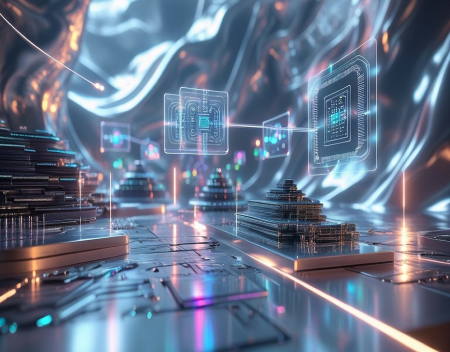
For more than half a century, silicon has been the foundation of modern computing. Almost every computer, smartphone, server, and electronic device we use relies on semiconductor technology based on silicon.
Silicon has been incredibly successful. Engineers have learned how to make transistors smaller, faster, and more efficient, allowing the number of transistors on a computer chip to increase dramatically over the decades.
But there is a problem: silicon cannot keep shrinking forever.
As transistors become extremely small, engineers face physical and manufacturing limitations. Heat, power consumption, quantum effects, and the difficulty of producing increasingly complicated chips are becoming major challenges.
This raises an interesting question: What comes after silicon chips?
The answer probably isn't a single replacement. Instead, the future of computing may involve several different technologies working alongside increasingly advanced silicon.
Why Silicon Has Been So SuccessfulSilicon is an excellent material for making computer chips because its electrical properties can be precisely controlled.
Transistors can be created using silicon and other semiconductor materials, allowing them to act as tiny electronic switches.
Modern processors contain billions of these switches.
Over the years, manufacturers have developed increasingly sophisticated manufacturing processes that allow transistors to become incredibly small.
This has resulted in faster computers, smaller smartphones, more powerful gaming systems, and enormous data centers capable of running artificial intelligence applications.
However, shrinking transistors is becoming increasingly difficult and expensive.
The Limits of Smaller TransistorsFor decades, one of the basic strategies for improving computer chips was simple: make the transistors smaller.
Smaller transistors allow more of them to fit onto a chip and can reduce the distance electrical signals have to travel.
But at extremely small scales, physics becomes a bigger problem.
Quantum effects begin to become more important, manufacturing tolerances become incredibly demanding, and controlling heat becomes increasingly difficult.
Simply making transistors smaller is no longer enough.
The computer industry therefore needs new approaches to improving performance.
Graphene and Other 2D MaterialsOne possibility involves materials that are only a few atoms thick.
Graphene is a sheet of carbon atoms arranged in a particular structure. It has remarkable electrical, thermal, and mechanical properties.
Researchers have investigated graphene for use in future electronics because electrons can move through it extremely efficiently.
Other two-dimensional materials are also being studied.
These materials could potentially be used to create transistors that operate differently from traditional silicon devices.
The challenge is turning impressive laboratory properties into reliable, mass-produced computer chips.
Gallium Nitride and Other SemiconductorsSilicon may also increasingly share the semiconductor industry with other materials.
Gallium nitride, for example, has become important in power electronics. It can operate efficiently at high voltages and frequencies and is already being used in products such as compact chargers and power systems.
Other semiconductor materials, including gallium arsenide and silicon carbide, have specialized advantages.
These materials aren't necessarily going to replace silicon processors in ordinary computers, but they can be extremely useful in applications where silicon isn't ideal.
The future may therefore involve a mixture of semiconductor materials, each designed for a particular purpose.
Quantum ComputingAnother possibility is quantum computing.
Traditional computers use bits that represent either a 0 or a 1. Quantum computers use quantum systems to create qubits that can behave in fundamentally different ways.
Quantum computers aren't simply faster versions of today's PCs. They are designed for specific types of problems where quantum algorithms can provide major advantages.
Potential applications include chemistry simulations, materials research, optimization, and certain cryptographic problems.
Quantum computers are still difficult to build and operate, and they are not expected to replace ordinary computers.
Instead, they may eventually work alongside conventional computing systems.
Photonic ComputingWhat if computers used light instead of electricity to move and process information?
That's the basic idea behind photonic computing.
Light can travel extremely quickly and can carry large amounts of information.
Photonic technology is already being used for high-speed communication, particularly inside and between data centers.
Researchers are exploring ways to use light for certain types of computation as well.
Photonic processors could potentially be particularly useful for artificial intelligence because many AI operations involve enormous numbers of mathematical calculations.
The challenge is creating practical systems that combine optical components with electronic components efficiently.
Neuromorphic ComputingAnother approach is to build computers that work more like the human brain.
Neuromorphic computing attempts to create hardware inspired by biological neural networks.
Instead of relying entirely on traditional processor architectures, neuromorphic systems use specialized circuits that can process information in ways that resemble neurons and synapses.
This could make certain types of AI processing significantly more energy efficient.
Rather than constantly moving data between memory and a processor, neuromorphic systems can potentially process information closer to where it is stored.
This could be particularly useful for robotics, sensors, autonomous vehicles, and other systems that need to make decisions locally.
3D ChipsThe future may not require abandoning silicon at all.
Instead, manufacturers are increasingly looking at ways to build chips in three dimensions.
Traditional chips are primarily designed as two-dimensional structures. Modern manufacturing techniques can stack multiple layers of components or combine several chip sections into a single package.
This allows manufacturers to increase computing capability without simply making individual transistors smaller.
Three-dimensional chip designs can also place memory and processing components closer together, reducing the distance data needs to travel.
This is particularly important for artificial intelligence and high-performance computing.
ChipletsAnother important development is the use of chiplets.
Instead of manufacturing one enormous processor as a single piece of silicon, designers can build several smaller chip components and combine them into one package.
Each chiplet can perform a particular function.
For example, a processor could contain separate chiplets for computing, graphics, memory controllers, or specialized AI processing.
This approach can make chip design more flexible and potentially improve manufacturing efficiency.
It also means that the future of processors may look very different from the traditional single-chip designs we have become accustomed to.
Carbon NanotubesCarbon nanotubes are another technology researchers have investigated as a possible successor or complement to silicon.
A carbon nanotube is essentially a tiny cylindrical structure made from carbon atoms.
Because of their electrical properties and extremely small size, carbon nanotubes could potentially be used to create very small and efficient transistors.
However, manufacturing large numbers of identical nanotubes and positioning them precisely remains a major challenge.
As with graphene, the science is promising, but turning that promise into affordable mass-produced computer hardware is difficult.
DNA and Molecular ComputingPerhaps one of the strangest possibilities is computing using molecules.
DNA computing uses biological molecules to represent and process information.
DNA can store enormous amounts of information in a very small physical space, which has attracted interest for long-term data storage.
However, DNA computing is not expected to replace the processor in your laptop.
Instead, molecular computing could eventually be useful for highly specialized problems where traditional electronics are less efficient.
Artificial Intelligence May Change Chip DesignThe rise of artificial intelligence is already changing what computer chips need to do.
Traditional processors are designed to perform many different kinds of tasks. AI systems, however, often require enormous numbers of similar mathematical operations.
This has resulted in specialized AI accelerators designed specifically for machine learning.
Future processors may become increasingly specialized.
Instead of having one chip responsible for everything, a computer could contain multiple types of processing hardware, each optimized for a particular workload.
Silicon Isn't Going Away Anytime SoonDespite all the research into alternatives, silicon is not about to disappear.
The semiconductor industry has invested enormous amounts of money and expertise into silicon manufacturing.
Modern silicon technology continues to improve through new transistor designs, advanced packaging, chiplets, 3D stacking, and specialized processors.
Rather than a sudden transition from silicon to something else, we are more likely to see an evolution.
Silicon will continue doing many jobs while other technologies take over specific tasks where they have an advantage.
Final ThoughtsThe question of what comes after silicon chips doesn't have a simple answer.
The future could involve graphene, carbon nanotubes, photonics, quantum computing, neuromorphic processors, molecular technology, advanced semiconductor materials, and increasingly sophisticated silicon designs.
Some of these technologies may remain specialized, while others could eventually become mainstream.
The most likely future isn't one technology replacing silicon overnight. Instead, computing will become a combination of different technologies, with each one being used where it makes the most sense.
Silicon has powered the computer revolution for decades, but the next major leap in computing may come from combining silicon with entirely new ways of storing, moving, and processing information.
The computer chip of the future may not look like the chips we use today—and it may not even rely on a single technology.
Great experience with Computer Geek. They helped with my website needs and were professional, respon . . . [MORE].

Great, quick service when my laptop went into meltdown and also needed Windows 11 installed. Also ca . . . [MORE].
It was a great experience to working with you. thank you so much. . . . [MORE].
Thank you so much for great service and over all experience is good . highly recommended for all peo . . . [MORE].
We engaged The Computer Geeks in mid-2023 as they have a reputation for API integration within the T . . . [MORE].
The Rise of Automation in

Why Every Business Needs

ERP Systems for Small Bus