Today, laptops are everywhere. Students carry them to school, professionals use them in offices and coffee shops, and travelers rely on them to work from almost anywhere. Modern laptops can outperform desktop computers from just a few decades ago while weighing only a few pounds.
However, portable computing did not begin with thin notebooks, powerful processors, or long-lasting batteries. The first portable computers were bulky, expensive, and limited by the technology available at the time. Their development required engineers to rethink how computers could be designed, powered, and used outside traditional offices.
The story of the first laptop is not about a single invention appearing overnight. It is a history of several machines that gradually transformed the idea of taking a computer anywhere into a practical reality.
The Idea of a Portable ComputerDuring the 1960s and early 1970s, computers were generally large machines housed in dedicated rooms. Mainframes occupied substantial space, while early minicomputers were smaller but still far from portable.
Most people interacted with computers through terminals connected to larger systems. The idea of carrying a complete computer from place to place seemed unrealistic because processors, memory, displays, and power supplies required considerable space and electricity.
However, engineers and researchers began exploring the possibility of personal computing devices that people could carry with them.
One influential concept came from Alan Kay, a computer scientist who proposed the Dynabook in the late 1960s and early 1970s. The Dynabook was envisioned as a portable personal computer for learning, creativity, and communication. It was intended to be accessible to children as well as adults.
The Dynabook was not a commercially available laptop, and the technology of the period could not fully deliver the concept. Nevertheless, its vision of a compact, interactive computer helped influence the development of later portable devices.
The Xerox NoteTaker: An Early Laptop ConceptIn the late 1970s, researchers at Xerox PARC developed the NoteTaker, an experimental portable computer designed to demonstrate what personal computing might become.
The NoteTaker included a display, keyboard, and computing hardware in a transportable design. It was far ahead of many contemporary computers in its approach to portability and graphical interaction.
However, the NoteTaker was an experimental research project rather than a mass-market product. Its size, weight, and power requirements limited its practicality, and it was never sold commercially in significant numbers.
Even so, it demonstrated that engineers were actively working toward the idea of a self-contained computer that could be moved between locations.
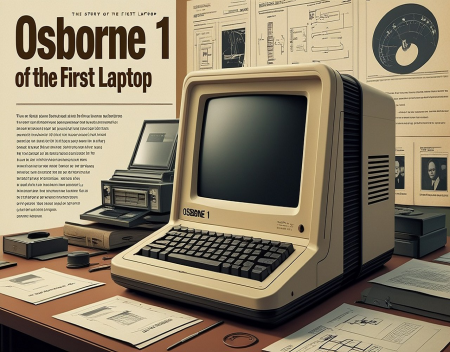
The Osborne 1: A Portable Computer for the Mass Market<PRIVATE_PERSON>One of the most important milestones arrived in 1981 with the introduction of the Osborne 1, developed by Osborne Computer Corporation.
The Osborne 1 is often described as one of the first commercially successful portable computers. It was not a laptop in the modern sense, but it brought computing portability to a much wider audience.
The machine weighed approximately 24.5 pounds and featured a small five-inch monochrome display. It included a keyboard that folded down to protect the computer during transport, as well as two floppy disk drives.
The Osborne 1 ran the CP/M operating system and came with useful business software. Its bundled programs helped make it attractive to professionals who wanted to work with documents, spreadsheets, and other business applications while traveling.
Despite its weight and limited display, the Osborne 1 offered a major advantage: users could carry a complete computer with them rather than depend on access to an office desktop.
It also demonstrated an important commercial principle. A portable computer did not need to be small by modern standards to be useful. It needed to provide enough functionality to justify the effort of carrying it.
The Grid Compass: A Laptop-Like DesignIn 1982, the GRiD Compass 1101 introduced a design that looked much more like the laptops we recognize today.
Developed by British industrial designer Bill Moggridge and produced by GRiD Systems, the Compass featured a distinctive clamshell design. Its flat display folded down over the keyboard, protecting the screen during transport.
The machine was built with portability and professional use in mind. It was expensive, costing thousands of dollars, and was primarily aimed at specialized customers rather than ordinary consumers.
Its technology was advanced for its time, and versions were used in demanding environments, including by NASA. The GRiD Compass helped demonstrate the value of a durable, compact computer that could be transported and opened for use.
Although it was not the first portable computer, its design became an important influence on the future of laptop development.
The Compaq Portable and IBM's EntryThe early 1980s saw several companies competing to make portable computing more practical.
Compaq introduced the Compaq Portable in 1983. Unlike a modern laptop, it resembled a sewing machine case with a built-in display and keyboard. It was relatively large and heavy, but it could run software compatible with IBM PC systems.
That compatibility was important because businesses had already begun investing in IBM-compatible computers and applications. Users could take familiar software with them rather than learn an entirely different system.
IBM entered the laptop-like portable market with the IBM PC Convertible in 1986. It included a folding design, a battery-powered operating mode, and floppy disk drives. Although it was still relatively bulky, it moved closer to the concept of a computer designed specifically for mobile use.
Competition among these manufacturers encouraged improvements in portability, compatibility, and usability.
The Toshiba T1100 Changes the Laptop MarketA major milestone arrived in 1985 with the Toshiba T1100. Toshiba marketed it as a portable IBM-compatible computer, and it helped establish the laptop as a practical category of personal computing.
The T1100 featured a folding display and keyboard, weighed approximately 4.1 kilograms, and used floppy disks rather than an internal hard drive. It was designed around portability and compatibility with the growing market for IBM PC software.
The machine had limitations. Its performance was modest, and its battery life and storage capabilities were far removed from those of modern devices. Nevertheless, it helped demonstrate that a laptop could be useful for business users who needed to work away from a desk.
Toshiba's development work also reflected the engineering challenges involved in portable computing: reducing component size, managing power consumption, and fitting the essential parts of a computer into a compact enclosure.
How Laptops Became Everyday DevicesDuring the 1990s, laptop technology improved rapidly. Displays became better, processors became more powerful, and hard drives allowed users to store programs and documents without relying entirely on floppy disks.
Battery technology also improved, although early laptops often offered limited operating time away from an electrical outlet.
Manufacturers introduced trackballs, pointing sticks, and eventually touchpads, reducing the need to carry a separate mouse. Networking capabilities made it easier to connect laptops to office systems and the internet.
By the late 1990s and early 2000s, laptops were becoming increasingly attractive to students, business travelers, and home users. They were still generally more expensive than desktop computers with similar specifications, but the convenience of portability justified the additional cost for many buyers.
Wireless networking was another major turning point. Wi-Fi made it possible to connect to the internet without plugging into a network cable, helping transform laptops into genuinely mobile devices.
The Modern Laptop RevolutionToday's laptops bear little resemblance to the heavy portable computers of the early 1980s.
Thin-and-light notebooks can weigh around two or three pounds while offering high-resolution displays, fast solid-state storage, multiple processing cores, and hours of battery life. Some models are designed for gaming or professional video editing, while others prioritize affordability and portability.
Advances in wireless connectivity, cloud computing, and video conferencing have also expanded what laptops can do. People can collaborate with colleagues across continents, attend virtual meetings, edit media, and access vast collections of online information from almost anywhere.
The development of smartphones and tablets has created additional competition, but laptops remain valuable because they combine portability with a traditional keyboard, a full desktop-style operating environment, and the flexibility required for demanding work.
Final ThoughtsThe first laptop was not a single machine but the result of decades of experimentation and engineering. Early concepts such as the Dynabook helped establish the vision, while machines such as the Osborne 1, GRiD Compass, and Toshiba T1100 demonstrated different ways to make portable computing practical.
Each generation solved some of the problems that had limited its predecessors, including excessive weight, short battery life, small displays, and limited storage.
The modern laptop is the product of this long evolution. What once required a heavy machine that was difficult to transport can now fit into a slim case and run for hours on battery power.
As processors, batteries, displays, and wireless technologies continue to improve, laptops will likely become even more capable. Yet their central purpose remains unchanged: giving people the ability to use a powerful computer wherever their work or interests take them.
Great experience with Computer Geek. They helped with my website needs and were professional, respon . . . [MORE].

Great, quick service when my laptop went into meltdown and also needed Windows 11 installed. Also ca . . . [MORE].
It was a great experience to working with you. thank you so much. . . . [MORE].
Thank you so much for great service and over all experience is good . highly recommended for all peo . . . [MORE].
We engaged The Computer Geeks in mid-2023 as they have a reputation for API integration within the T . . . [MORE].
The Story of the First La
The History of Computer S
The Evolution of Computer