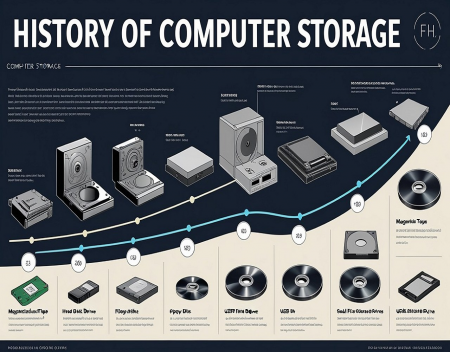
Every computer needs a way to store information. Operating systems, applications, photographs, videos, documents, and games all require storage space, and the technology used to preserve that information has changed dramatically over the decades.
Today's computers can store enormous amounts of data on tiny solid-state drives, memory cards, and cloud-based platforms. However, computer storage did not always offer such convenience. Early systems relied on paper cards, magnetic tape, and enormous mechanical devices that held only a fraction of the information that fits on a modern USB drive.
The history of computer storage is a story of shrinking hardware, increasing capacity, improving reliability, and the growing importance of preserving digital information.
The Earliest Days: Punch Cards and Paper TapeBefore modern electronic storage became available, computers often relied on physical media to hold instructions and data.
Punch cards were among the earliest methods used to represent information in a form that machines could read. Each card contained a pattern of holes corresponding to specific data or instructions. The concept developed from earlier punched-card systems used in industries such as textile manufacturing and census processing.
During the 1940s and 1950s, punch cards became an important part of computer operations. Programmers and operators prepared stacks of cards containing programs or data, which a computer could process in sequence.
Paper tape offered another way to store information. Like punch cards, it represented data using holes punched into a physical medium. Because tape could hold a continuous sequence of information, it was useful for certain types of input and output.
These methods were slow and inconvenient compared with modern storage. Cards could be dropped, damaged, misplaced, or loaded in the wrong order. Nevertheless, they played a critical role in the development of early computing.
Magnetic Tape and Early Disk StorageAs computers became more capable, the need for faster and more practical storage increased.
Magnetic tape became an important solution. Information was recorded magnetically on a long strip of tape, allowing large amounts of data to be stored relatively inexpensively.
Tape was particularly useful for backups, archives, and processing large amounts of information in sequence. However, finding a specific file could require moving through the tape until the desired location was reached. This made tape less convenient for applications that needed immediate access to many different pieces of data.
A major milestone arrived in 1956, when IBM introduced the IBM 305 RAMAC system, which included an early commercial hard disk drive. Its storage unit used a stack of large magnetic disks and could hold approximately five megabytes of data.
That capacity sounds tiny today, but the system was revolutionary for its time. Instead of relying entirely on sequential media, computers could access stored information more directly.
Early disk drives were enormous, expensive, and mechanically complex. Over time, however, manufacturers developed smaller drives with greater capacity and better performance.
The Rise of Floppy DisksDuring the 1970s and 1980s, floppy disks helped make computer storage more accessible.
Floppy disks used flexible magnetic media enclosed in protective covers. They allowed users to save programs, documents, and other files and transfer them between compatible computers.
The original 8-inch floppy disks were followed by smaller 5.25-inch versions and, eventually, the familiar 3.5-inch disks used with many personal computers.
Storage capacity increased across successive generations, although it remained limited by modern standards. A common high-density 3.5-inch floppy disk held 1.44 megabytes.
Despite their limitations, floppy disks transformed personal computing. Users could install software, back up documents, and exchange files without requiring access to a large central computer.
Their weaknesses included limited capacity, susceptibility to physical damage, and relatively slow data transfer. As applications and files grew larger, floppy disks gradually became impractical.
Hard Drives Become EssentialHard disk drives, commonly called HDDs, became a standard component of personal computers as the technology matured.
Unlike floppy disks, hard drives contained rigid magnetic platters that spun at high speeds. Read-and-write heads accessed information stored on their surfaces.
Early personal computer hard drives offered capacities measured in megabytes. Over the following decades, improvements in magnetic recording, mechanical engineering, and data organization increased storage capacity dramatically.
Gigabyte-sized drives became common, followed by drives holding hundreds of gigabytes and multiple terabytes.
Hard drives offered a major advantage over removable disks: they could store operating systems, applications, and large collections of personal files in one convenient location. Their relatively low cost per gigabyte also made them attractive for desktop computers, servers, and data centers.
However, hard drives rely on moving mechanical components. A fall, mechanical failure, or damaged component can make data inaccessible. Although modern drives are sophisticated devices, they remain vulnerable to certain physical failures.
Optical Storage: CDs, DVDs, and Blu-rayOptical storage introduced another major development in the history of computer data.
Compact discs, or CDs, became popular during the 1980s and 1990s. Data was encoded as microscopic features on a disc and read using a laser. A standard data CD could hold approximately 650 to 700 megabytes.
This represented a significant improvement over floppy disks. CDs were widely used to distribute software, music, multimedia presentations, and computer games.
Recordable CDs later allowed users to create their own discs, making them useful for transferring files and storing backups.
DVDs increased capacity further, with a common single-layer disc holding about 4.7 gigabytes. Blu-ray discs followed, offering substantially greater capacity and becoming popular for high-definition video and larger data collections.
Optical discs had several advantages, including portability and the ability to distribute prerecorded content cheaply. Properly stored recordable discs can also preserve information for extended periods, although their lifespan varies with the media, manufacturing quality, and storage conditions.
Eventually, faster internet connections, USB flash drives, and hard drives reduced the need for optical media in everyday computing.
USB Flash Drives and Memory CardsFlash memory changed how people carried and transferred digital information.
Unlike hard drives, flash storage has no moving parts. It stores data electronically and retains information even when power is removed.
USB flash drives became widely popular in the early 2000s, offering a convenient alternative to floppy disks and recordable CDs. Early models often held only a few megabytes or tens of megabytes, but capacities quickly increased.
Today, USB drives can hold hundreds of gigabytes or more, making it possible to carry large collections of documents, photographs, videos, and software in a device small enough to fit on a keychain.
Memory cards brought similar benefits to digital cameras, smartphones, handheld gaming devices, and other electronics. Formats such as SD and microSD made it easy to expand storage without significantly increasing the size of a device.
Flash storage is durable and portable, but it is not indestructible. Devices can be lost, damaged, or corrupted, and flash memory has finite write endurance. Important information should never exist in only one location.
The SSD RevolutionOne of the most important developments in modern storage has been the solid-state drive, or SSD.
SSDs use flash memory rather than spinning magnetic platters. Because they have no moving mechanical parts, they can access data much faster than traditional hard drives in many common computing tasks.
Computers equipped with SSDs often start up more quickly, launch applications faster, and respond more smoothly when handling many small files.
Early SSDs were expensive and offered relatively limited capacities. As flash memory manufacturing improved, prices declined and storage capacity increased.
The introduction of NVMe SSDs, which commonly connect through the PCI Express interface, further increased performance compared with older storage interfaces. These drives are particularly useful for demanding workloads, including large file transfers, video editing, and gaming.
Hard drives have not disappeared. They remain valuable for inexpensive bulk storage, backups, and large archives. SSDs, meanwhile, have become the preferred choice for primary storage in many modern computers.
Cloud Storage and the Future of DataComputer storage is no longer limited to physical devices inside a computer.
Cloud storage allows users to save files on remote servers and access them through the internet. Services such as online file drives make it easier to synchronize documents across devices, collaborate with others, and recover information after a local device is lost or damaged.
Cloud storage depends on remote infrastructure, network connectivity, account security, and the policies of the service provider. It can be convenient, but it should not automatically be treated as a complete backup solution.
Meanwhile, data centers continue to combine SSDs, hard drives, magnetic tape, and other technologies according to their performance, capacity, and cost requirements.
Future storage developments may include denser magnetic recording, improved flash memory, advanced optical technologies, and new approaches to long-term data preservation. Researchers are also investigating technologies such as DNA data storage, although this remains a specialized research area rather than a practical replacement for everyday computer drives.
Final ThoughtsThe history of computer storage shows just how far computing has advanced. Punch cards and paper tape gave way to magnetic tape, hard drives, floppy disks, optical discs, flash memory, and high-speed solid-state drives.
Each generation made it easier to store more information, access it more quickly, and share it with other people and devices.
Today, storage is so compact and affordable that an ordinary computer can hold more information than entire early computing systems. Yet the fundamental challenge remains the same: storing information reliably and ensuring it remains available when needed.
As digital files become increasingly important to work, entertainment, communication, and personal life, storage technology will continue to evolve. Regardless of how advanced future devices become, maintaining reliable backups and protecting valuable data will remain essential.
Great experience with Computer Geek. They helped with my website needs and were professional, respon . . . [MORE].

Great, quick service when my laptop went into meltdown and also needed Windows 11 installed. Also ca . . . [MORE].
It was a great experience to working with you. thank you so much. . . . [MORE].
Thank you so much for great service and over all experience is good . highly recommended for all peo . . . [MORE].
We engaged The Computer Geeks in mid-2023 as they have a reputation for API integration within the T . . . [MORE].
The History of Computer S
The Evolution of Computer

The Browser Wars Revisite