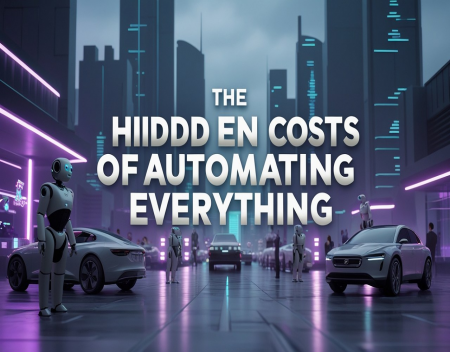
Automation has become one of the defining forces of modern technology. From business operations to everyday consumer tools, the push toward efficiency has led to a world where more tasks are handled by machines than ever before. Powered by advances in Artificial Intelligence and Machine Learning, automation promises speed, accuracy, and reduced human effort. On the surface, this seems like an obvious win. However, beneath the convenience lies a set of hidden costs that are often overlooked.
One of the most immediate impacts of automation is the gradual loss of human skill. When systems take over routine tasks, people no longer need to practice those skills regularly. Over time, this can lead to a decline in proficiency. For example, reliance on automated writing tools can weaken communication skills, while automated navigation systems may reduce spatial awareness. These changes are subtle, but they accumulate. Skills that were once second nature can become unfamiliar or even obsolete.
Another cost is the reduction of human oversight. Automated systems are designed to operate independently, making decisions based on data and predefined rules. While this can improve efficiency, it also creates a risk of errors going unnoticed. If a system makes a mistake, it can propagate quickly, especially when processes are interconnected. Without active human monitoring, small issues can escalate into significant problems. The assumption that automation is always accurate can lead to complacency, where errors are only discovered after they have caused damage.
There is also the issue of dependency. As automation becomes more integrated into daily life, individuals and organizations begin to rely on it for essential functions. This dependency can create vulnerabilities. When automated systems fail—whether due to technical issues, cyberattacks, or unexpected conditions—the impact can be severe. Businesses may struggle to operate without their automated processes, and individuals may find themselves unable to complete basic tasks without digital assistance. The more we automate, the more we risk losing the ability to function without it.
Economic implications are another important consideration. Automation can reduce costs for businesses by minimizing the need for human labor, but it can also lead to job displacement. Roles that involve repetitive or predictable tasks are particularly at risk. While new jobs may be created in areas related to technology and system management, the transition is not always smooth. Workers may need to retrain or adapt to entirely different fields, which can be challenging. The benefits of automation are not always evenly distributed, leading to potential inequalities.
Beyond economics, there is a psychological dimension to automation. Work is not just a means of earning a living; it is also a source of identity and purpose for many people. When tasks are automated, individuals may feel less connected to their work. The sense of accomplishment that comes from completing a task can be diminished when a machine does most of the work. This can lead to reduced engagement and satisfaction, particularly in roles that become heavily automated.
Automation also affects decision-making. Systems that analyze data and provide recommendations can be extremely useful, but they can also influence how decisions are made. When people rely on automated suggestions, they may be less likely to question or explore alternative options. This can limit creativity and critical thinking. Over time, decision-making may become more about accepting system outputs than actively evaluating choices.
Privacy is another hidden cost. Automated systems often rely on large amounts of data to function effectively. This data can include personal information, behavioral patterns, and usage habits. As more processes are automated, more data is collected and analyzed. This raises concerns about how that data is stored, used, and protected. Users may not always be aware of the extent to which their information is being utilized, creating a gap between convenience and control.
There is also a broader societal impact. As automation becomes more widespread, it can reshape how systems and institutions operate. From healthcare to finance, automated processes can influence outcomes in ways that are not always transparent. Decisions that affect individuals may be made by algorithms, raising questions about accountability and fairness. When a system determines an outcome, it can be difficult to understand or challenge the reasoning behind it.
Despite these challenges, automation is not inherently negative. It has the potential to improve efficiency, reduce errors, and free up time for more meaningful activities. The issue is not automation itself, but the extent to which it is applied without consideration of its consequences. A balanced approach is essential, where automation is used to support human capabilities rather than replace them entirely.
To achieve this balance, it is important to maintain human involvement in critical processes. This includes oversight, decision-making, and skill development. Organizations and individuals should be mindful of where automation adds value and where it may introduce risks. By understanding the hidden costs, it becomes possible to make more informed choices about how and when to automate.
In the end, the goal should not be to automate everything, but to automate wisely. Technology should enhance human capability, not diminish it. By recognizing both the benefits and the drawbacks, we can create systems that are not only efficient, but also resilient, ethical, and aligned with human needs.
Great experience with Computer Geek. They helped with my website needs and were professional, respon . . . [MORE].

Great, quick service when my laptop went into meltdown and also needed Windows 11 installed. Also ca . . . [MORE].
It was a great experience to working with you. thank you so much. . . . [MORE].
Thank you so much for great service and over all experience is good . highly recommended for all peo . . . [MORE].
We engaged The Computer Geeks in mid-2023 as they have a reputation for API integration within the T . . . [MORE].
The Rise of Automation in
Why Every Business Needs
ERP Systems for Small Bus