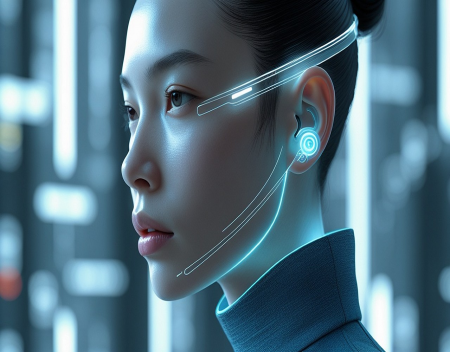
Wearable technology has evolved from simple digital watches and basic fitness trackers into sophisticated devices capable of monitoring activity, communicating with smartphones, displaying information, and assisting with everyday tasks.
Smartwatches can now track exercise, display messages, make calls, provide navigation, and monitor various aspects of a user's activity. Wireless earbuds have become miniature computers with microphones, sensors, and increasingly sophisticated software. Smart glasses are also developing rapidly, bringing digital information closer to our everyday surroundings.
But today's wearables may only be the beginning.
As sensors become smaller, processors become more efficient, and artificial intelligence becomes more capable, wearable technology could eventually become one of the most important ways humans interact with computers.
From Watches to Personal ComputersThe smartwatch is probably the most successful example of modern wearable technology.
Early smartwatches were primarily accessories for smartphones. They displayed notifications, tracked activity, and performed a few basic functions.
Today's devices are considerably more capable.
A modern smartwatch can often operate independently of a phone, connect to cellular networks, play music, provide directions, make payments, and run applications.
Future watches could become even more independent.
Instead of simply displaying information from a smartphone, the wearable itself could become a primary personal computing device.
The smartphone may still exist, but users could increasingly interact with their digital lives through a combination of watches, earbuds, glasses, and other wearable devices.
Artificial Intelligence on Your WristArtificial intelligence is likely to have a major impact on wearable technology.
Instead of requiring users to navigate menus and applications, future wearables could allow people to interact with an AI assistant naturally.
You might ask your watch a question, tell it to send a message, ask for directions, or request a summary of information without opening an application.
AI could also make wearables more personalized.
A device could learn how its owner typically behaves and provide useful information at the appropriate time.
Rather than constantly checking the device, users could receive assistance when it is actually relevant.
Smart GlassesSmart glasses could eventually become one of the most important wearable technologies.
Unlike a smartwatch, glasses can display digital information directly in front of the user's eyes without requiring them to look down at another device.
Potential applications include navigation, translation, communication, entertainment, education, and workplace assistance.
Imagine walking through a foreign city while your glasses provide directions in your field of view.
You could look at a sign and have it translated automatically.
You might receive a message without taking your phone out of your pocket.
These capabilities could make digital information feel much more integrated with the physical world.
Augmented RealityAugmented reality, or AR, is closely connected to the future of smart glasses.
AR overlays digital information onto the real world.
Future systems could recognize objects, locations, people, and environments and provide relevant information.
For example, a technician working on a piece of equipment could see instructions displayed directly over the machinery.
A student could look at a historical location and see information about what happened there.
A traveler could receive navigation directions without constantly checking a phone.
The possibilities are enormous.
Health and Fitness MonitoringWearables are also becoming increasingly sophisticated at monitoring the body.
Smartwatches and fitness trackers already measure things such as heart rate, activity, sleep, and exercise.
Future devices could incorporate additional sensors capable of monitoring more aspects of a person's physical condition.
This could make wearable technology increasingly useful for personal health management.
However, there is an important distinction between collecting information and providing reliable medical diagnoses.
Wearable devices can provide useful measurements and trends, but users shouldn't automatically assume that every measurement is medically accurate.
Continuous Personal MonitoringOne major advantage of wearable technology is that it can collect information throughout the day.
A smartphone might spend hours sitting on a desk or in a pocket.
A watch, ring, or other wearable can remain in contact with the user almost constantly.
This provides a much more continuous stream of information.
Over time, that information could reveal patterns that aren't obvious from individual measurements.
AI systems could analyze these patterns and potentially provide useful insights about activity, sleep, exercise, and daily habits.
The challenge will be making sure this information remains private.
Smart RingsSmart rings represent another interesting direction.
Unlike watches, rings are small and unobtrusive.
They can potentially contain sensors for measuring movement, temperature, heart rate, sleep, and other information.
Because they are worn continuously, they could provide valuable long-term data without the size and visual presence of a smartwatch.
Future smart rings could also become authentication devices, digital keys, payment devices, or personal identification tools.
Wearable PaymentsWearables are already being used for contactless payments.
Smartwatches can allow users to pay at compatible terminals without pulling out a phone or wallet.
As wearable technology becomes more widespread, payment functionality could become increasingly common.
A ring, watch, or other device could potentially function as a digital wallet.
This could reduce the need to carry physical payment cards.
Wearable CommunicationWearables could also change how we communicate.
Instead of pulling out a smartphone to read a message, a smartwatch or pair of smart glasses could deliver the information immediately.
Future earbuds could incorporate even more AI-powered communication features.
Real-time translation is particularly interesting.
A wearable could potentially translate another person's speech almost instantly, allowing people who speak different languages to communicate more naturally.
This technology is already being developed, but improvements in AI could make it increasingly practical.
The Smartphone May ChangeThe rise of wearables doesn't necessarily mean smartphones will disappear.
Instead, smartphones could become less central.
Today, the smartphone is the primary device through which we interact with digital services.
In the future, computing could become distributed across several devices.
Your phone might handle intensive processing while your watch monitors activity, your earbuds handle audio, and your glasses display information.
AI could connect all of these devices together.
The result could be an ecosystem where the user doesn't have to think about which device is performing a particular task.
Privacy ConcernsThe more powerful wearable technology becomes, the more important privacy will become.
A wearable device could potentially know where you are, what you are doing, what you are looking at, how active you are, and possibly information about your physical condition.
Smart glasses introduce additional concerns because they can potentially capture images and video of people without them realizing it.
Companies will need to establish strong privacy protections and clear rules around data collection.
Users should also have meaningful control over what information their devices collect and how it is used.
Battery LifeBattery technology remains one of the biggest challenges.
People don't want to constantly recharge devices they are expected to wear all day.
A smartwatch that runs out of power after a few hours isn't particularly useful.
Future wearables will need more efficient processors, better batteries, and potentially new methods of generating or conserving energy.
Smaller devices such as smart rings face an even greater challenge because they have extremely limited space for batteries.
Will Wearables Become Invisible?Perhaps the most interesting possibility is that wearable technology may eventually become less noticeable.
Instead of carrying obvious electronic devices, people could use technology integrated into clothing, glasses, jewelry, earbuds, or even other everyday objects.
Technology could become something we wear without thinking about it.
The computer itself may become less important than the services it provides.
Final ThoughtsWearable technology is moving far beyond fitness trackers and smartwatches.
The next generation could combine artificial intelligence, augmented reality, advanced sensors, wireless communication, and biometric technology to create devices that are much more integrated into everyday life.
Smart glasses could bring digital information into the physical world. Smart rings could quietly monitor activity and provide authentication. AI-powered watches and earbuds could become personal assistants that understand what we need without requiring constant interaction.
But this future also brings serious questions about privacy, security, data ownership, battery life, and how much technology we actually want surrounding us.
The most successful wearables may not be the devices with the most features.
They may be the ones that make technology feel less like something we're using and more like something that's simply there when we need it.
The smartphone revolution put a powerful computer in everyone's pocket.
The wearable revolution could take the next step by putting computing all around us.
Great experience with Computer Geek. They helped with my website needs and were professional, respon . . . [MORE].

Great, quick service when my laptop went into meltdown and also needed Windows 11 installed. Also ca . . . [MORE].
It was a great experience to working with you. thank you so much. . . . [MORE].
Thank you so much for great service and over all experience is good . highly recommended for all peo . . . [MORE].
We engaged The Computer Geeks in mid-2023 as they have a reputation for API integration within the T . . . [MORE].

The Rise of Automation in

Why Every Business Needs

ERP Systems for Small Bus