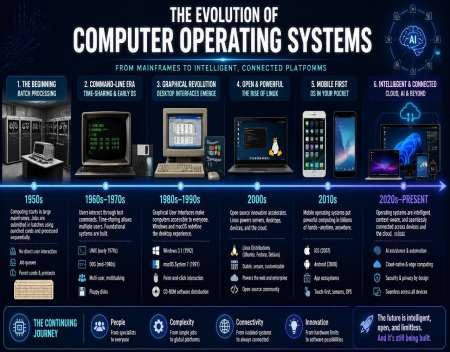
Every computer needs an operating system. Whether you are using a desktop PC, laptop, smartphone, tablet, or server, the operating system is the software responsible for managing the hardware and allowing applications to function.
Today, operating systems make computing seem relatively simple. Users can open programs, browse the internet, manage files, connect devices, and switch between applications without needing to understand what is happening behind the scenes.
However, operating systems have come a long way from the early days of computing. Their evolution reflects the broader history of technology, from enormous mainframe computers to personal computers, mobile devices, and cloud-based systems.
Understanding how operating systems developed helps explain why modern computers work the way they do.
Before Modern Operating SystemsIn the earliest days of computing, computers did not have operating systems like the ones we recognize today.
During the 1940s and early 1950s, computers were enormous machines that required specialized operators. Programs were entered using methods such as punched cards, switches, and paper tape. Users often had to interact directly with the hardware or prepare instructions for an operator to execute.
Each program generally ran individually, and setting up a new task could be time-consuming. There was little automation to manage different programs or share computer resources.
As computers became more powerful and businesses began using them for increasingly complex operations, managing these machines became more difficult. This created the need for software that could coordinate hardware, organize tasks, and simplify the execution of programs.
The First Operating SystemsDuring the 1950s, early operating systems began appearing on mainframe computers.
One important development was batch processing. Instead of requiring an operator to manually prepare and execute every individual program, jobs could be collected into groups and processed automatically.
The operating system managed the order in which tasks were performed and helped reduce the amount of time computers spent sitting idle between jobs.
IBM played a major role in the development of early operating systems. Its IBM 709 and later System/360 families helped advance automated computing environments.
In 1964, IBM introduced OS/360, an operating system designed for its System/360 mainframe computers. It was a major project intended to support a family of compatible machines.
OS/360 helped establish the idea that an operating system could manage many different hardware resources while providing a consistent environment for applications.
UNIX Introduces a New ApproachOne of the most influential operating systems in computing history is UNIX.
Developed at Bell Labs beginning in 1969, UNIX was designed to be flexible, efficient, and capable of supporting multiple users at the same time.
It introduced or popularized concepts that remain important in modern operating systems, including a hierarchical file system, multitasking, user permissions, and a powerful command-line environment.
Another important feature was portability. UNIX was rewritten in the C programming language, making it easier to adapt to different hardware platforms.
This helped UNIX spread into universities, research institutions, businesses, and later commercial computing environments.
Its influence remains visible today. Linux, macOS, and many server operating systems are based on or influenced by UNIX concepts.
The Rise of Personal Computer Operating SystemsThe arrival of affordable personal computers during the late 1970s and early 1980s created an entirely new market for operating systems.
One of the earliest widely used PC operating systems was CP/M, developed by Gary Kildall and Digital Research. It became popular on many early microcomputers and provided a standardized environment for running software.
A major turning point came in 1981 when IBM introduced its first IBM Personal Computer.
The machine used PC DOS, supplied by Microsoft, which also marketed a related version called MS-DOS.
MS-DOS became extremely influential because it was used by many IBM-compatible computers. It relied on a command-line interface, meaning users typed commands to perform tasks such as opening files, launching programs, and managing disks.
Although DOS was relatively limited compared with modern operating systems, it helped establish the personal computer market.
Users could now own a computer, install software, manage files, and perform many tasks without depending on a large centralized computer system.
Windows Changes How People Use ComputersMicrosoft Windows transformed personal computing by making graphical interfaces more accessible.
Before Windows became dominant, many PC users relied on command-line operating systems. Although powerful, these environments could be intimidating for beginners.
Microsoft introduced Windows 1.0 in 1985. It provided a graphical environment that allowed users to interact with applications through windows, menus, icons, and a mouse.
Early versions had limitations, but Windows continued to improve.
Windows 3.0, released in 1990, helped make graphical computing more popular. Windows 3.1 followed in 1992 and became widely used on personal computers.
A major milestone arrived in 1995 with Windows 95. It introduced the Start menu, taskbar, and a more familiar desktop experience that influenced later versions of Windows.
Windows 95 helped bring personal computing into millions of homes and businesses.
Subsequent releases, including Windows 98, Windows XP, Windows 7, Windows 10, and Windows 11, introduced improvements in performance, security, networking, and usability.
Windows remains one of the most widely used desktop operating systems in the world.
Apple's Contribution to Operating System DevelopmentApple has also played an important role in the evolution of operating systems.
The original Macintosh, introduced in 1984, helped popularize the graphical user interface for personal computers. Its combination of windows, icons, menus, and a mouse made computing more approachable for ordinary users.
Apple continued developing its classic Mac operating system throughout the following decades.
In 2001, Apple introduced Mac OS X, which was built on a UNIX-based foundation. It combined a modern graphical interface with the stability and technical foundations of UNIX.
The operating system was eventually renamed macOS and remains the foundation of Apple's desktop and laptop computers.
Apple's approach has emphasized close integration between hardware and software. This allows the company to design operating systems specifically for its own computers rather than supporting the enormous variety of hardware configurations found in the Windows ecosystem.
Linux and the Open-Source RevolutionAnother major milestone occurred in 1991, when Linus Torvalds began developing the Linux kernel.
Linux became the foundation of a large family of open-source operating systems known as Linux distributions.
Unlike proprietary operating systems that are controlled by individual companies, Linux is developed collaboratively by a global community of programmers and organizations.
Users can choose from many different distributions, including Ubuntu, Debian, Fedora, and Linux Mint.
Linux has become especially important in servers, supercomputers, cloud computing, embedded devices, and networking equipment.
It is also the foundation of Android, the world's most widely used mobile operating system.
The success of Linux demonstrated that open-source development could produce powerful, reliable software capable of competing with major commercial products.
The Mobile Operating System RevolutionThe arrival of smartphones created another major shift in operating system development.
Earlier mobile phones had relatively simple software designed primarily for calls, messaging, and basic applications.
Apple changed the market with the introduction of the iPhone in 2007 and its accompanying mobile operating system, initially called iPhone OS and later renamed iOS.
Its touchscreen interface, mobile applications, and integration with internet services helped establish a new standard for smartphones.
Google introduced Android commercially in 2008. Built on a Linux kernel, Android provided an alternative mobile operating system that could be used by many different smartphone manufacturers.
Together, iOS and Android transformed mobile computing.
Operating systems were no longer limited to desktop computers and laptops. They became essential to smartphones, tablets, smart televisions, watches, vehicles, and countless connected devices.
Cloud Computing and Modern Operating SystemsModern operating systems must manage more than the hardware inside a single computer.
Cloud computing has changed how applications are delivered, how information is stored, and how businesses manage their technology infrastructure.
Operating systems now play an important role in virtual machines, containers, remote computing environments, and large-scale server systems.
Some users interact with cloud-based applications through a browser without needing to install traditional desktop software.
Security has also become a much greater priority. Modern operating systems include built-in firewalls, encryption, access controls, automatic updates, application permissions, and other protective features.
Artificial intelligence is beginning to influence operating system development as well. Modern systems are incorporating AI assistants, intelligent search, automated productivity features, and tools that help users interact with their computers more naturally.
What Does the Future Hold?The next generation of operating systems will likely focus on security, automation, artificial intelligence, and integration across devices.
AI may become a more central part of the operating system itself, allowing users to perform tasks through natural language rather than navigating menus and applications.
Operating systems may also become increasingly connected to cloud services, allowing users to move between devices while maintaining access to their applications and information.
At the same time, privacy and security will remain major challenges. As computers become more interconnected, operating systems must protect users against increasingly sophisticated threats.
Final ThoughtsThe evolution of computer operating systems mirrors the development of computing itself.
Early computers relied on manual instructions and simple batch-processing systems. UNIX introduced influential concepts that continue to shape modern software. DOS helped establish the personal computer market, while Windows and macOS made graphical computing accessible to millions of people.
Linux demonstrated the power of open-source development, and Android and iOS transformed computers into portable devices that fit in our pockets.
Today's operating systems are far more than tools for launching applications. They manage complex hardware, protect information, connect devices, and provide the foundation for nearly every digital activity.
As technology continues to advance, operating systems will evolve alongside it. The next major transformation may be driven by artificial intelligence, making computers more intuitive, automated, and capable than ever before.
Great experience with Computer Geek. They helped with my website needs and were professional, respon . . . [MORE].

Great, quick service when my laptop went into meltdown and also needed Windows 11 installed. Also ca . . . [MORE].
It was a great experience to working with you. thank you so much. . . . [MORE].
Thank you so much for great service and over all experience is good . highly recommended for all peo . . . [MORE].
We engaged The Computer Geeks in mid-2023 as they have a reputation for API integration within the T . . . [MORE].
The Evolution of Operatin
How Search Engines Change
Milestones in Artificial