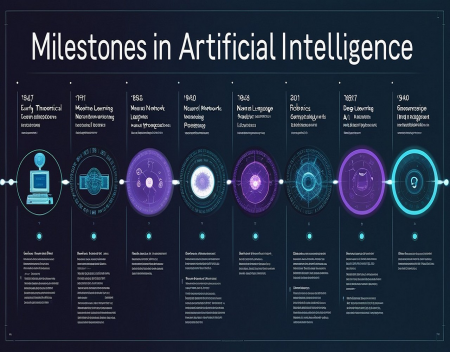
Artificial intelligence has become one of the most influential technologies of the modern world. It powers voice assistants, recommends movies and products, helps doctors analyze medical information, generates images and written content, and supports increasingly sophisticated business operations.
However, artificial intelligence did not appear overnight. Its development spans decades of scientific research, ambitious experiments, technological breakthroughs, and occasional disappointments. What began as an attempt to teach computers to perform tasks associated with human intelligence has grown into a major industry that is transforming how people live and work.
Understanding the major milestones in artificial intelligence provides a fascinating look at how far the technology has come and where it might be heading.
The Foundations of Artificial IntelligenceThe origins of artificial intelligence can be traced back to the early development of modern computing. During the 1940s and 1950s, scientists began exploring whether machines could perform tasks that traditionally required human reasoning.
One important figure was British mathematician Alan Turing. In 1950, he published a paper titled Computing Machinery and Intelligence, which explored the question of whether machines could think.
Turing proposed what became known as the Turing Test. The idea was to determine whether a machine could communicate in a way that was indistinguishable from a human during a text-based conversation. Although the test does not establish whether a machine truly understands information, it became an influential concept in AI research.
Another major milestone came in 1956 at the Dartmouth Summer Research Project on Artificial Intelligence. Organized by researchers including John McCarthy, Marvin Minsky, Nathaniel Rochester, and Claude Shannon, the conference helped establish artificial intelligence as a formal field of study.
John McCarthy is widely credited with coining the term "artificial intelligence." Researchers at the time were optimistic that machines could eventually solve problems, understand language, and demonstrate forms of human-like reasoning.
Early AI Programs and Problem SolvingDuring the late 1950s and 1960s, researchers developed programs designed to solve mathematical problems, prove logical statements, and play games.
One notable example was the Logic Theorist, developed in 1956 by Allen Newell, Herbert Simon, and Cliff Shaw. It was designed to prove mathematical theorems and demonstrated that computers could perform certain forms of logical reasoning.
Another important development was the General Problem Solver, introduced in 1957. It attempted to use a general approach to solving different types of problems rather than being designed for only one specific task.
Researchers also experimented with computer programs that could play chess and other strategy games. These early systems were limited by computing power, memory, and the complexity of the problems they were attempting to solve.
Nevertheless, they established an important principle: computers could be programmed to perform tasks that appeared to require intelligence.
The First AI WinterEarly enthusiasm about artificial intelligence led to ambitious predictions. Some researchers believed that human-level machine intelligence might be achieved within a relatively short period.
Reality proved more difficult.
Computers lacked the processing power and memory needed to handle many complex problems. Early AI systems also struggled with uncertainty, common sense, and situations that differed from the examples they had been programmed to recognize.
As progress slowed, government agencies and research organizations became less willing to fund ambitious projects.
This period became known as the first AI winter, which developed during the 1970s. Funding reductions and disappointment affected several areas of AI research, although important work continued.
The experience demonstrated that creating intelligent machines was considerably more difficult than early researchers had anticipated.
Expert Systems Bring AI into BusinessArtificial intelligence experienced renewed interest during the late 1970s and 1980s through the development of expert systems.
Unlike earlier programs that attempted to solve broad problems, expert systems focused on specific areas of knowledge. They used collections of rules and information provided by human specialists to make recommendations or reach conclusions.
One well-known example was MYCIN, an experimental medical expert system developed at Stanford University during the 1970s. It was designed to help identify certain bacterial infections and recommend appropriate antibiotics.
Expert systems were also used in manufacturing, engineering, financial services, and equipment troubleshooting.
Businesses became interested because these systems could help preserve specialized knowledge and assist employees with complicated decisions.
However, expert systems had limitations. They depended heavily on manually entered rules and could struggle when faced with unfamiliar situations. Maintaining their knowledge bases could also become expensive and time-consuming.
Interest eventually declined, contributing to another period of reduced enthusiasm for AI during the late 1980s and early 1990s.
IBM Deep Blue Defeats a Chess ChampionOne of the most publicized artificial intelligence milestones occurred in 1997, when IBM's Deep Blue defeated reigning world chess champion Garry Kasparov in a six-game match.
Deep Blue was a specialized chess-playing computer capable of evaluating enormous numbers of possible moves. Its performance demonstrated how powerful computing systems could outperform even world-class human experts in carefully defined tasks.
The victory attracted worldwide attention because chess had long been considered a measure of strategic intelligence.
However, Deep Blue was not a general-purpose intelligent machine. It was designed specifically for chess and relied heavily on search algorithms, evaluation functions, and specialized computing hardware.
Its achievement showed the potential of computers to outperform humans in certain intellectual activities, even without possessing human-like understanding.
Machine Learning Changes the Direction of AIFor many years, artificial intelligence relied heavily on instructions and rules written by human programmers. Machine learning introduced a different approach.
Instead of telling a computer exactly how to perform every task, developers could train systems using data. The computer would identify patterns and use them to make predictions or classifications.
Machine learning became increasingly important as computers grew more powerful and large collections of digital information became available.
Applications included spam filtering, credit risk assessment, fraud detection, speech recognition, and product recommendations.
A particularly important development was the growth of neural networks, which were inspired loosely by the structure of the human brain. These systems use interconnected artificial neurons to identify patterns in information.
Although neural networks had existed for decades, improvements in computing hardware, training techniques, and available data eventually made them far more practical.
Deep Learning and the Image Recognition BreakthroughA major turning point arrived in 2012 with the success of AlexNet in the ImageNet Large Scale Visual Recognition Challenge.
Developed by researchers including Alex Krizhevsky, Ilya Sutskever, and Geoffrey Hinton, AlexNet used a deep neural network trained on a large collection of labeled images.
It significantly outperformed competing approaches in the challenge, demonstrating the potential of deep learning for image recognition.
This achievement helped accelerate investment and research into neural networks.
Deep learning subsequently became important in facial recognition, medical image analysis, autonomous vehicles, voice assistants, language processing, and many other applications.
The combination of large datasets, powerful graphics processing units, and improved algorithms transformed AI from a specialized research field into a rapidly expanding commercial technology.
AlphaGo Makes HistoryIn 2016, Google's DeepMind achieved another major milestone when its AlphaGo system defeated Lee Sedol, one of the world's leading Go players.
Go is an ancient board game with an enormous number of possible positions. Unlike chess, where traditional search techniques can be particularly effective, Go presents a much more complicated challenge because of its vast decision space.
AlphaGo combined deep neural networks with search techniques to evaluate positions and select moves.
Its victory surprised many observers because Go had been considered especially difficult for computers to master at a high level.
The achievement demonstrated how machine learning could help computers develop effective strategies in complex environments.
Generative AI Changes EverythingOne of the most significant recent developments has been the emergence of generative artificial intelligence.
Earlier AI systems were often designed to recognize patterns, classify information, or make predictions. Generative AI goes further by producing new content, including written material, images, music, computer code, and video.
A major technical development behind modern language models was the transformer architecture, introduced by Google researchers in a 2017 research paper titled Attention Is All You Need.
Transformers made it possible to train increasingly powerful language models by analyzing relationships between words and other elements of information.
In 2022, OpenAI released ChatGPT to the public. Its conversational interface allowed people to interact with a large language model using ordinary written language.
The technology quickly attracted worldwide attention. Users discovered that AI could help draft emails, explain complicated subjects, write computer code, summarize documents, brainstorm ideas, and answer questions.
Other companies introduced competing systems, while AI image generators and video-generation tools expanded the range of creative applications.
Generative AI has also raised concerns about misinformation, copyright, privacy, employment, and the reliability of machine-generated information.
AI Agents and the Next Stage of DevelopmentArtificial intelligence is now moving beyond systems that simply respond to individual questions.
AI agents are designed to perform multi-step tasks with varying degrees of independence. Depending on their capabilities and permissions, they may research information, organize files, interact with software, prepare reports, or assist with business processes.
This represents an important shift from AI as a tool that generates answers toward AI as a system that can help complete work.
However, reliable autonomous operation remains challenging. Agents can misunderstand instructions, make mistakes, or take inappropriate actions if they are given excessive permissions or insufficient supervision.
As a result, human oversight, security controls, and careful testing remain important parts of practical AI deployment.
Final ThoughtsThe history of artificial intelligence is filled with important milestones, from Alan Turing's early questions about machine intelligence to the Dartmouth conference, expert systems, Deep Blue, deep learning, AlphaGo, and modern generative AI.
Each breakthrough built upon earlier research and benefited from improvements in computing power, algorithms, and access to information.
Artificial intelligence has moved from experimental programs in university laboratories to tools used by millions of people every day. Yet many of the original questions remain unanswered. Can machines truly understand the world? Will they eventually demonstrate general intelligence? How should society manage systems that become increasingly capable?
The next milestones in AI may be even more significant than those that came before. What is certain is that artificial intelligence will continue to influence technology, business, science, and everyday life for many years to come.
Great experience with Computer Geek. They helped with my website needs and were professional, respon . . . [MORE].

Great, quick service when my laptop went into meltdown and also needed Windows 11 installed. Also ca . . . [MORE].
It was a great experience to working with you. thank you so much. . . . [MORE].
Thank you so much for great service and over all experience is good . highly recommended for all peo . . . [MORE].
We engaged The Computer Geeks in mid-2023 as they have a reputation for API integration within the T . . . [MORE].
Milestones in Artificial
The Story of the First La
The History of Computer S