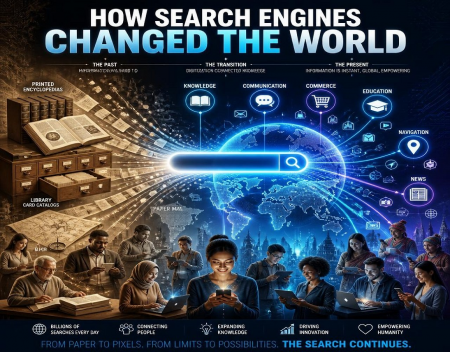
Imagine trying to find information today without Google, Bing, or any other search engine. Looking for a restaurant, researching a medical question, finding a business, or learning how to repair something would be considerably more difficult. We have become so accustomed to typing a few words into a search box and receiving thousands of results that it is easy to forget how revolutionary this technology really is.
Search engines fundamentally changed how people access information. They transformed the internet from a collection of disconnected websites into a searchable resource that influences education, business, entertainment, communication, and everyday decision-making.
Their impact extends far beyond helping people find websites. Search engines have changed how companies operate, how information spreads, and even how society understands the world.
Before Search Engines: Finding Information Was DifficultDuring the early days of the internet, finding information was not nearly as convenient as it is today.
The World Wide Web began expanding in the early 1990s, but there were relatively few websites compared with the billions available today. Users often discovered websites through recommendations, online communities, printed directories, and lists maintained by other websites.
Early web directories organized websites into categories such as business, education, technology, and entertainment. Yahoo!, which began as a directory of websites in 1994, became one of the best-known examples.
Directories were useful, but they depended on people manually reviewing and organizing websites. As the internet expanded, keeping these directories complete and current became increasingly difficult.
Users needed a better way to search through the growing amount of information available online.
The First Search EnginesSeveral early search engines helped establish the technology we use today.
One important early system was Archie, created in 1990 to help users locate files stored on public FTP servers. Although it did not search the modern web in the way today's engines do, it demonstrated the value of automatically indexing online information.
As the World Wide Web grew, more sophisticated search tools appeared. WebCrawler, launched in 1994, became one of the first search engines to index the full text of webpages.
Other services followed, including Lycos, AltaVista, Excite, and Infoseek. These platforms helped users locate websites by entering keywords and receiving lists of matching results.
However, early search engines had limitations. Results were often determined largely by keyword matching, which meant that websites could rank highly simply by repeating popular search terms. Finding the most useful or trustworthy information was not always easy.
The industry needed a better way to determine which websites deserved to appear near the top of search results.
Google Changes the Search Industry<PRIVATE_PERSON>One of the most important moments in search engine history occurred in 1998, when Larry Page and Sergey Brin officially launched Google.
Their approach included an algorithm known as PageRank, which evaluated the importance of webpages partly by examining links between them. A link from another website could be interpreted as a signal that a page was useful or relevant.
This approach helped Google deliver more useful results than many competing search engines at the time.
Google also became known for its simple interface. Instead of filling its homepage with news, advertisements, and directory categories, the company focused on a clean search box.
The combination of relevant results, speed, and simplicity helped Google become the dominant search engine.
Over time, Google expanded beyond basic web searches. It introduced services and features for searching images, maps, news, videos, shopping information, and academic research.
Search became an essential part of Google's business model, particularly through advertising. Businesses could pay to display advertisements alongside relevant search results, creating an enormous new market for online advertising.
Search Engines Transform BusinessSearch engines changed the way businesses attract customers.
Before online search became widespread, companies relied heavily on traditional advertising methods such as newspapers, radio, television, flyers, and telephone directories.
The internet introduced a different opportunity. Instead of advertising to everyone in a particular area or audience, businesses could reach people who were actively searching for a specific product or service.
This helped create the modern search engine marketing industry.
Companies began investing in search engine optimization, commonly known as SEO. SEO involves improving a website's content, structure, and technical performance so that it has a better chance of appearing prominently in relevant search results.
Paid search advertising also became a major industry. Businesses could bid on keywords and pay when users clicked their advertisements.
For small businesses, search engines created opportunities that previously would have been difficult to achieve. A local company could attract customers searching for its services without needing the advertising budget of a large corporation.
Today, appearing in search results can have a significant impact on website traffic, sales, brand recognition, and business growth.
Search Engines Changed Education and ResearchSearch engines have also transformed education and access to knowledge.
In the past, students and researchers often depended on libraries, printed encyclopedias, specialized publications, and physical reference materials.
These resources remain valuable, but search engines have made it much faster to locate information from around the world.
Students can research historical events, scientific discoveries, technical subjects, and current developments within seconds. Researchers can discover academic papers, government publications, and specialized databases without physically visiting multiple libraries.
Search engines have also made lifelong learning more accessible. Someone interested in programming, photography, electronics, business, or virtually any other subject can find tutorials, educational videos, and detailed explanations online.
However, easier access to information does not automatically mean that the information is accurate. Search engines can return outdated, misleading, biased, or incorrect material. Learning how to evaluate sources has become an important digital skill.
The Rise of Search-Driven CultureSearch engines have changed human behavior in ways that extend beyond business and education.
People increasingly expect immediate answers to everyday questions. Rather than trying to remember a fact, many simply search for it. Directions, product reviews, recipes, weather information, entertainment recommendations, and troubleshooting instructions are all available within seconds.
This has created a culture in which information is expected to be instantly accessible.
Search engines have also influenced how people communicate. Businesses write website content around the phrases customers are likely to search. News organizations consider search visibility when publishing stories. Content creators research popular topics and questions to attract audiences.
Even the way people phrase questions has changed. Instead of searching for a broad subject, users increasingly enter complete questions such as "How do I replace a laptop battery?" or "What is the difference between an SSD and an HDD?"
Search technology has adapted to these habits by becoming better at understanding the meaning behind queries rather than simply matching individual words.
The Dark Side of Search EnginesDespite their benefits, search engines have created several challenges.
Privacy concerns: Search engines can collect information about searches, browsing activity, locations, and user interests. Depending on the service and its settings, this information may be used to personalize results and advertising.
Misinformation: Search results can lead users to unreliable websites, conspiracy theories, fraudulent services, and misleading content. Ranking highly does not automatically make a source trustworthy.
Advertising influence: Paid advertisements can appear alongside organic results. Although they are generally labeled, users may not always distinguish between sponsored content and independently ranked webpages.
Market concentration: A small number of major companies control a substantial portion of the search market. This raises questions about competition, transparency, and how information is ranked and presented.
The impact on publishers: Websites, newspapers, and independent content creators often depend on search traffic. Changes to search algorithms can dramatically affect their visitor numbers and advertising revenue.
These issues have encouraged the development of alternative search engines that emphasize privacy, different ranking approaches, or specialized search experiences.
Artificial Intelligence Is Changing Search AgainSearch engines are now entering another major period of transformation.
Traditional search engines generally provide a list of links that users must open and evaluate themselves. Artificial intelligence is introducing systems that can summarize information, answer questions conversationally, and combine details from multiple sources.
AI-powered search experiences may allow users to ask complicated questions and receive organized explanations instead of having to visit numerous websites.
This can make research faster and more convenient, but it also introduces new concerns. AI-generated answers can contain errors, misunderstand information, or fail to recognize important differences between sources.
There are also questions about how website publishers will be affected if users receive answers directly from search engines without visiting the original websites.
The relationship between search engines, online publishers, advertisers, and users is likely to change considerably as AI becomes more integrated into information discovery.
Final ThoughtsSearch engines have fundamentally changed the world by making information easier to find, access, and share. They helped transform the internet from a relatively difficult collection of websites into an essential resource for modern life.
They have created new business opportunities, changed education, influenced advertising, and reshaped how people make everyday decisions.
However, the technology continues to evolve. Artificial intelligence, privacy concerns, misinformation, and the growing influence of major technology companies will shape the next generation of search.
The original purpose of search engines was relatively simple: help people find information. Today, they do much more than that. They influence what people discover, what businesses succeed, and how society interacts with knowledge.
As the technology continues to advance, search engines will remain one of the most important tools shaping our digital world.
Great experience with Computer Geek. They helped with my website needs and were professional, respon . . . [MORE].

Great, quick service when my laptop went into meltdown and also needed Windows 11 installed. Also ca . . . [MORE].
It was a great experience to working with you. thank you so much. . . . [MORE].
Thank you so much for great service and over all experience is good . highly recommended for all peo . . . [MORE].
We engaged The Computer Geeks in mid-2023 as they have a reputation for API integration within the T . . . [MORE].
How Search Engines Change
Milestones in Artificial
The Story of the First La