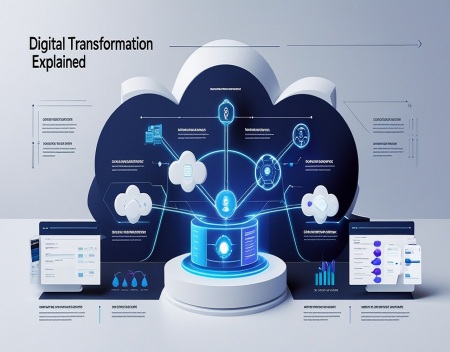
Technology is changing the way businesses operate, communicate with customers, manage employees, and deliver products and services. From cloud computing and artificial intelligence to automation and data analytics, modern technology offers businesses new ways to become more efficient and competitive.
This broader shift is known as digital transformation.
Digital transformation involves using digital technologies to improve how an organization operates and delivers value to its customers. However, it is about much more than purchasing new computers or installing new software. It often requires businesses to rethink existing processes, improve how information is shared, and change the way employees work.
For businesses of all sizes, understanding digital transformation is becoming increasingly important.
What Is Digital Transformation?Digital transformation is the process of integrating digital technology into different areas of a business to improve performance, efficiency, and customer experiences.
Consider a company that still manages customer orders using paper forms and spreadsheets. Employees may spend hours entering information, checking inventory, creating invoices, and updating records.
By introducing integrated business software, the company could automate many of these tasks. Orders could update inventory automatically, invoices could be generated electronically, and managers could access current sales information through a central dashboard.
This is an example of digital transformation because technology is changing how the business operates, rather than simply replacing one tool with another.
Digital transformation can affect almost every department, including accounting, marketing, sales, customer service, human resources, inventory management, and information technology.
Why Is Digital Transformation Important?Businesses face growing pressure to operate efficiently, respond quickly to customers, and compete with organizations that use modern technology.
Companies that rely on outdated systems may struggle with slow processes, duplicated work, limited access to information, and rising operating costs.
Digital transformation can help address these challenges.
For example, automated processes can reduce repetitive administrative work. Cloud-based systems can allow employees to access information from different locations. Data analytics can help managers identify business trends, while online services can make it easier for customers to interact with a company.
Digital transformation can also help businesses adapt to changing market conditions.
Organizations that can introduce new services, improve their operations, and respond to customer needs quickly may have an advantage over competitors that are slower to change.
Key Technologies Driving Digital TransformationSeveral technologies are helping businesses modernize their operations.
Cloud ComputingCloud computing allows businesses to use software, storage, and computing resources delivered over the internet.
Instead of maintaining every application on local computers or company-owned servers, businesses can use cloud-based services.
This can reduce the need for expensive hardware and make it easier for employees to access applications remotely. Cloud platforms can also help businesses expand their computing resources as their needs change.
Artificial IntelligenceArtificial intelligence is becoming an important part of digital transformation.
AI can help businesses analyze large amounts of information, automate customer support, generate reports, identify unusual activity, and assist with routine administrative tasks.
For example, an online retailer might use AI to recommend products to customers, while a service company could use AI tools to summarize customer inquiries and help employees respond more quickly.
AI can improve productivity, but businesses must also consider accuracy, privacy, security, and the need for human oversight.
AutomationBusiness process automation uses technology to perform repetitive tasks with limited manual intervention.
Examples include automatically sending invoices, processing online orders, scheduling appointments, generating reports, and notifying employees when a task requires attention.
Automation can reduce errors and free employees to concentrate on activities that require judgment, communication, or specialized knowledge.
Data AnalyticsBusinesses generate information through sales transactions, customer interactions, websites, marketing campaigns, and daily operations.
Data analytics helps turn this information into useful insights.
A company might discover which products generate the most profit, which marketing campaigns attract the most customers, or which processes are creating unnecessary costs.
Better information can help managers make more informed decisions.
The Internet of ThingsThe Internet of Things, commonly called IoT, connects physical devices to networks so they can collect and exchange information.
Businesses can use connected sensors to monitor equipment, track shipments, manage energy consumption, and identify maintenance problems.
For manufacturers, this technology can help detect equipment issues before they cause expensive production interruptions.
Digital Transformation and Customer ExperienceCustomer expectations have changed significantly as digital services have become more common.
Customers increasingly expect to find information online, place orders electronically, receive timely updates, and obtain support through convenient channels.
Digital transformation can help businesses meet these expectations.
For example, a company might introduce online booking, customer account portals, automated appointment reminders, or live order tracking.
A business could also use customer relationship management software to keep customer information and communication history organized.
When these systems work together, employees can provide more consistent service and customers may spend less time waiting for answers.
However, adding technology does not automatically improve customer experience. Digital tools should make interactions easier, not introduce unnecessary complexity.
Digital Transformation for Small BusinessesDigital transformation is not limited to large corporations with substantial technology budgets.
Small businesses can benefit from relatively simple improvements.
A local service company might replace paper scheduling with an online booking system. A retailer could introduce inventory management software. A professional services firm might move from scattered files to secure cloud document management.
Other possibilities include electronic invoicing, online payment processing, customer management software, and automated email marketing.
The key is to identify problems that technology can solve.
Small businesses do not need to replace every system at once. In many cases, starting with one important process and expanding gradually is a more practical approach.
The Challenges of Digital TransformationAlthough digital transformation offers many benefits, it can also create challenges.
Cost is one concern. New software, implementation services, training, and system integrations can require a significant investment.
Employee resistance is another challenge. People who are comfortable with existing processes may be reluctant to adopt unfamiliar technology. Clear communication and practical training can help employees understand why changes are being made.
Cybersecurity also becomes increasingly important as more business operations move online. Companies must protect sensitive information, control access to systems, maintain backups, and keep software updated.
Integration problems can arise when new applications do not work well with existing systems. Businesses should evaluate compatibility before committing to new platforms.
Finally, organizations must avoid adopting technology simply because it is popular. Every investment should address a genuine business need.
How to Start a Digital Transformation ProjectA successful digital transformation begins with a clear understanding of the business's current situation.
First, identify processes that are slow, expensive, unreliable, or unnecessarily complicated. Talk to employees who perform these tasks and determine where improvements would make the greatest difference.
Next, establish specific goals. These might include reducing administrative work, improving customer response times, decreasing inventory errors, or making financial reporting more accurate.
Research technologies that can help achieve these goals, considering their cost, security, ease of use, and ability to integrate with existing systems.
It is usually sensible to begin with a manageable project rather than attempting to modernize the entire organization immediately.
After implementation, measure the results. Determine whether the new system has improved productivity, reduced costs, or delivered the intended benefits.
Successful projects can then provide a foundation for further improvements.
The Future of Digital TransformationDigital transformation will continue as businesses adopt more advanced technologies.
Artificial intelligence is likely to become increasingly integrated into everyday business software. Automation may handle more complex workflows, while connected devices will provide businesses with more detailed information about equipment, products, and operations.
Businesses may also use digital twins, which are virtual representations of physical objects or processes, to simulate conditions and improve planning.
At the same time, cybersecurity, data privacy, and responsible technology use will become even more important.
The organizations most likely to benefit will not necessarily be those that adopt every new technology. They will be the ones that identify useful opportunities, implement technology carefully, and continually improve how they operate.
Final ThoughtsDigital transformation is about using technology to make a business work better. It can improve productivity, reduce repetitive tasks, enhance customer service, and help organizations make better decisions.
However, successful digital transformation requires more than buying new software. It involves understanding business problems, setting clear goals, training employees, protecting information, and measuring results.
For small businesses and large organizations alike, the process does not have to happen overnight.
By starting with practical improvements and building on successful results, businesses can use digital transformation to become more efficient, adaptable, and competitive in an increasingly digital world.
Add practical business examplesDefine digital transformation more distinctly
Great experience with Computer Geek. They helped with my website needs and were professional, respon . . . [MORE].

Great, quick service when my laptop went into meltdown and also needed Windows 11 installed. Also ca . . . [MORE].
It was a great experience to working with you. thank you so much. . . . [MORE].
Thank you so much for great service and over all experience is good . highly recommended for all peo . . . [MORE].
We engaged The Computer Geeks in mid-2023 as they have a reputation for API integration within the T . . . [MORE].
Digital Transformation Ex
The Rise of Automation in
Why Every Business Needs