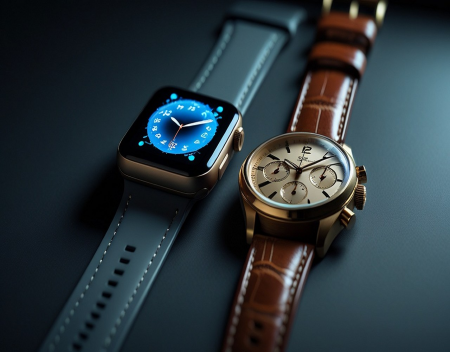
For hundreds of years, watches served one primary purpose: telling time. A mechanical or quartz watch could sit on your wrist and provide the current time whenever you needed it. Today, however, watches can do much more than tell time.
Smartwatches have transformed the traditional concept of a wristwatch. They can display messages, track exercise, monitor activity, provide directions, control music, make payments, and connect directly to smartphones and cellular networks.
With all of these capabilities, an obvious question has emerged: Are smartwatches replacing traditional watches?
The answer depends largely on what people want from a watch.
The Rise of the SmartwatchThe modern smartwatch has evolved into a small wearable computer.
Early smartwatches were relatively limited and often depended heavily on a connected smartphone. Today's models are considerably more sophisticated.
A smartwatch can function as a fitness tracker, notification center, communication device, alarm clock, stopwatch, GPS navigation system, and sometimes even a standalone phone.
For people who want technology available at a glance, this is extremely convenient.
Instead of pulling a phone out of your pocket every time a notification arrives, you can simply look at your wrist.
More Than Telling TimeThe biggest difference between a smartwatch and a traditional watch is functionality.
A traditional watch tells you the time. A smartwatch can tell you the time and provide dozens of other services.
You can check the weather, read messages, control music, set reminders, track workouts, monitor activity, and receive navigation instructions.
Some models can also make and receive calls without being connected to a smartphone.
For technology enthusiasts, that functionality makes a smartwatch far more useful than a traditional watch.
Fitness TrackingFitness tracking has become one of the biggest reasons people purchase smartwatches.
Traditional watches don't typically know how many steps you have taken or how long you've been exercising.
Smartwatches can use sensors to monitor movement and activity throughout the day.
Depending on the model, they can track workouts, heart rate, distance, calories, sleep, and other measurements.
This has made smartwatches particularly attractive to people who want technology that encourages them to stay active.
Notifications at a GlanceAnother major advantage is notifications.
Smartwatches can alert users when they receive phone calls, text messages, emails, or other notifications.
This can be surprisingly useful.
If you're in a meeting, driving, exercising, or simply don't want to constantly check your phone, you can glance at your wrist to determine whether a notification actually requires your attention.
This also creates an interesting change in how people interact with their smartphones.
Instead of constantly reaching for the phone, users can sometimes handle simple tasks directly from the watch.
Traditional Watches Still Have AdvantagesDespite the popularity of smartwatches, traditional watches are far from obsolete.
One of their biggest advantages is simplicity.
A traditional watch doesn't require software updates, Bluetooth connections, applications, or charging.
You put it on your wrist and it works.
A quality mechanical watch can run for decades with proper maintenance, while a smartwatch may become outdated when its software or battery technology becomes obsolete.
That difference is important to people who value longevity.
Battery LifeBattery life remains one of the biggest disadvantages of smartwatches.
Most smartwatches need to be recharged regularly.
Depending on the model and how it is used, this could mean charging every day or every few days.
A traditional quartz watch can operate for years on a single battery.
Mechanical watches don't require batteries at all.
For someone who simply wants to know the time, regularly charging a watch may seem unnecessary.
Style and FashionTraditional watches also remain important as fashion accessories.
Luxury watches are often purchased for their design, craftsmanship, materials, history, and brand reputation.
A mechanical watch can represent craftsmanship and engineering in a way that a digital device doesn't necessarily replicate.
For some people, wearing a particular watch is part of their personal style.
Smartwatches can certainly be fashionable, but their designs are generally influenced by technology and screen requirements.
The Luxury Watch MarketThe continued popularity of expensive mechanical watches demonstrates that smartwatches haven't eliminated demand for traditional timepieces.
Luxury watches can cost thousands or even tens of thousands of dollars.
People aren't paying that kind of money simply to find out what time it is.
They are purchasing craftsmanship, design, heritage, exclusivity, and collectability.
A mechanical watch can also have sentimental value and be passed down through generations.
That is difficult for an electronic device designed around a relatively short technology cycle to replicate.
Smartwatches Become OutdatedTechnology changes quickly.
A smartwatch purchased today may receive software updates for several years, but eventually its hardware may no longer support the latest features.
Batteries also degrade over time.
A traditional mechanical watch doesn't face the same type of technological obsolescence.
A well-maintained mechanical watch can potentially continue working for generations.
This gives traditional watches a significant advantage for people who value permanence.
Smartwatches and Younger ConsumersYounger consumers have generally grown up surrounded by smartphones and digital technology.
For many of them, a smartwatch feels completely natural.
It isn't simply a watch; it's another connected device.
Younger users may be more interested in fitness tracking, notifications, mobile payments, and other digital features than mechanical movements or traditional watchmaking.
This could influence the watch market over the long term.
However, traditional watches can also experience a revival as fashion items, particularly among people looking for something different from the technology everyone else is wearing.
The Best of Both WorldsThere is also a middle ground.
Some watches combine traditional watch styling with smart features.
Hybrid watches can look like conventional analog watches while incorporating activity tracking, notifications, and other connected capabilities.
These products appeal to people who want some of the advantages of wearable technology without wearing a full digital smartwatch.
They demonstrate that the future doesn't necessarily have to be entirely digital.
Will Smartwatches Eventually Win?Smartwatches will probably continue gaining market share for everyday use, particularly among consumers who value health tracking, notifications, communication, and integration with their smartphones.
However, replacing traditional watches completely is unlikely.
The two products serve somewhat different purposes.
A smartwatch is primarily a technology device that happens to tell time.
A traditional watch is primarily a timepiece that can also be a piece of jewelry, fashion, craftsmanship, or personal history.
That distinction is important.
A Changing Definition of the WatchPerhaps the real change is not that smartwatches are replacing traditional watches, but that the definition of a watch is expanding.
For some people, a watch is now a miniature computer attached to their wrist.
For others, it's a carefully crafted mechanical instrument.
Both can coexist.
Just as digital cameras didn't completely eliminate photography with traditional cameras, smartwatches don't necessarily have to eliminate traditional watches.
Different people will choose different tools based on what they value.
Final ThoughtsSmartwatches have changed what people expect from something worn on the wrist.
They provide communication, fitness tracking, navigation, notifications, payments, and numerous other features that traditional watches cannot match.
But traditional watches offer advantages that technology has difficulty reproducing: simplicity, longevity, craftsmanship, style, and emotional value.
For someone who wants a wrist-mounted personal assistant, a smartwatch is an obvious choice.
For someone who appreciates mechanical engineering, luxury design, or simply doesn't want another device to charge every night, a traditional watch may be the better option.
The future probably won't belong entirely to one or the other.
Smartwatches may become the everyday choice for technology and convenience, while traditional watches remain the choice for craftsmanship, fashion, and timeless appeal.
In other words, the traditional watch may be changing—but it certainly isn't dead.
Great experience with Computer Geek. They helped with my website needs and were professional, respon . . . [MORE].

Great, quick service when my laptop went into meltdown and also needed Windows 11 installed. Also ca . . . [MORE].
It was a great experience to working with you. thank you so much. . . . [MORE].
Thank you so much for great service and over all experience is good . highly recommended for all peo . . . [MORE].
We engaged The Computer Geeks in mid-2023 as they have a reputation for API integration within the T . . . [MORE].

The Rise of Automation in

Why Every Business Needs

ERP Systems for Small Bus