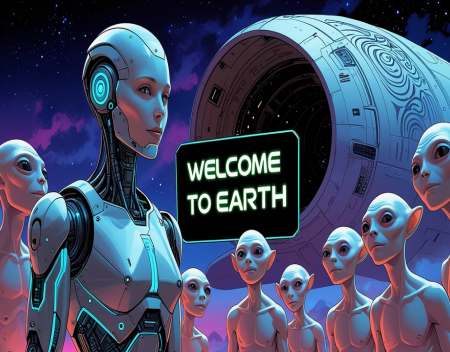
The idea of humanity’s first contact with extraterrestrial intelligence has fascinated people for generations, but the rise of artificial intelligence introduces a completely new dimension to how such an encounter might unfold. Instead of humans being the first to communicate with an alien civilization, advanced AI systems could become the initial translators, interpreters, or even ambassadors. This possibility raises profound questions about communication, trust, cultural understanding, and the role technology might play in shaping one of the most significant moments in human history.
One of the biggest challenges in any first contact scenario is communication. Humans rely on language structures, cultural context, and shared experiences to understand one another. With extraterrestrial intelligence, those common reference points may not exist at all. AI systems trained on massive datasets and capable of pattern recognition could analyze unknown signals far faster than human researchers. They might identify mathematical patterns, visual structures, or symbolic systems embedded in alien transmissions, helping bridge the communication gap. Instead of relying solely on linguists and scientists working slowly over years or decades, AI could accelerate interpretation dramatically, potentially turning an incomprehensible signal into a meaningful exchange within months or even weeks.
AI could also help humanity prepare for first contact before it even happens. By simulating thousands or millions of potential alien communication methods and behavioral patterns, researchers could test responses and predict possible outcomes. These simulations might help governments and international organizations craft diplomatic strategies or safety protocols. For example, AI could model scenarios where extraterrestrial intelligence is curious, indifferent, cooperative, or even potentially hostile. While no simulation could perfectly predict reality, such preparation might reduce panic and confusion if contact were ever confirmed.
Another important aspect of AI in first contact scenarios is emotional and psychological filtering. Human reactions to extraterrestrial contact could range from excitement and wonder to fear and social instability. AI systems could act as buffers, helping process raw data before it reaches the public. They might filter out misleading patterns or false alarms, ensuring that only credible findings are shared. However, this introduces ethical questions. Who controls the AI? Who decides what information is revealed and when? If AI becomes the primary interpreter of alien communication, humanity may rely heavily on algorithms to shape our understanding of another intelligent species.
There is also the possibility that extraterrestrial intelligence itself could be artificial rather than biological. If an advanced civilization has developed its own AI, first contact might actually occur between machines before humans are directly involved. Machine to machine communication could happen at speeds and levels of complexity that humans struggle to comprehend. AI systems might exchange vast amounts of information rapidly, potentially learning from one another and creating new technological insights. While this could lead to rapid advancements for humanity, it could also leave humans feeling disconnected from the process, unsure whether they truly understand the relationship being formed.
Trust becomes a major concern in AI mediated first contact. Humans would need to verify that AI interpretations of alien messages are accurate and unbiased. Even small errors in translation could create misunderstandings with enormous consequences. Building transparent AI systems with clear oversight mechanisms would be essential. International cooperation would likely be necessary to ensure that no single nation or corporation monopolizes access to alien communication channels. Shared governance structures could help maintain accountability and encourage collective decision making during such a critical moment.
AI could also help manage the logistical challenges of contact. If extraterrestrial technology or physical artifacts were discovered, AI powered robotics might be used to examine them safely. Autonomous systems could conduct experiments, monitor environmental risks, and analyze unfamiliar materials without exposing humans to potential biological or chemical hazards. In this way, AI would function as a protective layer, allowing humanity to explore the unknown more cautiously and responsibly.
Beyond practical considerations, the philosophical implications of AI in first contact are enormous. If machines become humanity’s primary interface with extraterrestrial intelligence, it could reshape how people think about consciousness, identity, and intelligence itself. Humans might need to confront the possibility that AI is better suited than biological beings to communicate across vast differences in biology or cognition. This realization could challenge long held assumptions about what it means to be human and how humanity fits into a larger cosmic community.
In the end, AI has the potential to transform first contact from an overwhelming unknown into a more structured and manageable process. By acting as translators, analysts, diplomats, and safeguards, AI systems could help humanity navigate the uncertainties of meeting another intelligent civilization. However, relying on artificial intelligence also introduces risks related to control, transparency, and interpretation. The future of first contact may depend not only on who or what we encounter beyond Earth, but also on how wisely we develop and manage the intelligent tools that stand between us and the stars.
Great experience with Computer Geek. They helped with my website needs and were professional, respon . . . [MORE].

Great, quick service when my laptop went into meltdown and also needed Windows 11 installed. Also ca . . . [MORE].
It was a great experience to working with you. thank you so much. . . . [MORE].
Thank you so much for great service and over all experience is good . highly recommended for all peo . . . [MORE].
We engaged The Computer Geeks in mid-2023 as they have a reputation for API integration within the T . . . [MORE].

Why Every Business Needs

ERP Systems for Small Bus

CRM Software Explained